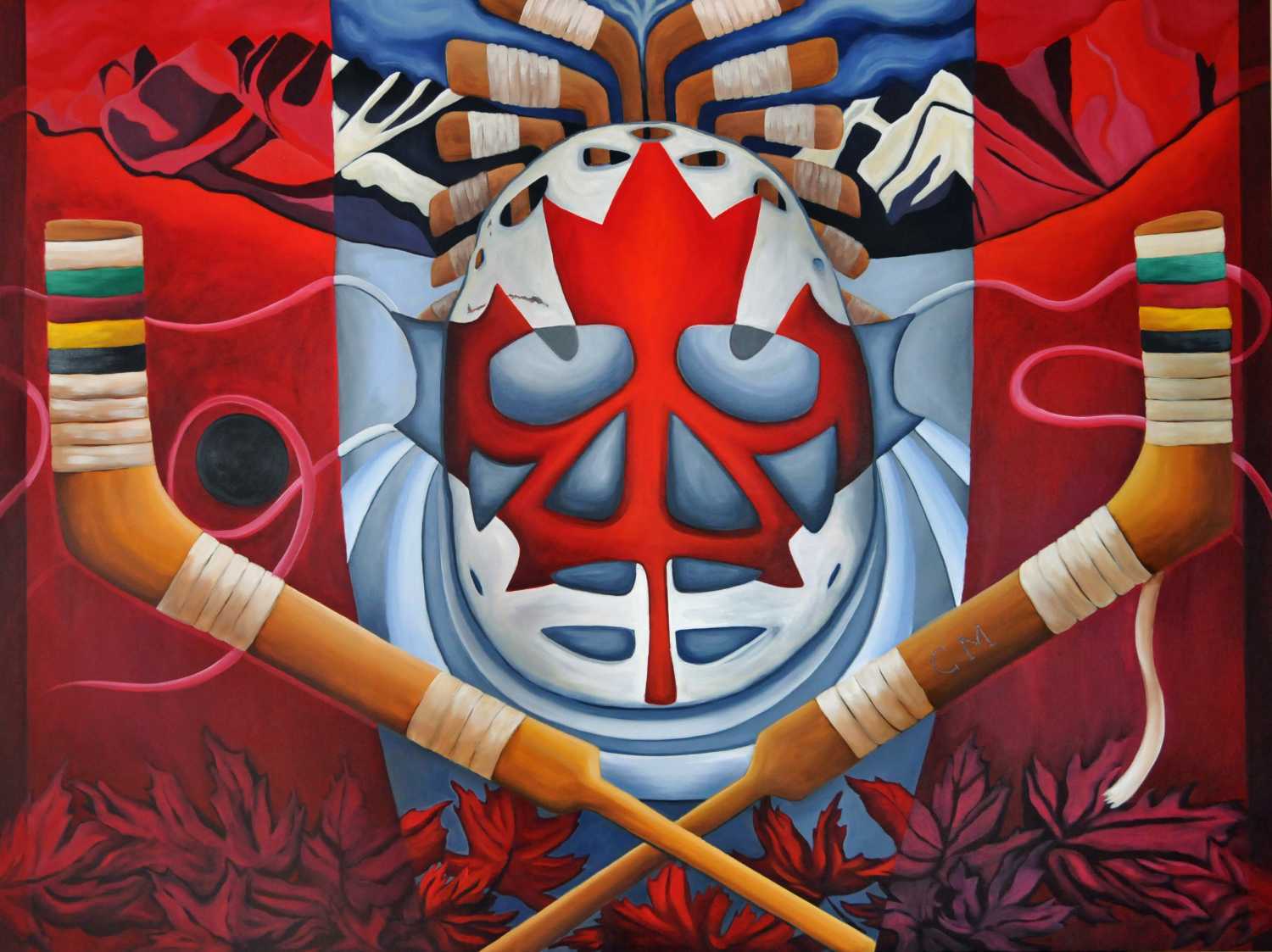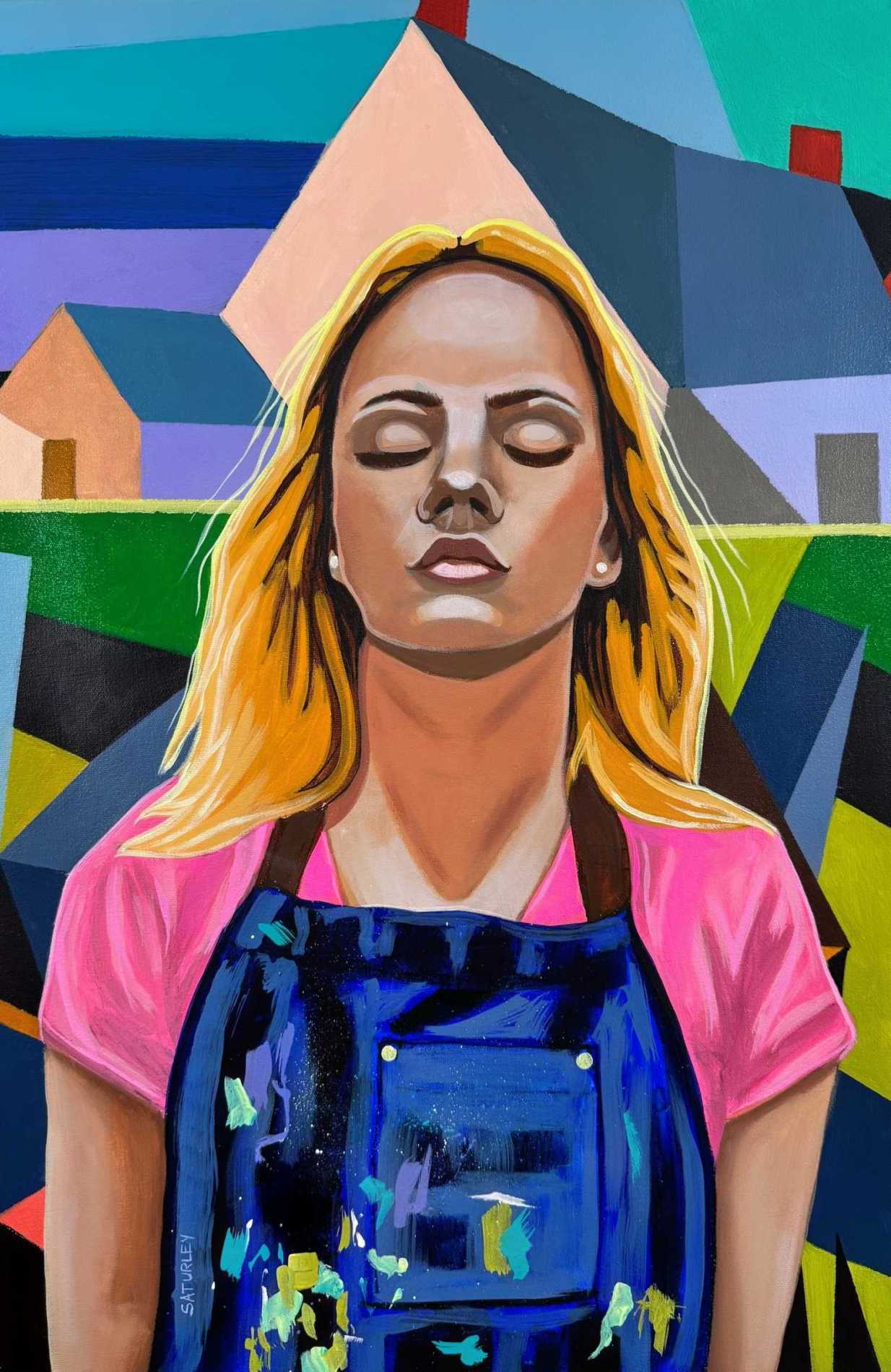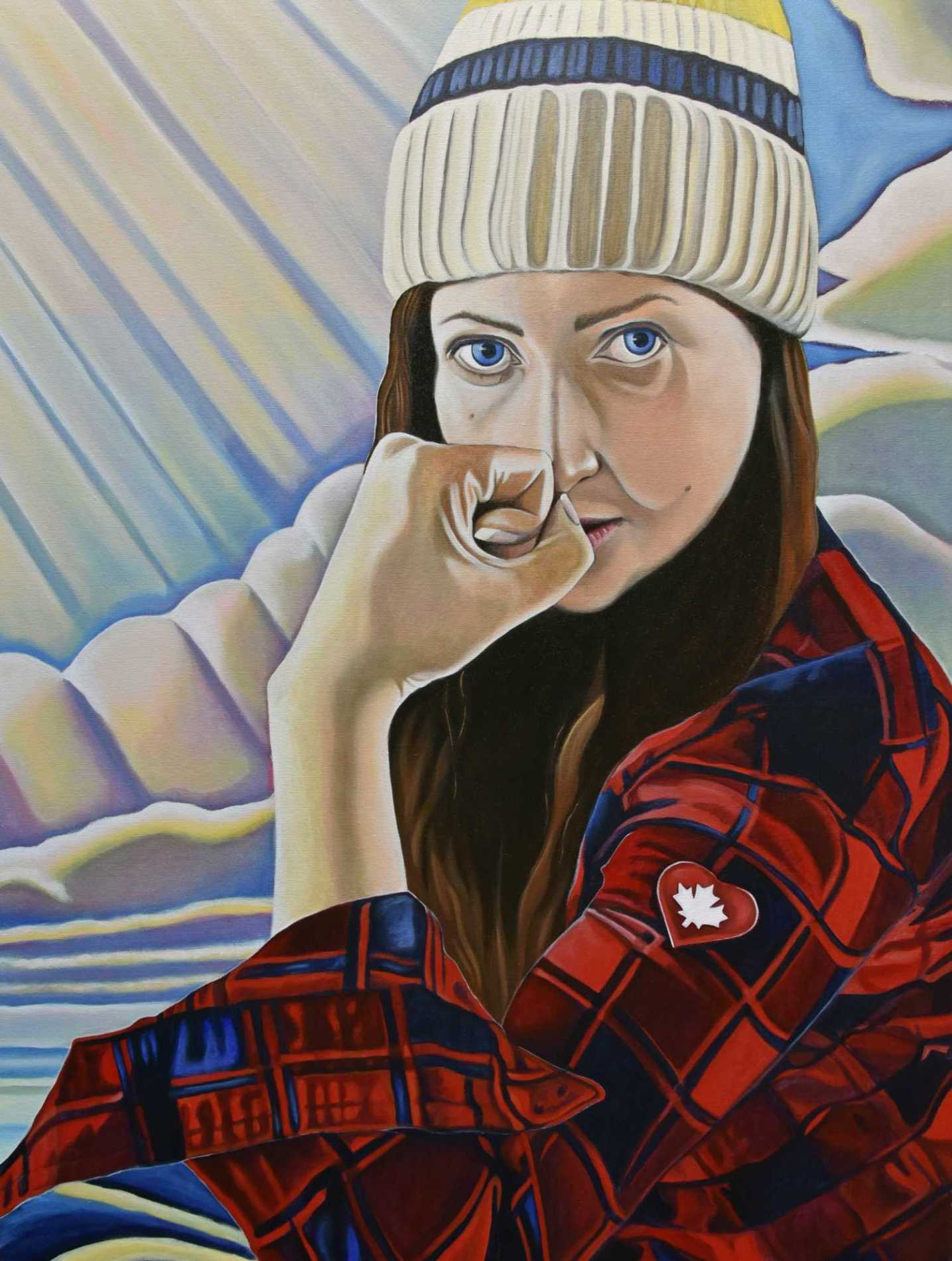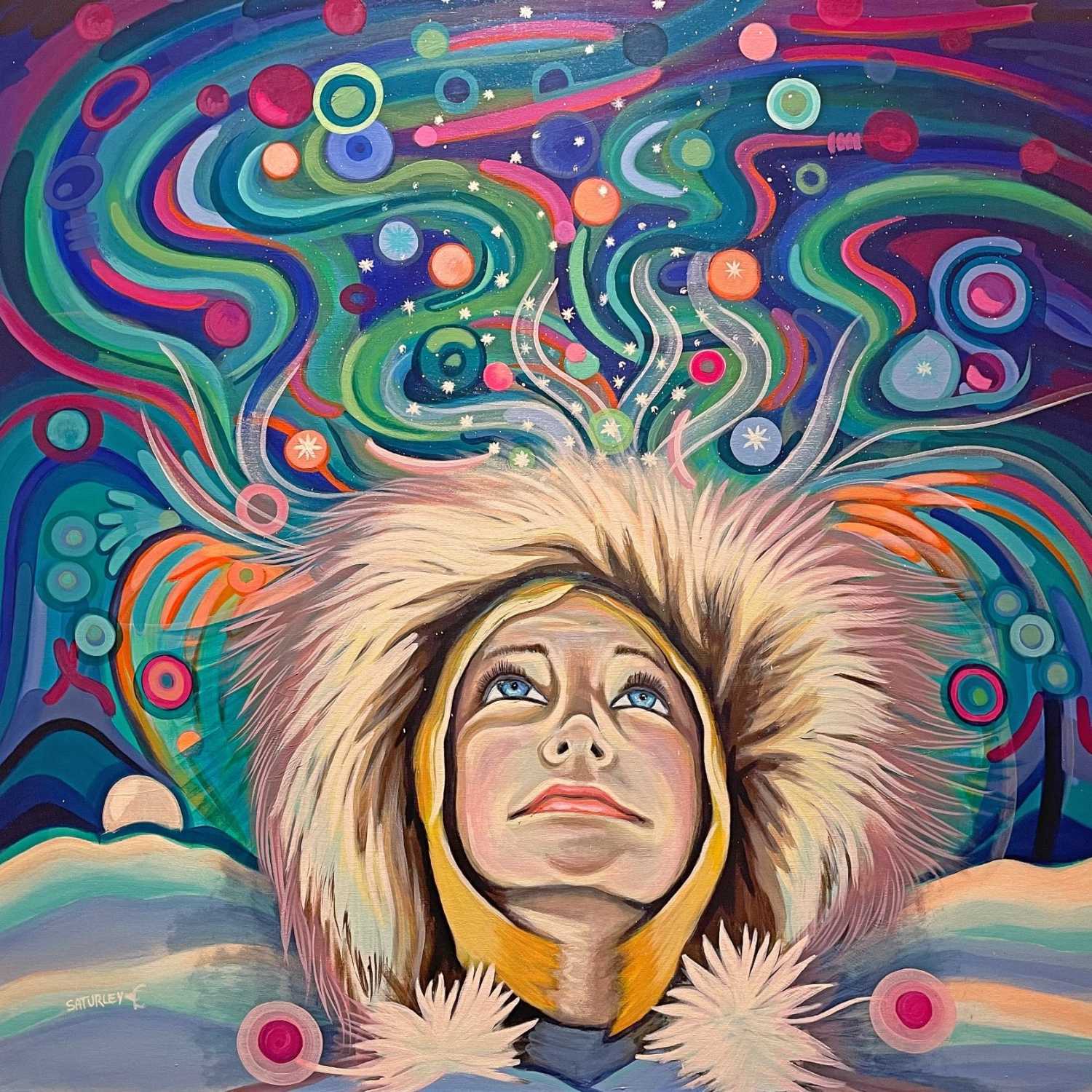
The Art of Brandy SaturleyIconic Canadian Pop Art to Collect #iconiccanuck
  • Home
  • Paintings by Series
  • Paintings
  • About
  • Testimonials
  • Buying Art
  • Contact
  • News
  • Menu Menu

Tag Archive for: Canadian Art

Posts

Painting Canada’s West Coast

Art History

Painting the Edge of the Continent: The Artists Who Defined Canada’s West Coast

The west coast of Canada has long inspired artists with its dramatic landscapes, ancient forests, rugged shorelines, and ever-changing skies. Stretching from Vancouver Island to Haida Gwaii and north along British Columbia’s coastal wilderness, the region offers a visual language unlike anywhere else in Canada. Painting Canada’s West Coast.

For more than a century, painters have attempted to capture the spirit of this landscape. Some approached it through realism, others through modernism, abstraction, or Indigenous traditions. Together, they created a visual record of the Pacific coast and helped shape Canada’s artistic identity.

Here are some of the most influential painters associated with Canada’s West Coast.

Painting Canada's West Coast

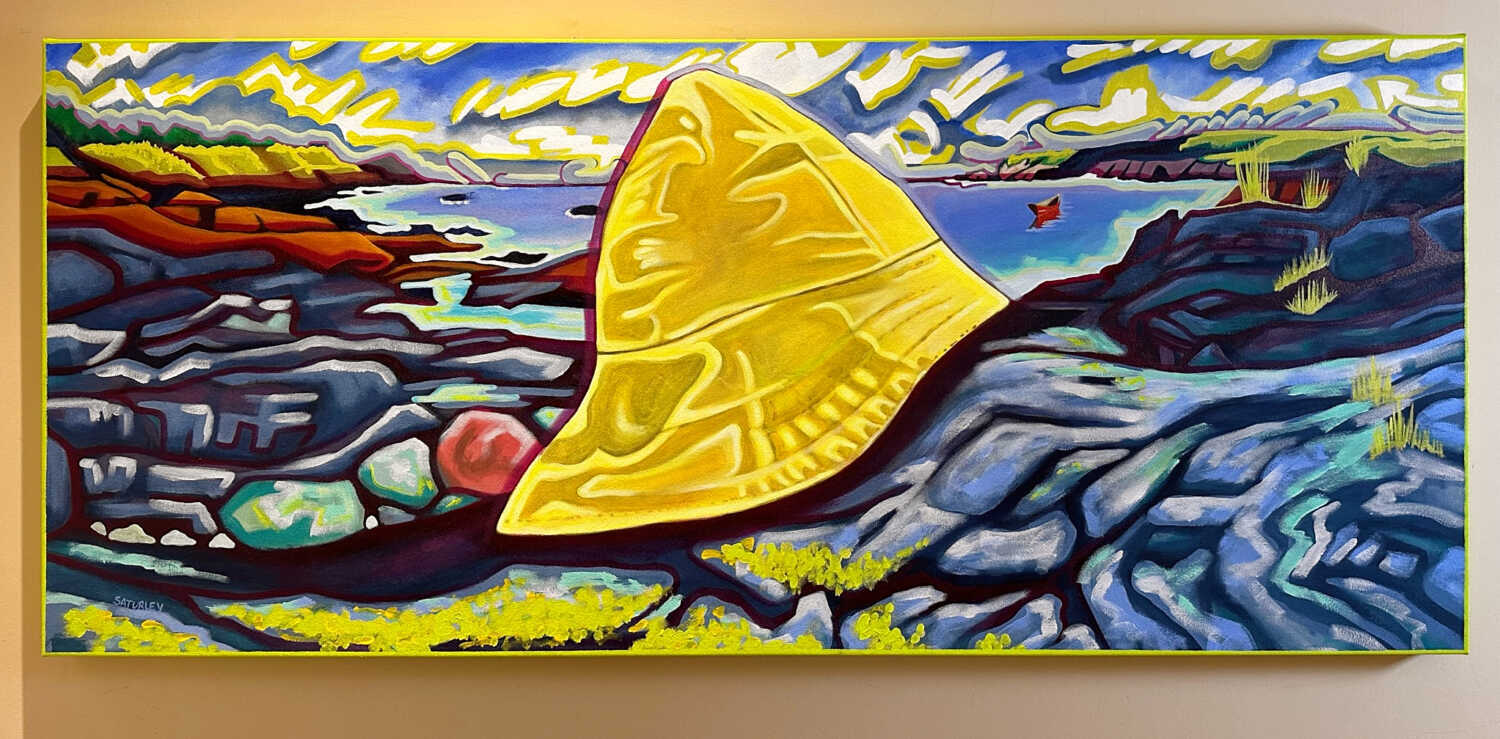
Sealions Song, c. 2026 Acrylic On Canvas 30 x 60 x 1.5 in – Brandy Saturley

Emily Carr (1871-1945)

No discussion of West Coast art can begin anywhere other than with Emily Carr.

Born in Victoria, British Columbia, Carr devoted much of her career to painting the forests, coastal villages, and Indigenous cultures of the Pacific Northwest. Her expressive paintings of towering cedars, windswept skies, and totem poles remain among the most iconic images in Canadian art.

Carr’s work moved beyond simple documentation. She sought to capture the spiritual energy of the landscape itself. Her paintings transformed the forests of British Columbia into living, breathing presences and helped establish the West Coast as a distinct artistic subject.

E.J. Hughes (1913-2007)

If Emily Carr painted the soul of the forest, then E. J. Hughes painted the character of coastal communities.

Living for many years on Vancouver Island, Hughes became known for his vibrant depictions of fishing villages, harbours, roads, forests, and small-town life. His paintings distilled the landscape into simplified forms and brilliant colours while retaining a deep sense of place.

Today, Hughes is considered one of Canada’s most beloved painters and one of the most important visual interpreters of coastal British Columbia.

Jack Shadbolt (1909-1998)

Born in England but deeply connected to British Columbia, Jack Shadbolt became one of Canada’s most important modernist painters.

Shadbolt drew inspiration from Indigenous art, coastal mythology, and the rhythms of the Pacific landscape. His paintings often blend abstraction with references to nature, creating works that feel both ancient and contemporary.

He helped expand the conversation about what West Coast art could be beyond traditional landscape painting.

Gordon Smith (1919-2020)

For more than seven decades, Gordon Smith explored the forests and landscapes of British Columbia.

His work evolved from representational painting into increasingly abstract interpretations of nature. Trees, rivers, and mountains became recurring motifs that reflected the changing relationship between artist and environment.

Smith’s influence as both artist and educator helped shape generations of West Coast painters.

Takao Tanabe (1926-2024)

Born in Prince Rupert, British Columbia, Takao Tanabe became known for his serene and contemplative landscapes.

His paintings often reduce the landscape to subtle bands of colour, atmosphere, and horizon. While minimalist in appearance, they are deeply rooted in the geography and mood of Canada’s western regions.

Tanabe’s work demonstrates how the West Coast landscape can be interpreted through restraint rather than detail.

Painting Canada's West Coast

Gateway to The World, c. 2026 Acrylic On Canvas 18 x 48 x 1.5 in – Brandy Saturley

Contemporary Voices : Painting Canada’s West Coast

Today’s West Coast art scene remains vibrant and diverse. Artists continue to explore themes of environment, identity, climate, culture, and place through painting.

From Indigenous artists reclaiming traditional narratives to contemporary painters examining urban and rural life, the Pacific coast continues to inspire new generations of creators.

The West Coast remains more than a geographic location. It is a source of stories, symbols, and visual inspiration that continues to shape Canadian art.

Why the West Coast Matters

What makes the West Coast unique is not simply its scenery. It is the intersection of ocean, forest, mountains, weather, and culture. The region contains some of the oldest living ecosystems on Earth and some of the richest Indigenous artistic traditions in North America.

Artists who paint this coast are often responding to something larger than landscape. They are responding to a sense of place, history, and connection.

From Emily Carr’s forests to E.J. Hughes’ villages, from Robert Davidson’s Haida imagery to contemporary interpretations of the Salish Sea, the West Coast continues to offer artists an endless source of inspiration. It remains one of Canada’s most powerful creative frontiers.

west coast paintings

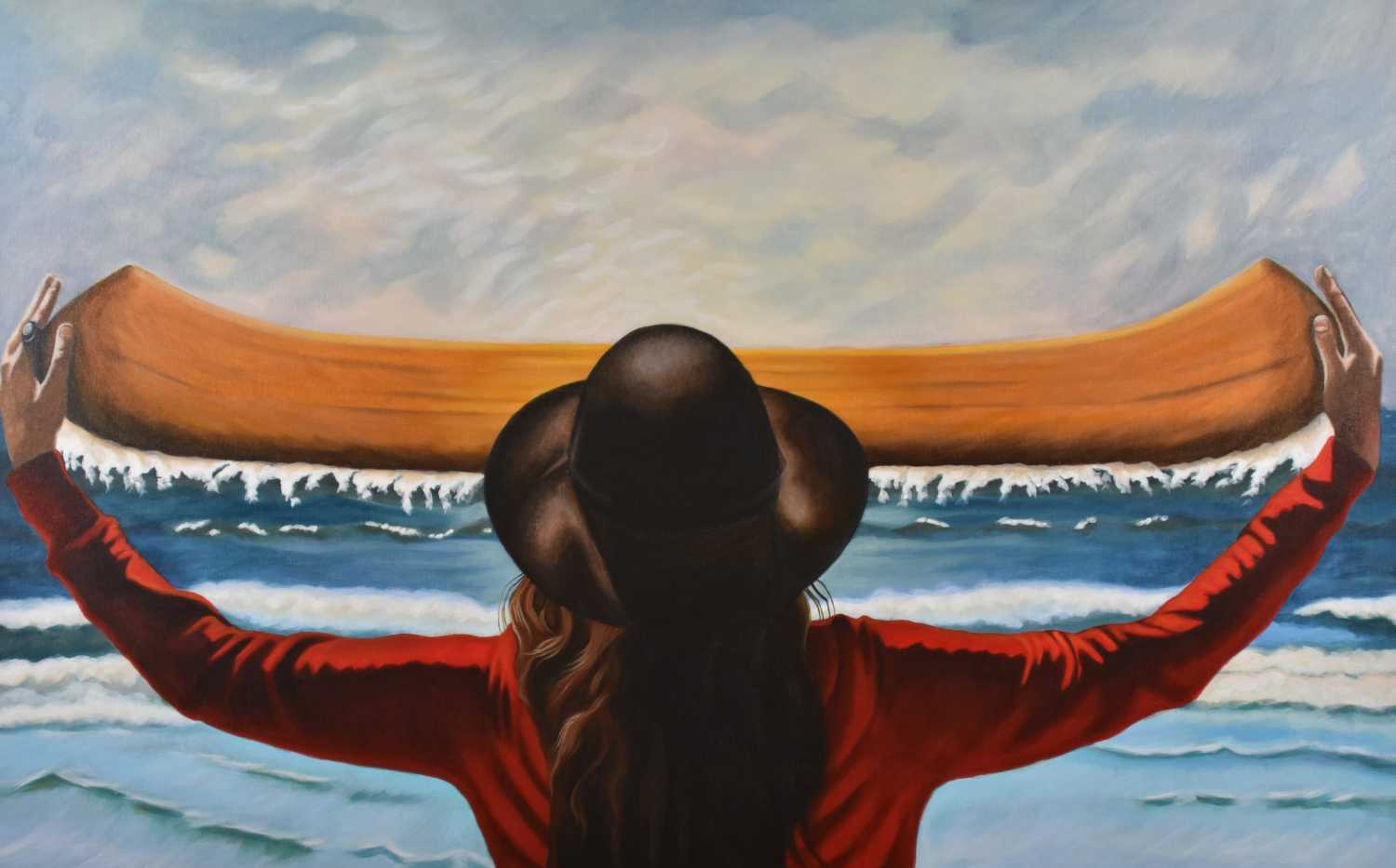
When I Go to SEE, c. 2025 Acrylic On Canvas 30 x 60 x 1.5 in – Brandy Saturley

Five Living West Coast Painters to Watch : Painting Canada’s West Coast

While the legacy of Emily Carr, E.J. Hughes, and Jack Shadbolt continues to influence Canadian art, a new generation of artists is carrying the conversation forward. These painters and visual artists are expanding what West Coast art can be while remaining connected to the landscapes, cultures, and stories of the Pacific coast.

Robert Davidson

Among the most influential Indigenous artists in Canada, Robert Davidson has spent decades revitalizing and evolving Haida visual traditions. His paintings, prints, and installations blend ancestral knowledge with contemporary expression. Davidson’s work has had a profound impact on Canadian art and continues to inspire artists across generations.

Rande Cook

A Kwakwaka’wakw artist from Vancouver Island, Rande Cook is internationally recognized for his paintings, carvings, and installations. His work draws upon traditional Northwest Coast design while addressing contemporary themes of identity, culture, and resilience. Cook represents the powerful continuity of Indigenous artistic practice on the West Coast.

Luke Ramsey

Based in British Columbia, Luke Ramsey has developed a distinctive visual language that combines drawing, painting, storytelling, and imagination. His work often blurs the boundaries between observation and dream, creating richly detailed worlds populated by curious characters and unexpected narratives. Ramsey’s work reflects the creative spirit and independent nature of contemporary West Coast culture.

Victoria Klassen

Based in Vancouver BC, working primarily with acrylic and mixed media on canvas or wood panel, she is best known for her expressive brushwork and graphite mark-making, utilizing both a vibrant yet subdued colour palette or a neutral limited palette. Her work explores themes of solitude and vulnerability through organic shapes found in nature. Characterized by the use of visible brushwork and line, her paintings evoke a sense of freedom, energy and wildness.

Brandy Saturley

Over the past two decades, Brandy Saturley has built a body of work that explores Canadian identity through painting. While her work spans the entire country, Vancouver Island and the West Coast continue to play an important role in her visual vocabulary. Drawing upon Canadian symbolism, popular culture, landscape, and storytelling, Saturley creates paintings that examine what it means to be Canadian in the twenty-first century. Her ongoing explorations of the Salish Sea, coastal communities, and the evolving iconography of Canada place her within the continuing tradition of artists inspired by the West Coast.

Painting Canada's West Coast

Beach House, c. 2025 Acrylic On Canvas 36 x 48 x 1.5 in – Brandy Saturley

The Next Chapter of West Coast Art

What connects these contemporary artists is not a shared style, but a shared relationship to place. The West Coast continues to provide artists with endless material: ancient forests, shifting shorelines, Indigenous histories, working waterfronts, island communities, and the constant presence of the Pacific Ocean.

Just as Emily Carr and E.J. Hughes interpreted the coast through the lens of their own time, today’s artists are documenting and reimagining the region for a new generation. Their work ensures that the story of West Coast art remains a living, evolving conversation.

Canadian Art Licensing Opportunity

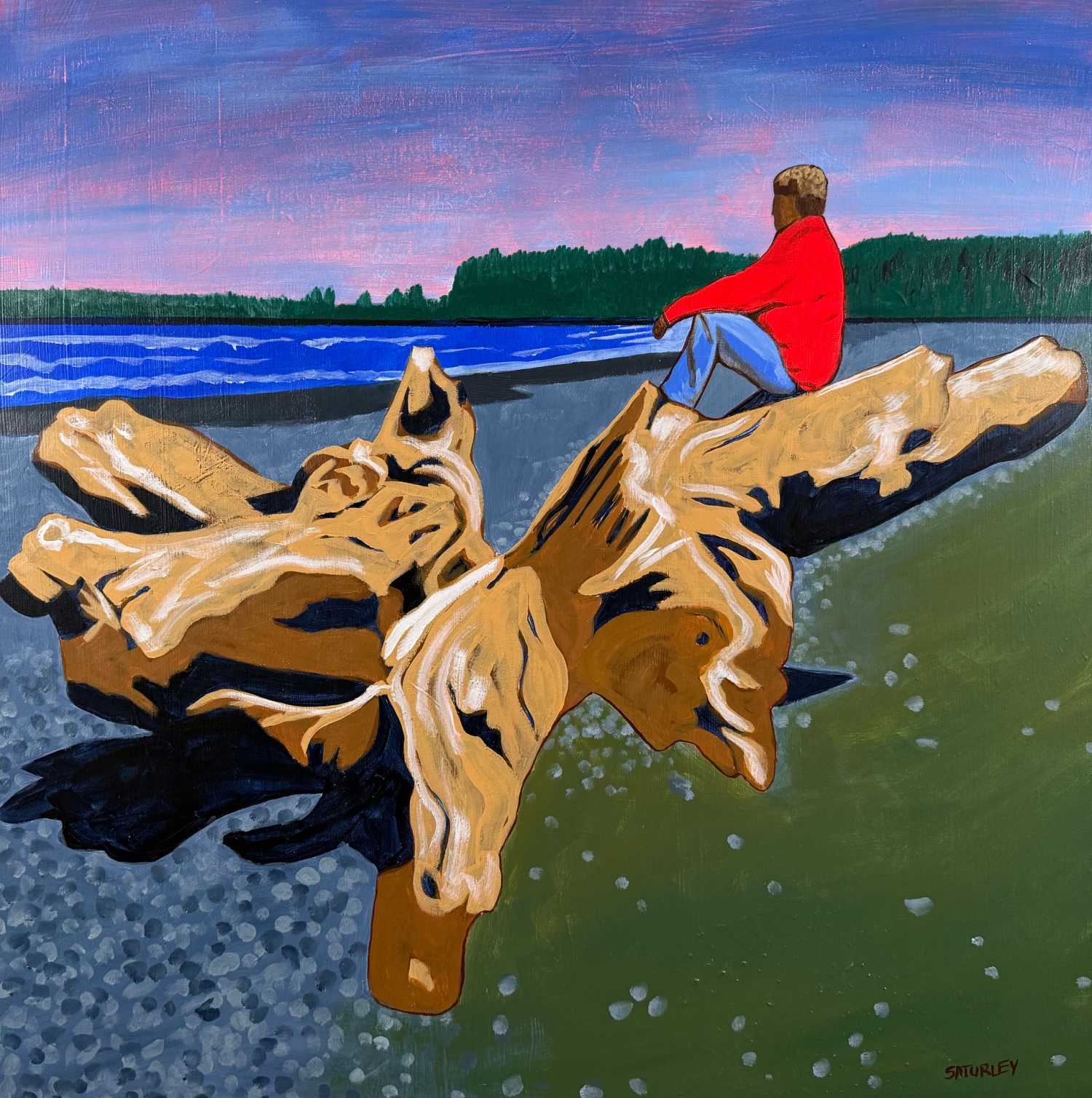
West Coast Solitudes, 2022 Acrylic on Canvas 48 x 36 x 1.5 in – Brandy Saturley

June 22, 2026
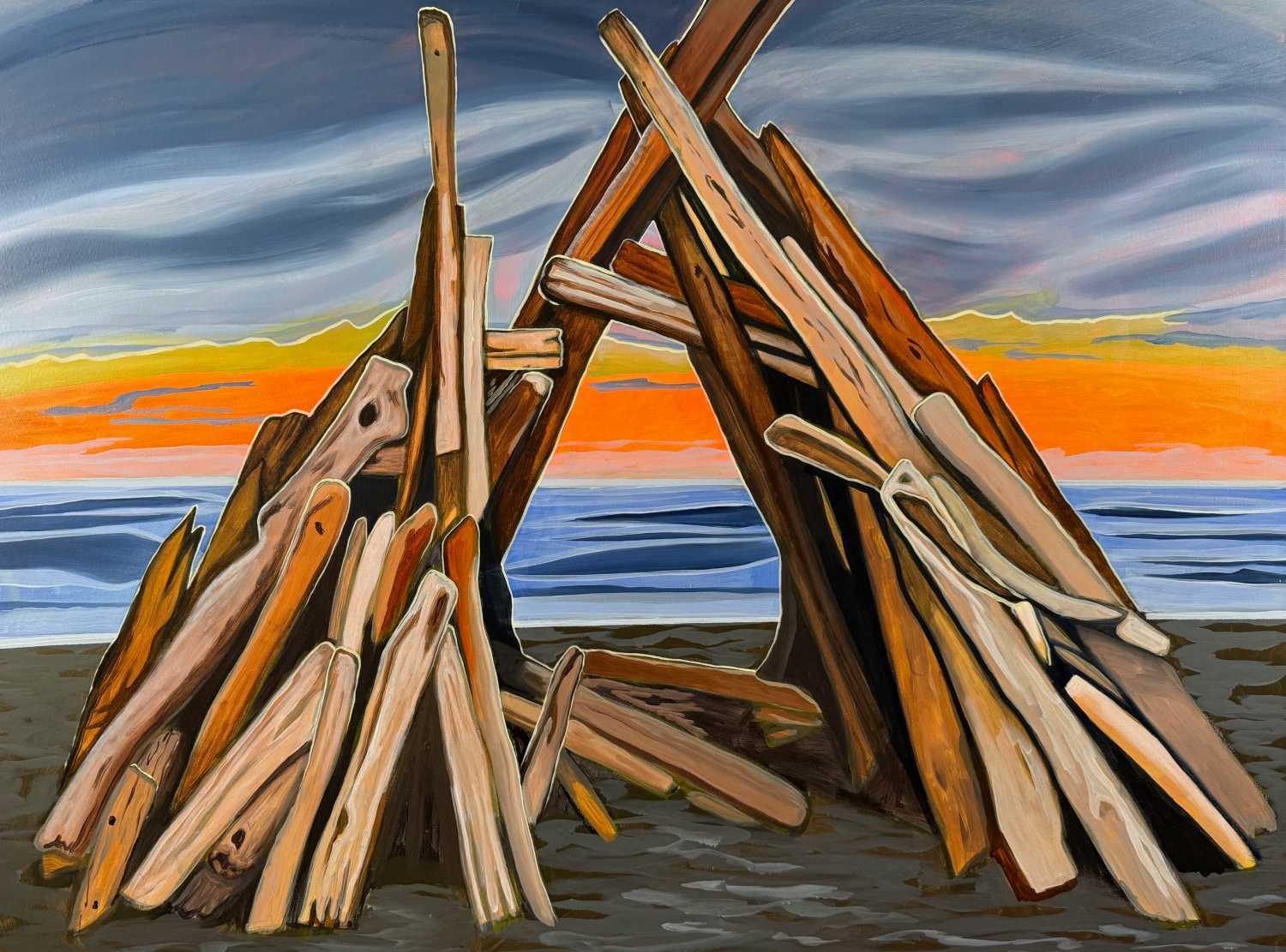
https://www.brandysaturley.com/wp-content/uploads/2025/11/beachhut1.jpg 1111 1500 Brandy Saturley https://www.brandysaturley.com/wp-content/uploads/2020/10/brandysaturley_logo.png Brandy Saturley2026-06-22 11:19:412026-06-22 11:19:41Painting Canada’s West Coast

Painting The Salish Sea

New Paintings

A New Series Evolves – Painting The Salish Sea

If there is one constant in my work, it is this: every fourth or fifth painting seems to open a door. One image leads to another and suddenly a series is born, fuelled by fascination, repetition, and the need to stay with a subject long enough to really understand it. Painting The Salish Sea.

A new series is now unfolding in my studio. Its point of origin was a commission, a painting about sea lions on the Salish Sea. I live on the west coast, on Vancouver Island, yet I had not fully immersed my painting practice in this coastline until recently. A move from Victoria to Parksville, mid-island on the eastern shore, shifted my daily rhythm toward the tide line. Now my days are shaped by beach walks, shifting light, and close encounters with marine life.

Painting The Salish Sea

Sealions Song Sealions Song, c. 2026 Acrylic On Canvas 30 x 60 x 1.5 in – Brandy Saturley

Not long ago, we watched a school of dolphins moving through shallow water near Qualicum Beach, briefly caught in the choreography of a low tide. Moments like this stay with me. They accumulate.

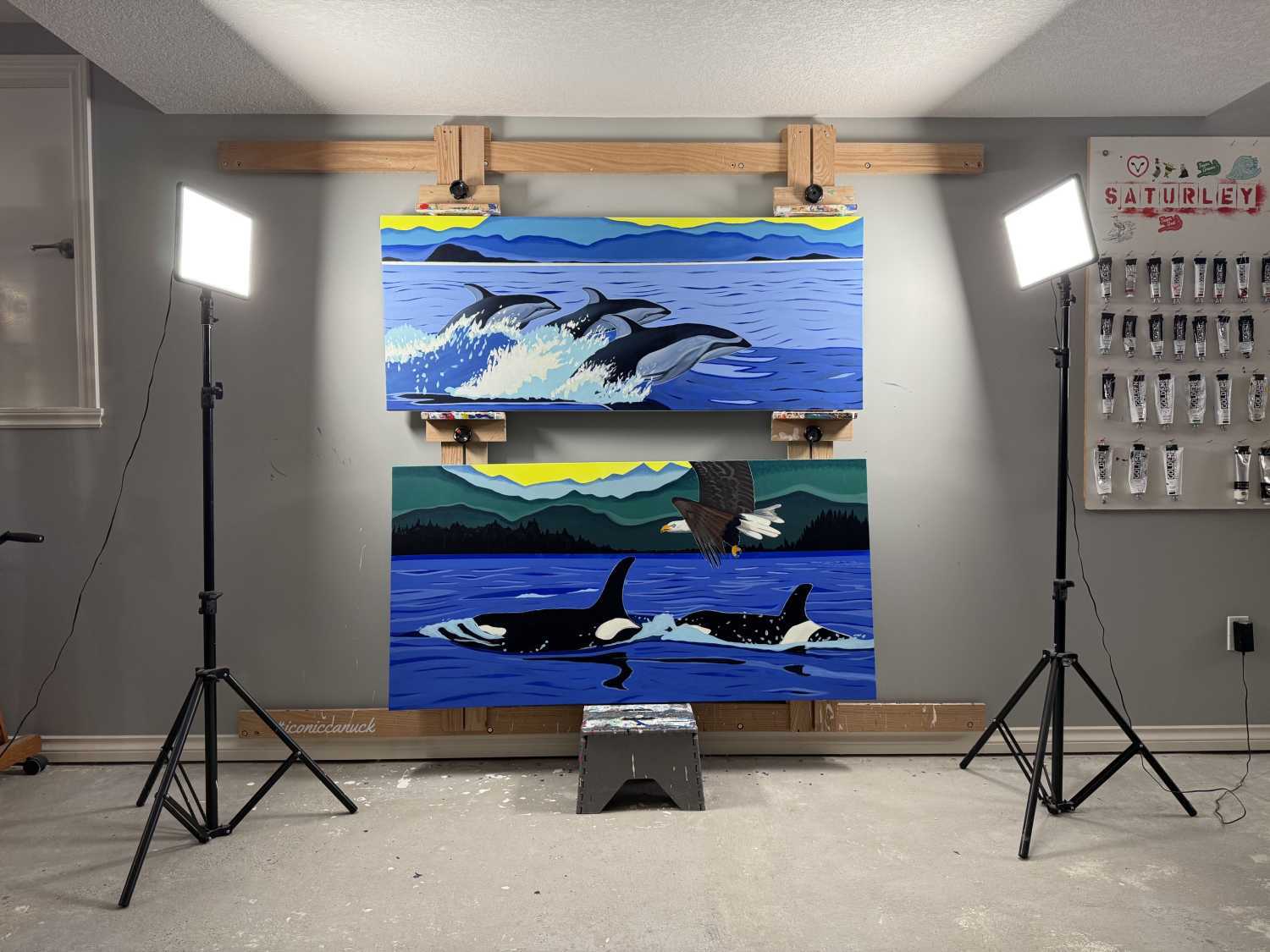
What began with sea lions and a raven has now expanded into a growing cast of coastal presences: orcas moving through deep channels, bald eagles tracking the shoreline, and dolphins racing the tide’s edge with effortless play.

Eagle and Orcas Painting

Guardians of The Salish Sea, c. 2026 Acrylic On Canvas 30 x 60 x 1.5 in – Brandy Saturley

Each painting in this series carries a palette drawn from the West Coast itself, deep blues, softened greys, and sudden bursts of neon yellow sky. The compositions are held from a low vantage point, where coastal mountains and dense forest hover in the distance like quiet witnesses.

In this most recent work, Ultramarine Jazz, I have simplified and distilled form even further. Shapes become almost symbolic, pared back to their essential energy. There is a sense of flow and rhythm here, echoing the pulse of the ocean itself, unpredictable, musical, alive.

Painting The Salish Sea

Ultramarine Jazz, c. 2026 Acrylic On Canvas 24 x 60 x 1.5 in – Brandy Saturley

The Salish Sea, Place and Myth

The Salish Sea is the inland network of coastal waters that stretches between Vancouver Island, the mainland of British Columbia, and the state of Washington. It is not a single oceanic expanse, but a living system of straits, inlets, and channels, including the Strait of Georgia, the Strait of Juan de Fuca, and Puget Sound. It is a place of constant movement where tides, wind, and freshwater rivers meet and reshape one another daily.

Long before it was named on contemporary maps, these waters were home to Indigenous nations whose relationships with the sea are foundational and ongoing. The name “Salish Sea” itself is a modern designation that honours the Coast Salish peoples whose cultures, languages, and lifeways are deeply tied to these waters.

Within these coastal traditions, the sea is not only geography but presence. It is understood as a sentient space where land, water, and spirit are interwoven. Stories of transformation, animal kinship, and ecological balance are carried through generations, often expressed through oral histories, carving, weaving, and song. Orcas, eagles, salmon, and dolphins are not simply wildlife, but beings with agency, memory, and meaning within the fabric of the world.

This layered mythology continues to echo through the region today. Even in contemporary life, there is a sense that the Salish Sea holds more than surface reality. It carries story as much as saltwater, a depth of narrative that is both ancient and immediate. For me, painting within this environment means engaging not only with its visible forms but with this deeper field of presence and meaning.

Painting in progress.

Working in Series, Painting The Salish Sea

Working in series allows the work to breathe and evolve rather than resolve too quickly. Each painting becomes a chapter rather than a conclusion, and each encounter on the shoreline offers another thread to follow. Over time, these threads weave together into something larger, a visual narrative shaped by place, memory, and repetition.

My practice has always been rooted in storytelling. I am not only painting animals, coastlines, or atmospheric moments, I am building a language of experience drawn from living within these environments. The Salish Sea becomes both subject and storyteller, holding movement, mood, and myth within its shifting surface.

In this way, each series functions like a journal of attention. It records what lingers, what returns, and what insists on being seen again. The story is never fixed. It moves like tidewater, carrying fragments of observation into new forms and new paintings.

Painting The Salish Sea

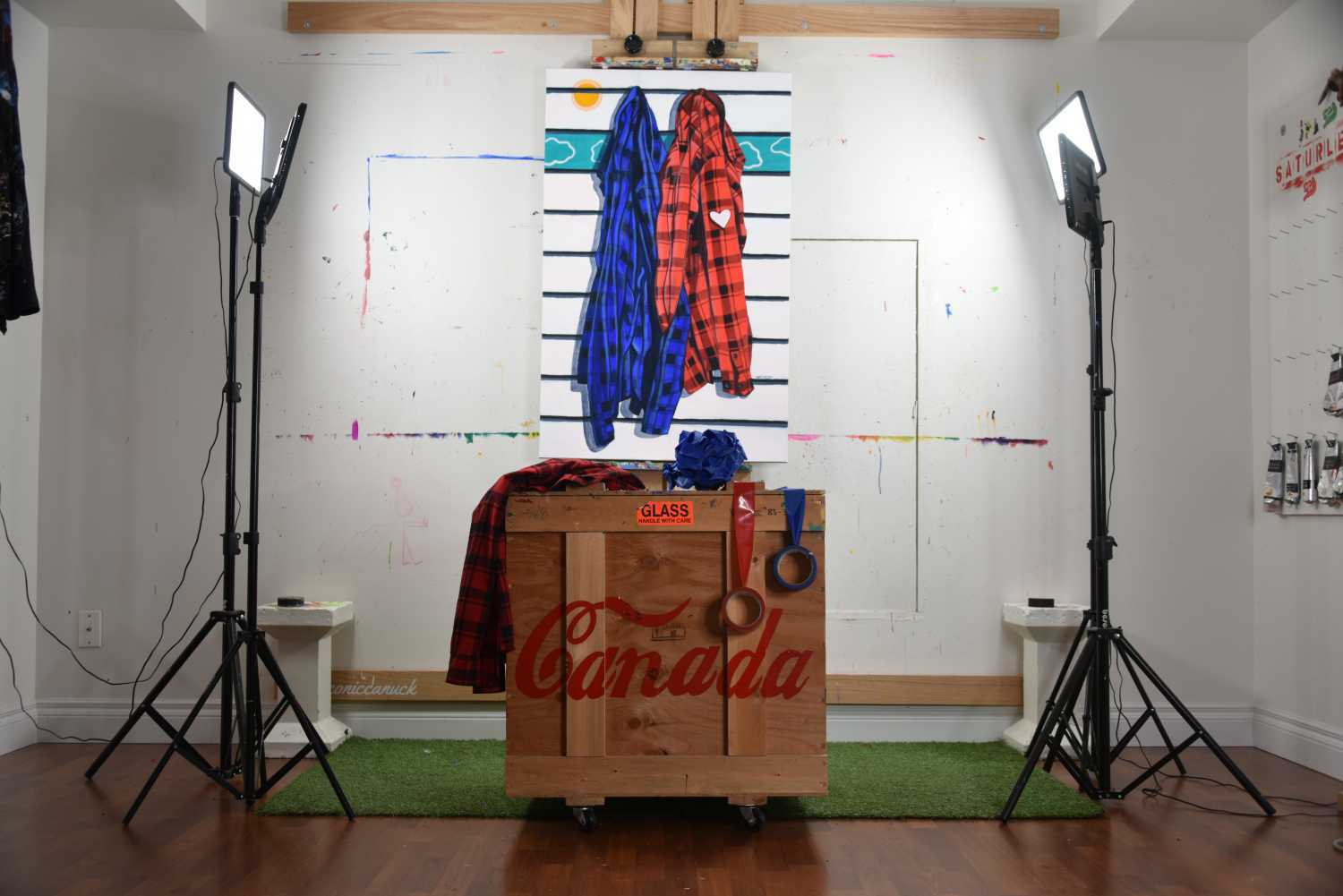
Inside Brandy Saturley studio in Parksville, Canada – 2026

June 17, 2026
https://www.brandysaturley.com/wp-content/uploads/2026/06/IMG_1252.jpeg 1125 1500 Brandy Saturley https://www.brandysaturley.com/wp-content/uploads/2020/10/brandysaturley_logo.png Brandy Saturley2026-06-17 14:03:332026-06-17 14:08:55Painting The Salish Sea

Recently Sold Paintings

Buying Art

These Paintings Have Been Collected: Recently Sold Works

When it comes to the business of selling art, collectors acquire my paintings in many different ways. Some discover my work through galleries that represent me, while others purchase directly through my website. However they find their way to the work, it is always rewarding to see paintings leave the studio and begin a new life in a collector’s home.

Recently Sold Paintings

Sealions Song, c. 2026 Acrylic On Canvas 30 x 60 x 1.5 in – sold by BrandySaturley.com

While I am best known for painting Canadiana and exploring the Canadian consciousness, the subject matter within my work is remarkably diverse. From people in the landscape to iconic objects and cultural symbols, my paintings examine the many layers of Canadian identity and experience.

Recently Sold Paintings

Beach House, c. 2025 Acrylic On Canvas 36 x 48 x 1.5 in – sold by BrandySaturley.com


A maple leaf, a hockey mask, a goalie, a skier, a tower of balanced rocks on a beach, or a polar bear searching for a new home. Each painting becomes a visual story drawn from my travels, observations, memories, and experiences across Canada. The subject might be a well-photographed location in the Alberta Rockies or the colourful homes of Newfoundland. It might be a plaid shirt hanging on a wall, a bottle of beer alongside a bag of Hawkins Cheezies, or a quiet stretch of highway disappearing into the horizon. Together, these subjects create a journey through a Canada that is familiar, personal, and distinctly our own.

Recently Sold Paintings

Say Cheezies!, c. 2025 Acrylic On Canvas 14 x 14 x 1.5 in – ARTAttack Art Auction – Miller Art Gallery

When it comes to which paintings sell quickly and which remain in the studio a little longer, there is rarely a predictable pattern. Art collecting is deeply personal. A painting resonates with a collector because it connects to a memory, a place, a feeling, or a story that is meaningful to them. What speaks profoundly to one person may be overlooked by another, and that is part of what makes collecting art so fascinating.

Recently Sold Paintings

Below are a selection of recently sold paintings that have found new homes in private and corporate collections across Canada.

Recently Sold Paintings

Little Red Saltbox, 2024 Acrylic on Wood 18 × 24 in – Brandy Saturley – Sold by James Baird Gallery


Recently Sold Paintings

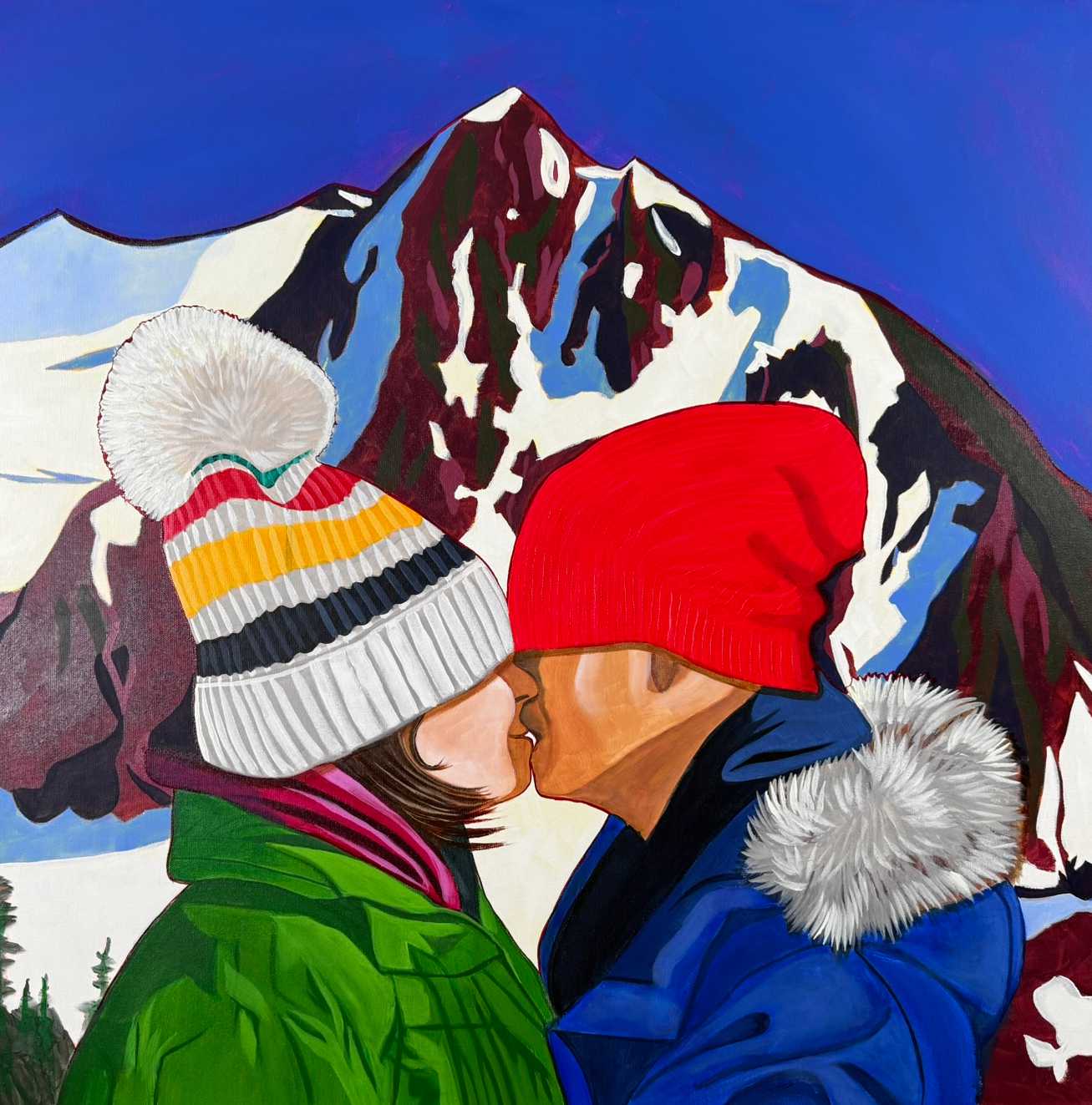
The Kiss, c. 2023 Acrylic On Canvas 36 x 48 x 1.5 in – Brandy Saturley – Sold by Miller Art Gallery


Recently Sold Paintings

Noble Steward, 2023, acrylic, gouache, gold leaf on canvas, 12 x 9 x 1.5 in – sold by Willock & Sax Gallery


New Polar Bear Painting

The Wild Life, c. 2025 Acrylic On Canvas 36 x 60 x 1.5 in – Brandy Saturley – sold by Miller Art Gallery


Among the Wildflowers, c. 2025 Acrylic On Canvas 18 x 36 x 1.5 in – sold by BrandySaturley.com


A West Coast Painting

Beach House, c. 2025 Acrylic On Canvas 36 x 48 x 1.5 in – Sold by BrandySaturley.com


Recently Sold Paintings

The Lake, acrylic on canvas, 30 x 24 x 1.5 inches – Brandy Saturley

June 1, 2026
https://www.brandysaturley.com/wp-content/uploads/2024/12/114.LittleRedSaltBox_18x24.jpg 1115 1500 Brandy Saturley https://www.brandysaturley.com/wp-content/uploads/2020/10/brandysaturley_logo.png Brandy Saturley2026-06-01 15:12:592026-06-01 15:12:59Recently Sold Paintings

Being Alone in Canada

Artist Process

The Beauty of Being Alone in Canada

Canada is a country that teaches you how to be alone. Not necessarily lonely, but alone in a quieter and more reflective sense. Alone with weather. Alone with distance. Alone with long stretches of road, ocean horizon, prairie sky, northern forest, or snowfall moving across the Rocky Mountains. The older I get and the more I travel this country, the more I realize that solitude is woven deeply into the Canadian experience.

Being Alone in Canada

Rocky Mountains Higher, c. 2023 Acrylic 36 x 48 x 1.5 in – Brandy Saturley

There are places in Canada where silence feels physical. You can feel it standing beside a frozen lake in winter or driving a remote highway at the early hours of the morning with no other vehicles in sight for miles. You feel it walking coastal trails in fog or watching light disappear across prairie fields at the end of the day. In many ways, Canada is shaped as much by emptiness as presence. This atmosphere has increasingly influenced my work as a painter.

Being Alone in Canada

Angel of Snow & Ice, c. 2023 Acrylic On Canvas 36 x 48 x 1.5 in – Brandy Saturley

When people think of Canadian art, they often think first about landscape. Mountains, forests, lakes, and vast skies. But what interests me most is not simply the appearance of these places, but the emotional experience of existing within them. The feeling of standing still in a massive country that seems to stretch endlessly in every direction. There is a certain vulnerability that comes with that kind of space.

Being Alone in Canada

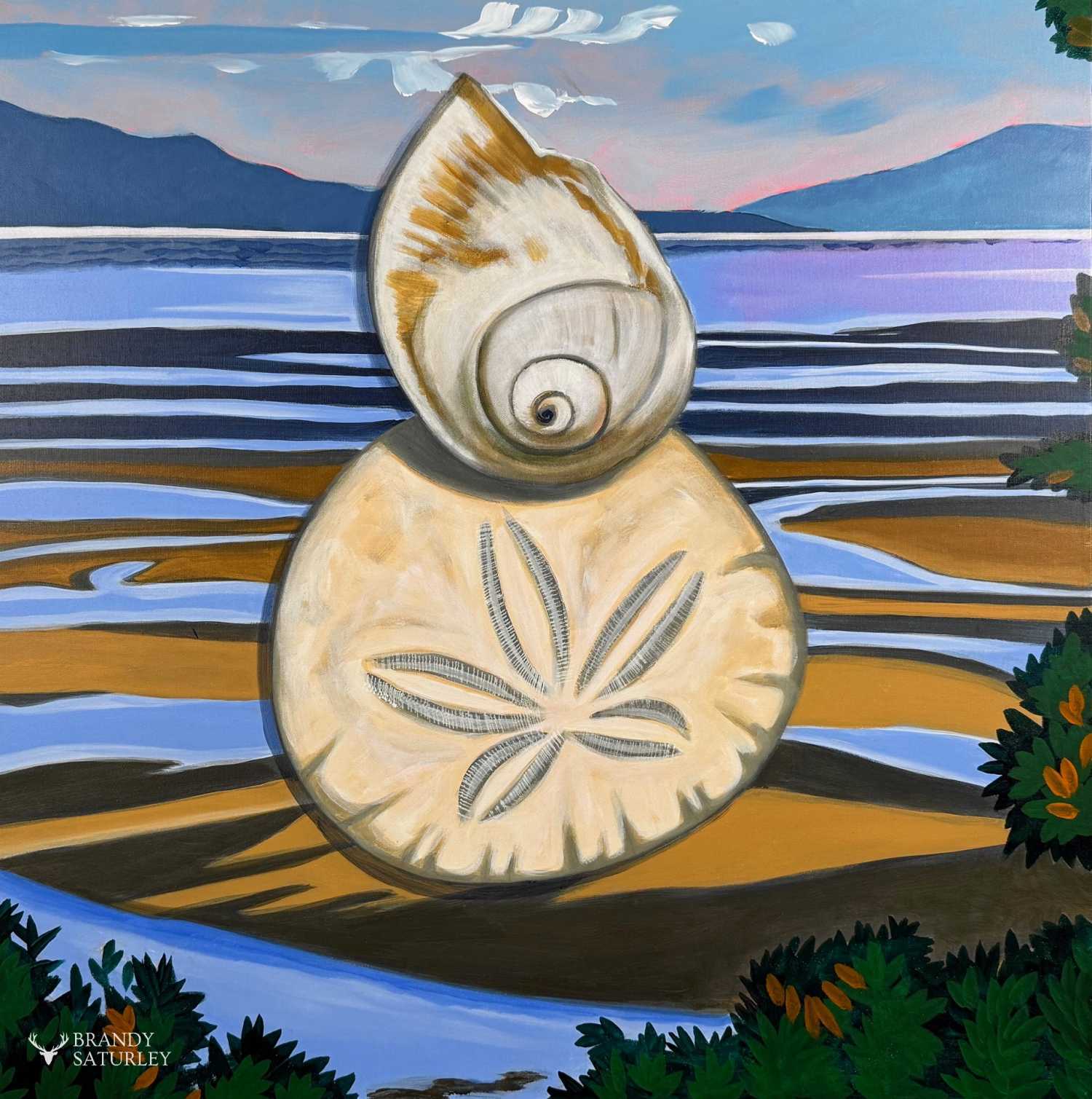
Your Wonderland, c. 2025 Acrylic On Canvas 16 x 16 x 1.5 in – Brandy Saturley

You become aware of your own smallness. Your own thoughts. Your own memories. There are fewer distractions in solitude, and because of this, ordinary moments begin to feel heightened. A coffee steaming on a dashboard during a rainstorm. The glow of a winter sunrise. Boots drying beside a heater. A ferry crossing at sunset. These moments may appear quiet from the outside, but emotionally they can feel enormous.

A Sunset Between Us, c. 2019 Acrylic 24 x 48 x 1.5 in – Brandy Saturley

I think many Canadians understand this instinctively. We are a country connected not only by culture, but by weather, distance, and endurance. Winter itself encourages introspection. Storms keep people indoors. Rural life creates physical isolation. Travel between places can take hours or even days. Even in cities, there is often an emotional spaciousness that differs from other parts of the world. Perhaps this is why nostalgia and atmosphere play such a strong role in Canadian storytelling, music, and art. Solitude sharpens memory.

The Beach, c. 2025 Acrylic on wood panel 18 x 24 x 2 in – Brandy Saturley

Being Alone in Canada – Expressions of Solitude Through Art

When I travel across Canada gathering inspiration, many of the most meaningful experiences happen when I am alone. Driving through unfamiliar towns. Watching snow fall in parking lots late at night. Sitting quietly in hotel restaurants. Walking through small public art galleries or empty beaches. These are not dramatic moments, but they stay with me.

The Barn, c. 2020 Acrylic on canvas 24 x 30 x 1.5 in – Brandy Saturley

Back in the studio, fragments of these experiences find their way into my paintings. Not as literal documentation, but as emotional residue. A painting may begin with a landscape, object, or figure, but underneath it is often an attempt to capture a mood that is harder to describe. A sense of stillness. Distance. Longing. Reflection. The strange beauty of existing quietly within an enormous country. There is romance in this kind of solitude.

Being Alone in Canada

Gateway to The World, c. 2026 Acrylic On Canvas 18 x 48 x 1.5 in – Brandy Saturley

Not the romance of escape, but of connection. Connection to place, memory, weather, and self. Canada has a way of slowing people down enough to notice things they might otherwise miss. The texture of glacial snowbanks. The colour of mid-day skies against prairie fields. The sound of ferry horns through fog. The silence between radio stations on northern highways. These details become part of our emotional landscape.

Mountain Paintings in Canada

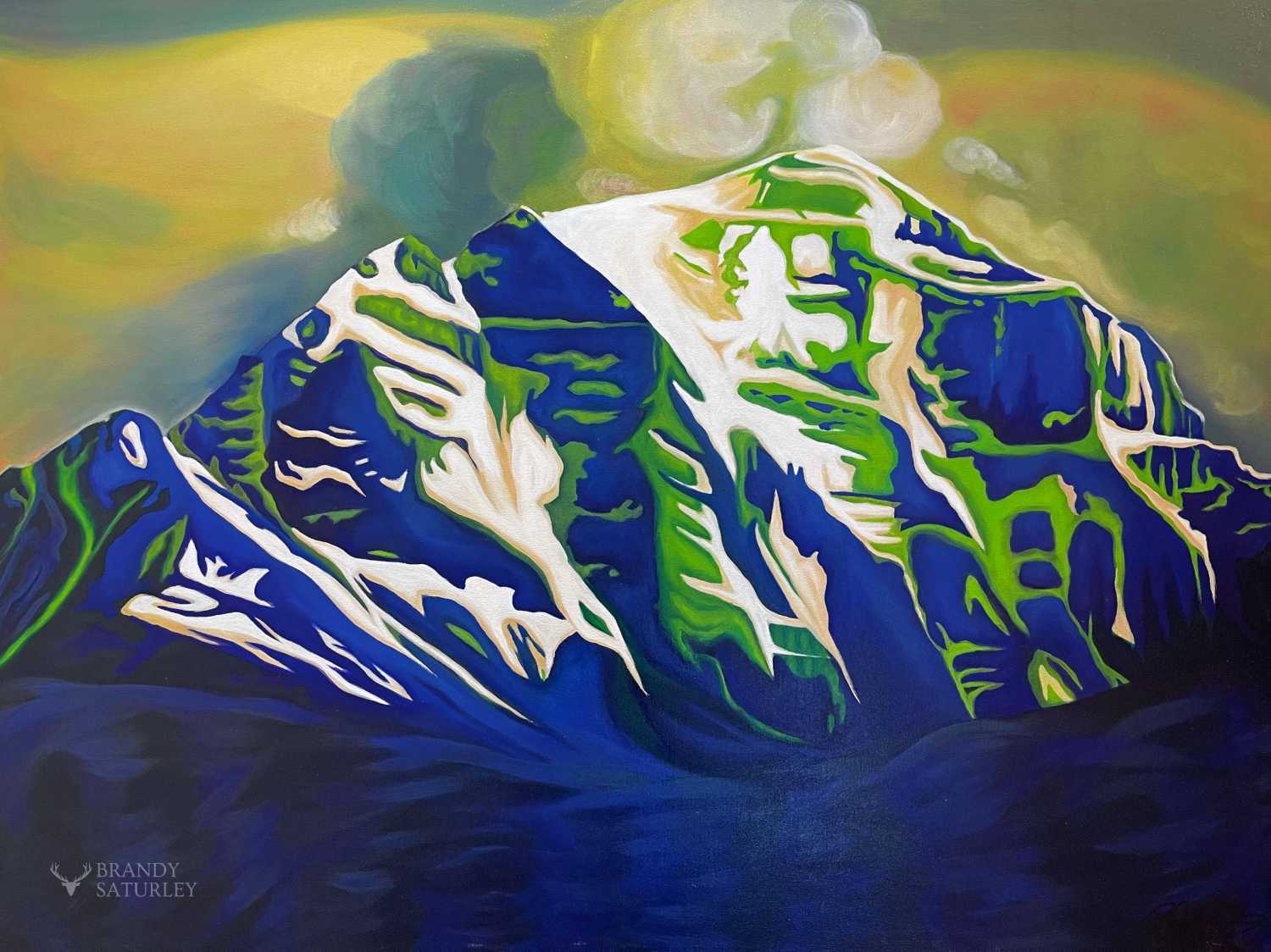
Three Sisters, 2025 Oil and Acrylic on canvas 24 x 48 x 1.5 in – Brandy Saturley

The beauty of being alone in Canada is that the country never truly leaves you alone. The land itself becomes company. The weather becomes conversation. Memory becomes louder. And somewhere in the quiet, you begin to understand yourself differently.

Being Alone in Canada

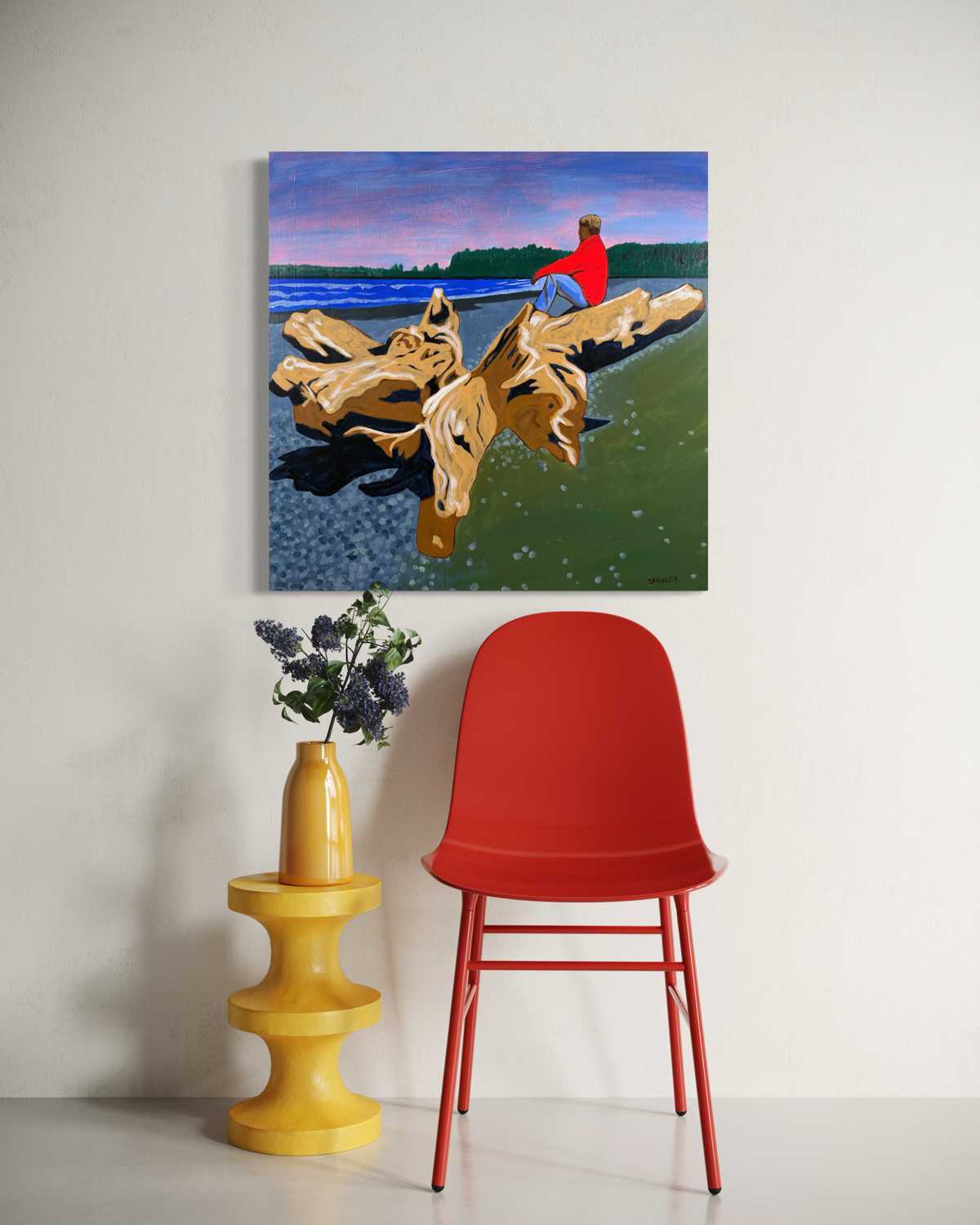
When I Go to SEE, c. 2025 Acrylic On Canvas 30 x 60 x 1.5 in – Brandy Saturley

You can find The Art of Brandy Saturley at Willock & Sax Gallery in Banff, James Baird Gallery in Newfoundland and Nicholas Penn Fine Art in Royston, UK.
May 27, 2026
https://www.brandysaturley.com/wp-content/uploads/2026/03/YourWonderland.jpg 1285 1278 Brandy Saturley https://www.brandysaturley.com/wp-content/uploads/2020/10/brandysaturley_logo.png Brandy Saturley2026-05-27 11:30:402026-05-27 11:30:40Being Alone in Canada

Palette Colours of Canada

Artist Process, Canadian Paintings

The Colours of Canada – A Lived Palette

Reds, Denim Blues, Ice Whites & Forestry Greens in Canadian Painting

Canada has a colour palette all its own. Not the official palette of tourism brochures or flag ceremonies, but the lived palette of roadside buildings, hockey arenas, fishing towns, ski hills, workwear, winter light, and long drives through shifting landscapes. It is a palette built from weather, labour, nostalgia, and survival. A national psychology expressed through colour.
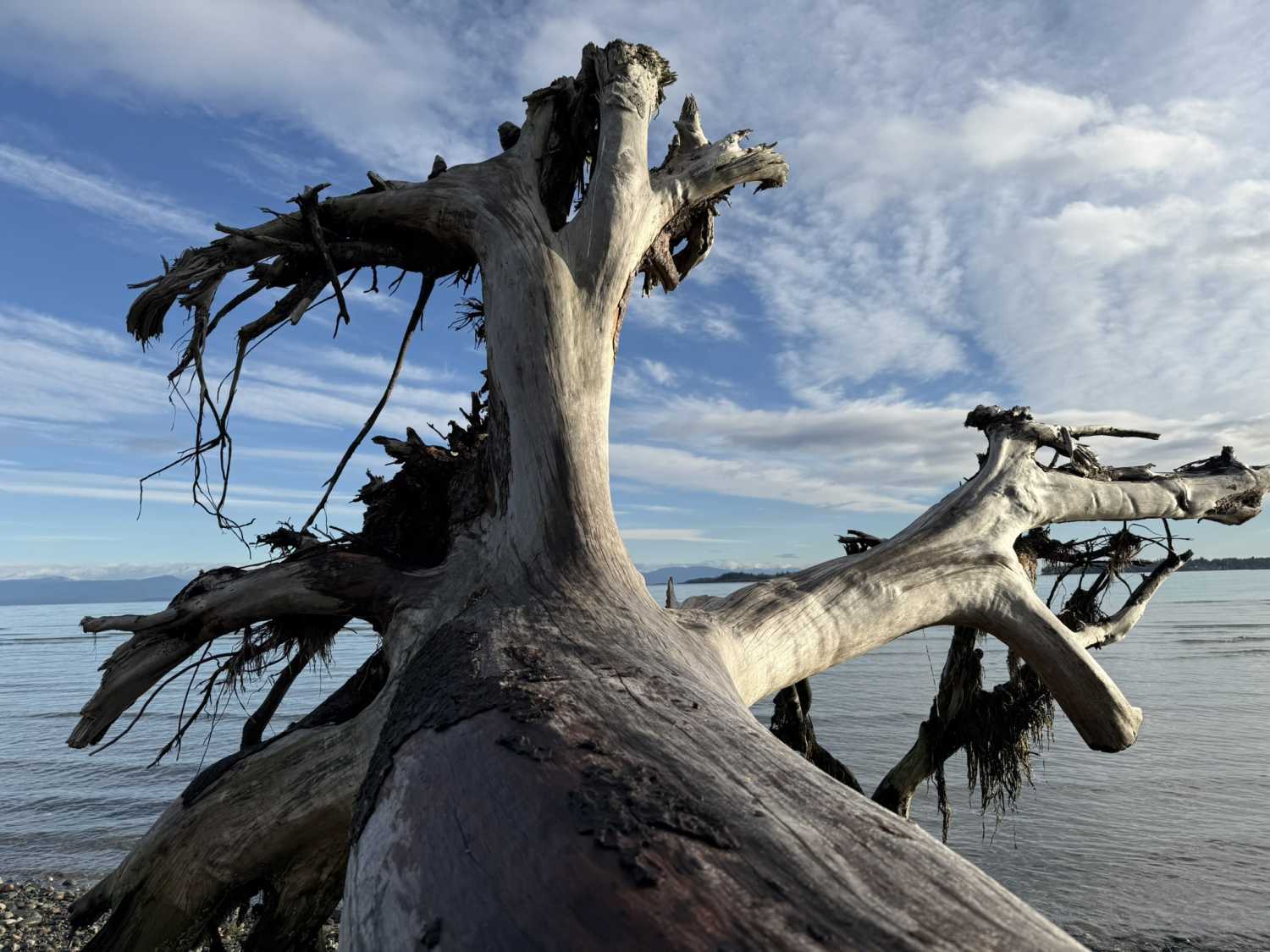
As a painter working across the iconography of Canada, I often find myself returning to certain tones instinctively. They appear again and again in my paintings like recurring characters in a story. Canadian reds. Denim blues. Ice whites. Forestry greens.

These colours are more than aesthetic choices. They carry emotional memory.

Palette Colours of Canada

Charity, c. 2017 Acrylic 36 x 36 x 1.5 in – Brandy Saturley

Canadian Red

Red in Canada is not subtle.

It flashes through the landscape like a signal fire. The red of the maple leaf. The Hudson’s Bay stripe translated into winter wear. The glowing taillights on the Trans-Canada Highway in a snowstorm. Hockey jerseys. Barn roofs. Muskoka chairs. Canoes. Poppies pinned to denim jackets in November.

Canadian red carries both warmth and warning.

It is the colour of resilience against cold climates and vast distances. In painting, I often use red as an emotional anchor point. It pulls the eye forward through mist, snow, trees, or open space. A visual heartbeat in the composition.

Red is also deeply tied to collective memory in Canada. It contains patriotism, but also longing. It can feel celebratory or lonely depending on its placement within the landscape.

Palette Colours of Canada

Rocky Mountains Higher, c. 2023 Acrylic 36 x 48 x 1.5 in – Brandy Saturley

Denim Blues

Denim blue may be one of the most quietly Canadian colours.

It is the colour of workwear, faded lake jeans, labour, music culture, prairie skies, and northern shadows. It exists somewhere between toughness and tenderness.

Growing up in Canada, denim feels almost like a second skin. It belongs equally to farmers, artists, miners, musicians, and teenagers standing outside arenas in winter.

In my paintings, denim blues often function as emotional atmosphere. These blues soften the landscape while holding a sense of distance and memory. They evoke road trips, old photographs, and the vastness of Canadian geography.

There is humility in denim blue. It does not shout. It endures.

Hanging On A Cloud, 2025 Acrylic on canvas 52 x 25 in – Brandy Saturley

Ice Whites

Winter changes the psychology of colour in Canada.

Ice white is never simply white. It absorbs blues, violets, silver light, and silence. Snow-covered landscapes create a strange emotional compression where sound softens and colour becomes precious.

In painting, ice white creates pause.

It allows breathing room around objects and symbols while amplifying isolation, reflection, and stillness. A single red jacket or green pine against a field of white suddenly becomes cinematic.

Canadian winter light has shaped generations of painters because it alters perception itself. The landscape becomes distilled. Simplified. Honest.

There is nowhere to hide in winter.

Palette Colours of Canada

Bottoms Up, 2026, acrylic on canvas, wrapped, 30 x 30 x 1.5 inches – Brandy Saturley

Forestry Greens

The green of Canada is dense with mythology.

Forestry green speaks of wilderness, national parks, wet coastal forests, northern muskeg, canoe routes, camping trips, and the deep psychological relationship Canadians have with trees.

It is a colour connected to both freedom and solitude.

For many Canadians, green represents escape from urban life and a return to something elemental. Cabins. Trails. Mountains. Rain-soaked cedar. Moss climbing telephone poles on the West Coast.

In my work, forestry greens often ground the paintings emotionally. They connect human symbols and pop culture references back to the land itself. The landscape remains the constant character beneath all the noise of contemporary culture.

Rewriting the Canadian Landscape

The Red We Carry, c. 2026 Acrylic On Canvas 30 x 30 x 1.5 in – Brandy Saturley

Painting The Canadian Consciousness: Palette Colours of Canada

Over time I have realized that my work is not simply about painting Canada visually. It is about painting the emotional atmosphere of living here.

Colour becomes a language for that experience.

The reds carry memory and identity.
The blues hold distance and endurance.
The whites contain silence and reflection.
The greens root us to the land.

Palette Colours of Canada

Spirited Island, 2024, acrylic on canvas, 48×48 inches – Brandy Saturley

Together they form a distinctly Canadian emotional palette shaped by climate, geography, popular culture, and collective experience.

As I continue to travel and paint across the country, I keep discovering new variations within these colours. Newfoundland fog creates a different blue than Alberta prairie sky. Northern snow reflects differently than coastal winter light. Every region shifts the emotional register slightly.

Canada is vast, but its colours continue to tell connected stories.

And as a painter, I continue following them.

I Am The Polar Bear

King Of The Polar Bears, acrylic on canvas, 36×48, Brandy Saturley

May 7, 2026
https://www.brandysaturley.com/wp-content/uploads/2024/12/37.RockyMountainsHigher_36x48.jpg 1123 1500 Brandy Saturley https://www.brandysaturley.com/wp-content/uploads/2020/10/brandysaturley_logo.png Brandy Saturley2026-05-07 11:47:132026-05-07 11:47:13Palette Colours of Canada

Behind the Paintings

Art Career, Artist Process

Behind the Paintings: Why I Travel Canada to Make This Work

Canada is a country that reveals itself slowly. You cannot understand it from a map or a photograph alone. It unfolds through miles of highway, conversations with strangers, quiet landscapes, and small cultural details that begin to accumulate over time. For me, travel has become an essential part of my painting practice.

Behind the Paintings

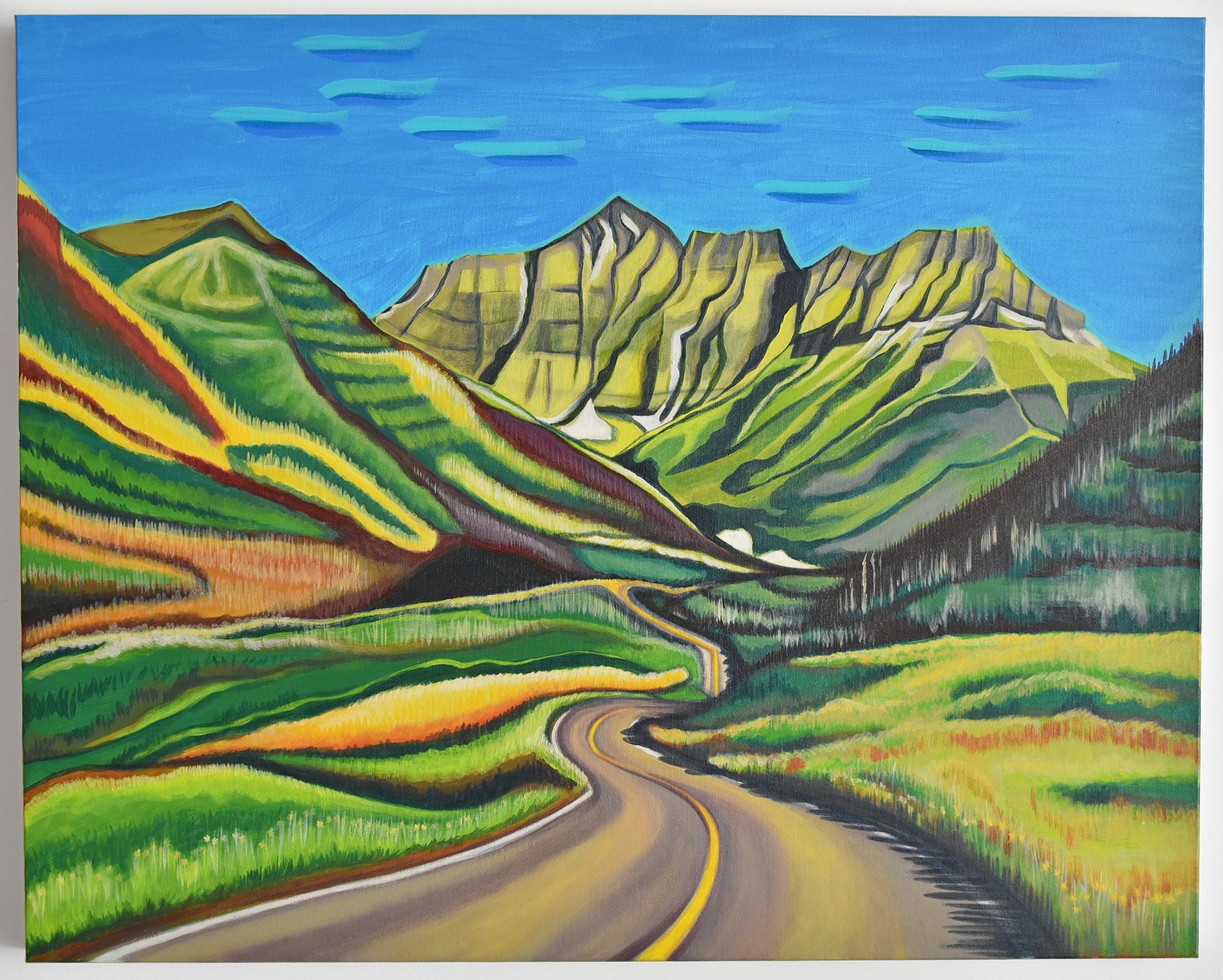
A Long and Winding Road, acrylic on canvas, 24 x 30 x 1.5 inches (60.96 x 76.2 x 3.81 cm – Brandy Saturley

My work is rooted in Canadian identity. The symbols, landscapes, and everyday moments that shape how we see ourselves as a country. But those ideas do not appear in the studio by accident. They are gathered out in the world. Over the past two decades I have traveled across Canada, spending time in cities and remote communities alike. From the wide skies of the prairies to the rugged coastline of Newfoundland, from northern territories to mountain towns like Banff, each place carries its own character and visual language.

Love on The Rock, Acrylic On Canvas 18 x 36 x 1.5 in (45.72 x 91.44 x 3.81 cm) – Brandy Saturley

When I travel, I am constantly collecting material. Sometimes it is a photograph taken along the side of the road. Sometimes it is a quick sketch in a notebook, or a phrase written down after a conversation. Other times it is simply a colour in the landscape or a piece of clothing someone is wearing that captures something unmistakably Canadian.

Behind the Paintings

The Barn, Acrylic on canvas 24 x 30 x 1.5 in (60.96 x 76.2 x 3.81 cm)

Behind the Paintings – These fragments eventually find their way into the paintings.

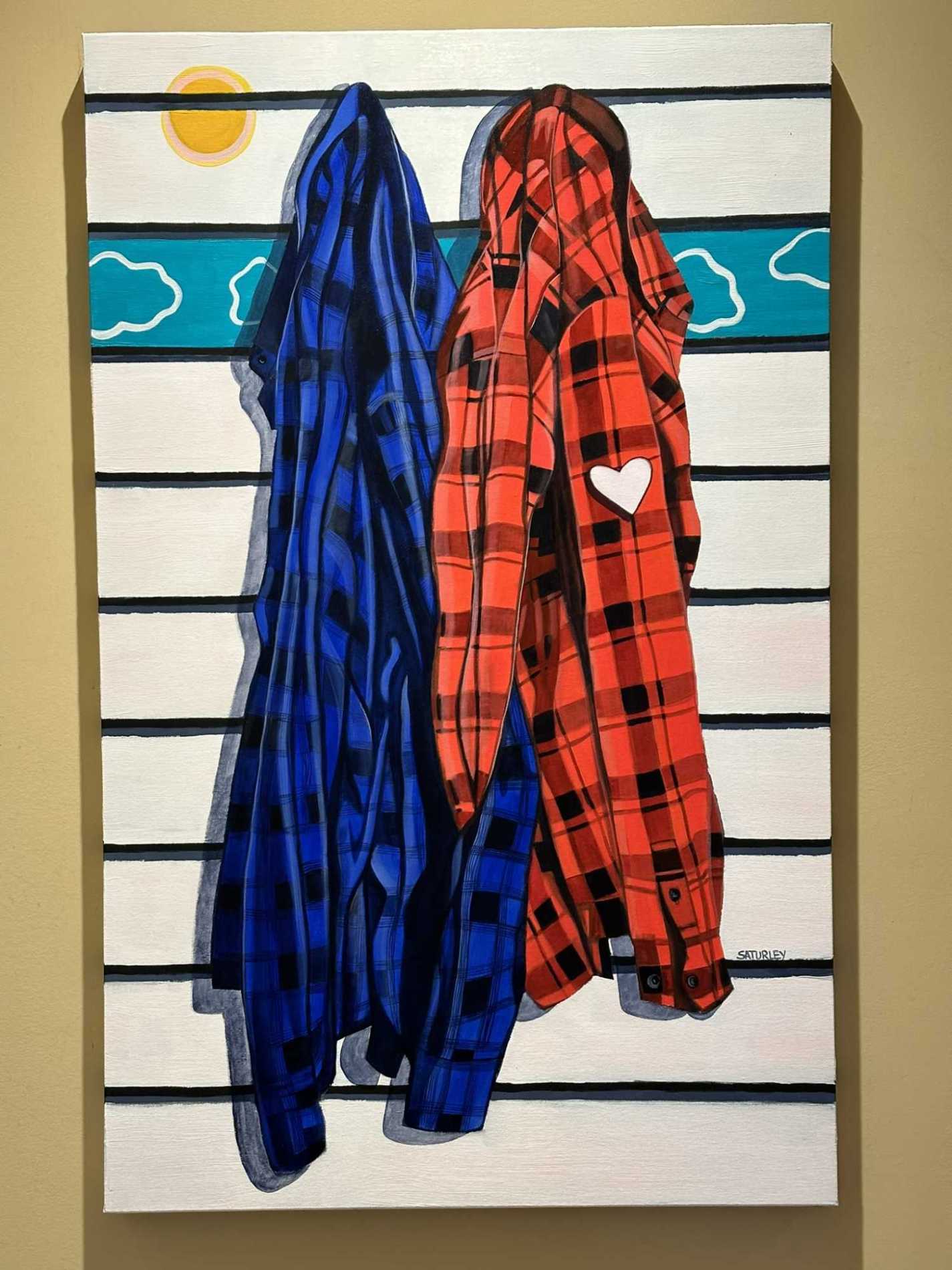
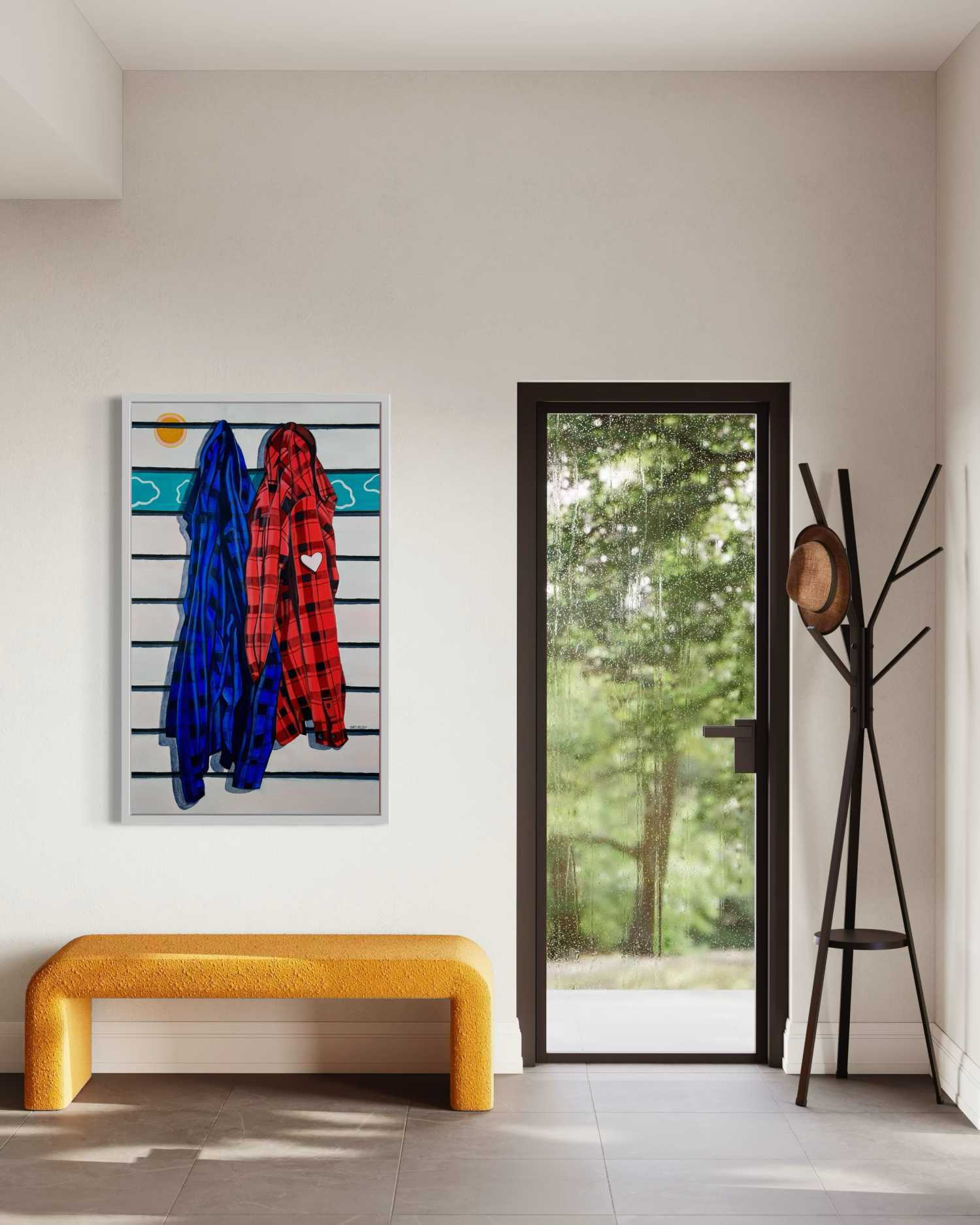
A plaid shirt hanging on a wall.
A denim jacket with a poppy pinned to the pocket.
A winter road disappearing into a mountain valley.
A polar bear moving through the landscapes of North America

10 best paintings 2024

Come On Just Let’s Go, 2024 Acrylic on Canvas 48 x 30 in – Brandy Saturley

Each image begins as an observation but becomes something larger in the studio. When I return home to paint, those collected experiences begin to merge into visual stories that reflect how Canada feels rather than simply how it looks. Travel also reminds me that Canada is not one single story. It is many stories layered across geography and culture. Every region offers its own rhythm, its own humour, its own symbols that quietly define local life.

Behind the Paintings

The Kiss, Acrylic On Canvas 36 x 48 x 1.5 in (91.44 x 121.92 x 3.81 cm) – Brandy Saturley

By spending time in these places, I gain a deeper understanding of the country I am painting. For collectors, these journeys become part of the artwork itself. The paintings are not imagined from afar. They are shaped by real landscapes, real experiences, and the people who inhabit them. In many ways, my studio becomes a meeting point where these travels converge. Northern wilderness, coastal mornings, winter rituals, and cultural symbols all begin to interact on the canvas. What emerges is a visual narrative about Canada as I experience it.

Looking for The Icebergs, Acrylic On Canvas 30 x 48 x 1.5 in (76.2 x 121.92 x 3.81 cm) – Brandy Saturley

Travel continues to fuel this process. Each new place offers new imagery, new stories, and new questions about what defines Canadian identity today. Those discoveries eventually become the foundation for future paintings and exhibitions.

Behind the Paintings

Rocky Mountains Higher, Acrylic on canvas 36 x 48 x 1.5 in (91.44 x 121.92 x 3.81 cm) – Brandy Saturley

For collectors who live with these works, the paintings carry those journeys within them. They hold the memory of a landscape, a moment of light, or a symbol that feels familiar. Art has always been, for me, a way of giving something back. A way of reflecting the places that shape us and inviting viewers to see those places with fresh attention.

Collecting Canadian Art

When I Go to SEE, Acrylic On Canvas 30 x 60 x 1.5 in (76.2 x 152.4 x 3.81 cm) – Brandy Saturley

Canada is vast, complex, and endlessly inspiring.

The road simply helps me find the stories worth painting.

Behind the Paintings

Brandy Saturley Studio in Victoria BC

March 9, 2026
https://www.brandysaturley.com/wp-content/uploads/2025/03/BrandySaturleyInStudio.jpg 803 1024 Brandy Saturley https://www.brandysaturley.com/wp-content/uploads/2020/10/brandysaturley_logo.png Brandy Saturley2026-03-09 11:42:512026-03-09 11:42:51Behind the Paintings

Canada Goose Painting

New Paintings

A Messenger From The North – A Painting About a Canada Goose

When I look back at the paintings I’ve made over the past two decades, a few things rise to the surface like landmarks on a familiar map. I return again and again to the stories of my Canadian experience as seen through the eyes of a woman travelling, observing, and painting her way across the country. I’m drawn to figurative landscapes where people anchor the land and the land shapes them in return. And woven through this long journey is one recurring companion: the Canada Goose.

The goose has appeared in many of my narratives about Canada. Sometimes it stands at the centre, a full-bodied protagonist. Other times it moves along the edges, framing the story with its quiet authority. No matter its position, it carries its own weight of meaning.

To many, the Canada Goose is more than a bird. Its steadfast flight speaks of loyalty, cooperation, communication, and endurance. Its V-formation is a testament to shared leadership. Its lifelong bonds echo the resilience of relationships built through weather and time. Across Indigenous cultures, the goose is a sacred seasonal marker, a signal of change and continuity. In folklore, it can move between worlds, a guide or a wandering soul. It is a creature stitched deeply into the cycles of nature and into our collective sense of the North.

In this new painting, a woman stands in the open hush of a snow-covered landscape, her gaze steady beneath the warm shelter of a fur hat. Behind her, the sky burns in a late-day flare of orange, as if the sun has cracked the horizon and spilled its final breath of light across a ridge of deep blue mountains.

Canada Goose Painting

Northern Messenger – 18×36 inches, acrylic on canvas, 2025 – Brandy Saturley

A Canada Goose cuts across her face in full flight, its wing sweeping through the scene like a living brushstroke. It becomes an envoy, sliding the wild world directly into her line of sight, binding her to the land and to the long migratory stories carried on beating wings. Her embroidered coat glows with reds and blues, a pulse of northern life against the winter quiet.

Canada Goose Painting

The painting settles into something part portrait and part vision: a moment where human presence and the instinctive rhythm of nature align in brief, luminous agreement. The goose becomes the messenger, the woman the witness, and the landscape a silent accomplice to their shared moment of connection.

Inside Brandy Saturley Studio – Parksville, Canada

December 12, 2025
https://www.brandysaturley.com/wp-content/uploads/2025/12/IMG_8824.jpg 812 1500 Brandy Saturley https://www.brandysaturley.com/wp-content/uploads/2020/10/brandysaturley_logo.png Brandy Saturley2025-12-12 11:03:122025-12-12 11:06:08Canada Goose Painting

Inukshuk Painting

New Paintings

A Totem to The Stars – An Inukshuk Painting

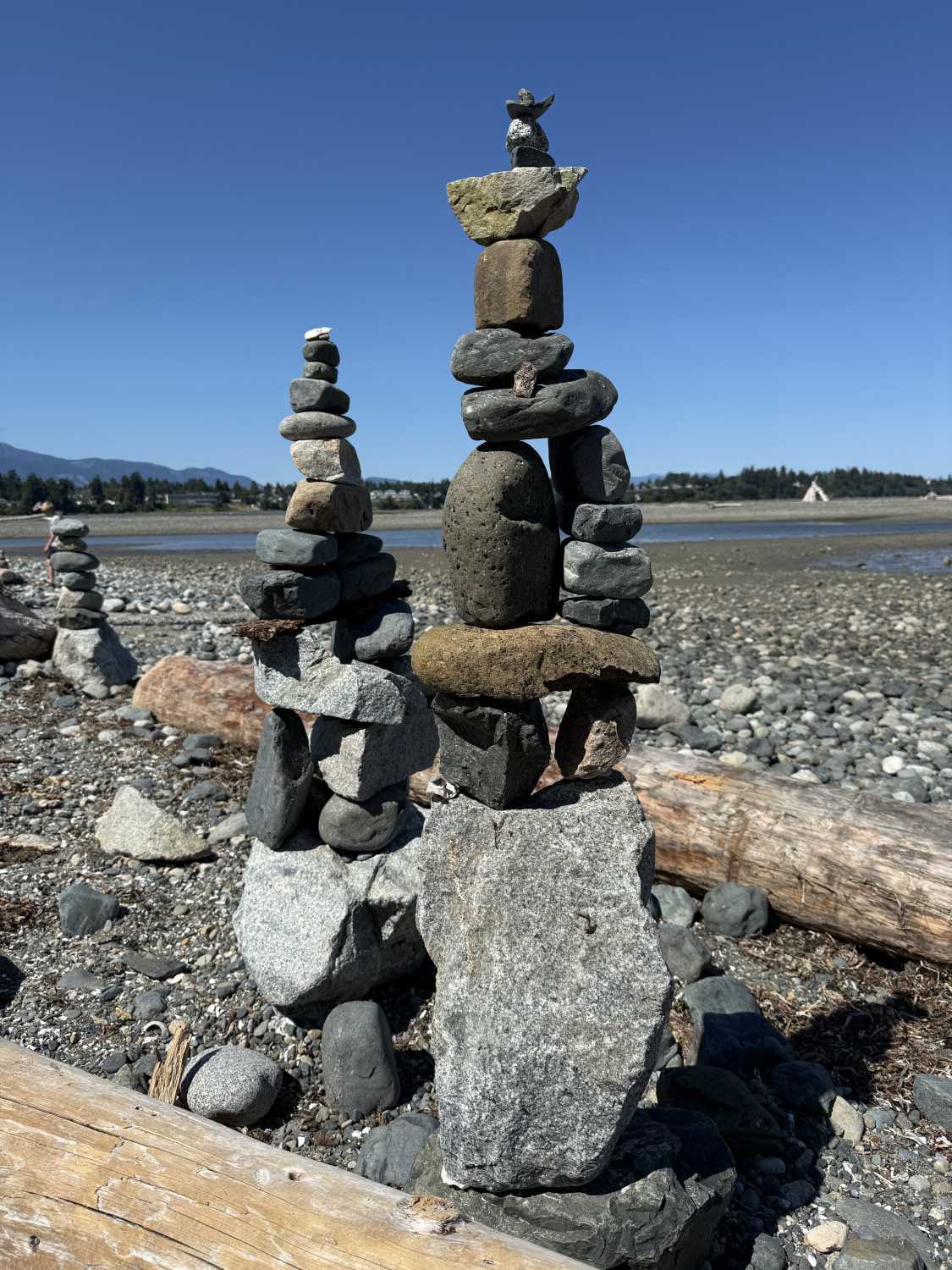
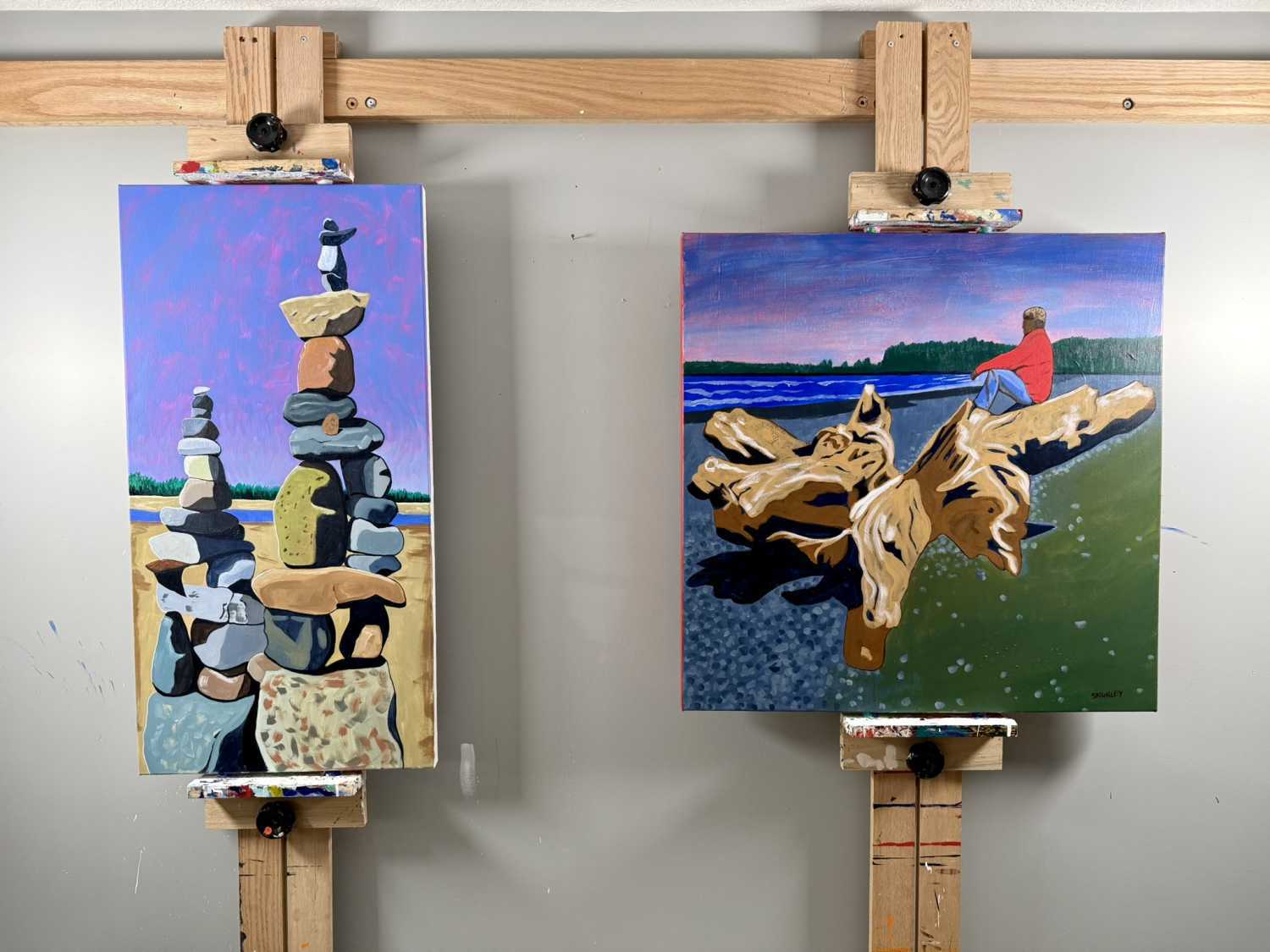
It is no secret by now that I have been painting stories of west coast beaches this Autumn. The treasures that line the sand and the structures built from beach things by human hands. I have been making paintings about shells, beach huts, Inukshuk and being in these landscapes.

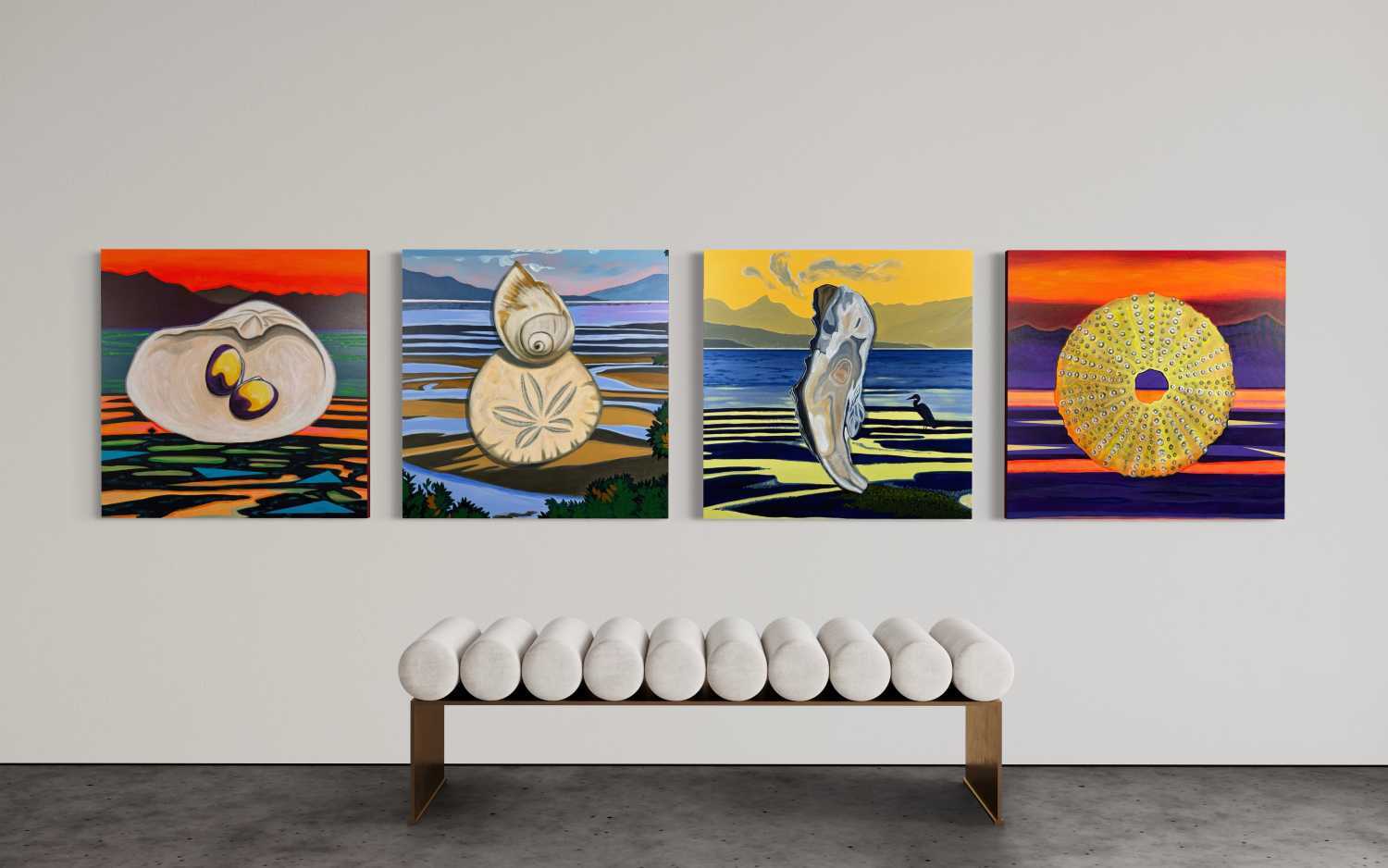
Shell Still Life Paintings – Brandy Saturley – 2025

With this most recent painting I wanted to capture the aura of the rock stacks seen on the beaches. Here on Vancouver Island you will see these totems of balanced rocks at the corners of the beaches. Sometimes balanced on rock and other times balanced on logs. Know as Inukshuk, these towers come with rocks of various sizes and shapes and are skillfully built into delicately balanced towers to the sky.  Inukshuk is a figure made of piled stones or boulders constructed to communicate with humans throughout the Arctic. Traditionally constructed by the Inuit, inuksuit are integral to Inuit culture and are often intertwined with representations of Canada and the North.

Inukshuk in Parksville, BC – 2025

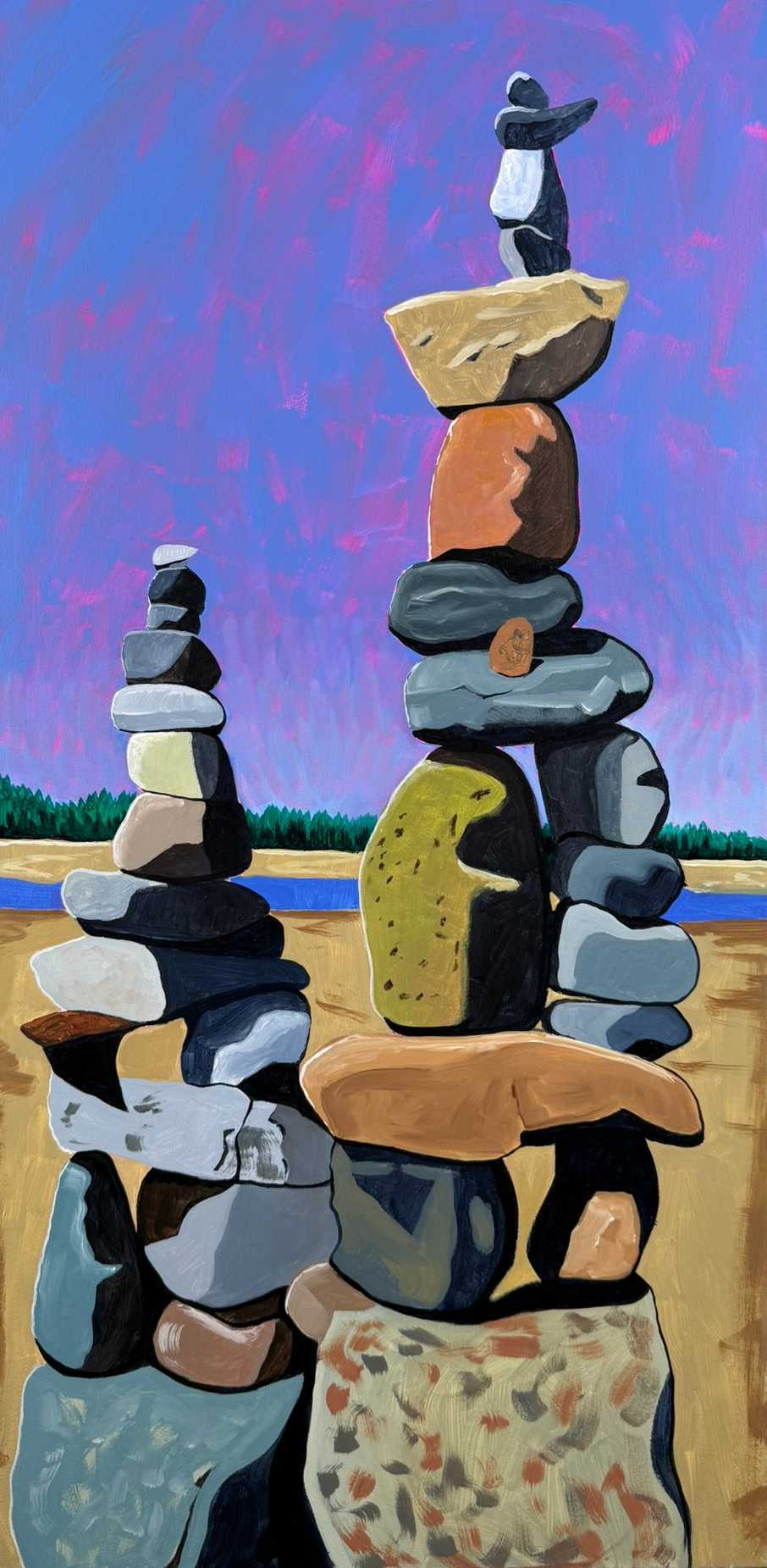
This vibrant acrylic painting features an inuksuk rendered in bold, sculptural layers of stone, each shape carefully balanced to form a vertical figure rising from a rugged landscape. The stones are painted in warm earth tones – soft creams, deep charcoals, russet reds, and weathered greys – giving the structure a grounded, tactile presence. Behind it, the sky glows with a rich blend of ultramarine, violet, and magenta, creating a luminous twilight atmosphere. Flecks of white stars scatter across the sky, lending a sense of vastness and quiet northern magic.

Inukshuk Painting

Totem Song, 36×18, acrylic on canvas, 2025 – Brandy Saturley

The foreground suggests rocky terrain, its textures and contours echoing the layered forms of the inuksuk itself. The contrast between the solid, ancient stones and the dreamlike celestial backdrop creates a powerful tension between earth and sky, permanence and wonder. The painting captures the symbolism of the inuksuk as both a guide and a marker of presence – a beacon of human connection within the expansive Canadian landscape.

Inukshuk Painting

Inukshuk painting on an entry wall.

December 5, 2025
https://www.brandysaturley.com/wp-content/uploads/2025/12/IMG_8783.jpg 1500 1200 Brandy Saturley https://www.brandysaturley.com/wp-content/uploads/2020/10/brandysaturley_logo.png Brandy Saturley2025-12-05 11:46:282025-12-05 11:46:28Inukshuk Painting

West Coast Still Life

New Paintings

Painting on the Left Coast – West Coast Still Life

We recently moved our home and my studio to the seaside city of Parksville, British Columbia – leaving my hometown of Victoria behind for a serene and immersive locale. After just one month, the studio is finally feeling like my own, and the paintings are flowing again. Five new works are already complete. It feels somewhat like being on an artist residency, and I’ve been treating these first few weeks as such.

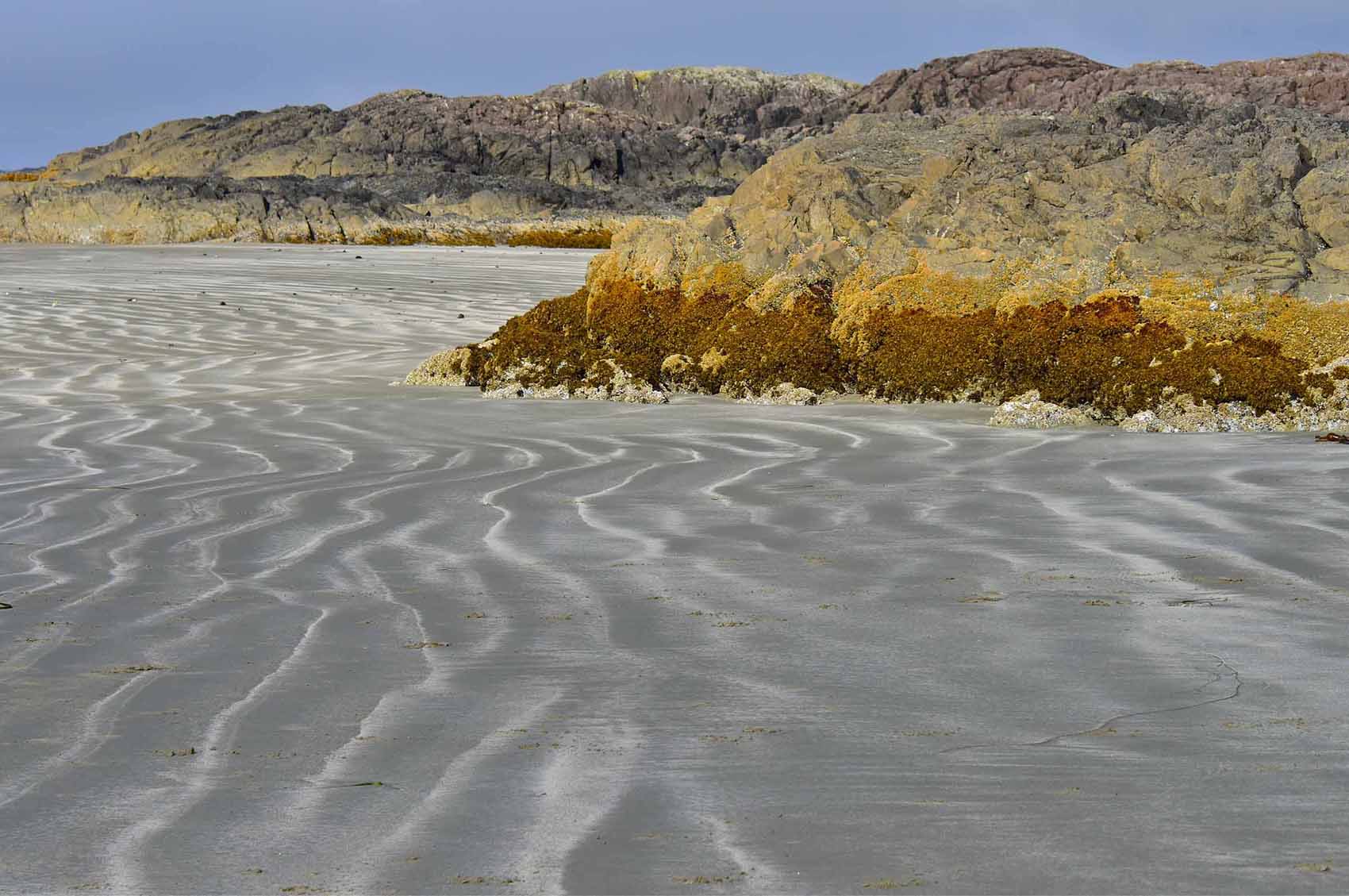
The beach at low tide in Parksville BC – Canada

Though I’ve lived on Vancouver Island my entire life and traveled across Canada to make and show my art, I’ve rarely turned my focus to painting the West Coast itself. Since moving here, I’ve learned that many locals affectionately refer to it as the “Left Coast.” The phrase plays on geography, our coast lies on the left of the map, but also carries a certain spirit of independence and creative energy that defines this region.

The desire that once drove me to travel and connect with the rest of Canada came largely from feeling isolated from the national identity and the stereotypes of “Canadiana.” British Columbia has always stood apart. When British poet Rupert Brooke arrived in Vancouver after a cross-Canada journey in 1913, he wrote home: “It’s a queer place, rather different from the rest of Canada.” While others may have viewed BC as a rain-sodden outpost, those who live here understand that “Super, Natural British Columbia” is far closer to the truth. As humorist Eric Nicol once quipped, “British Columbians like to think of their province as a large body of land entirely surrounded by envy.”

The Beach in Parksville, BC – Canada

I’ve often said that we live in our own biosphere here on the coast. BC is undeniably part of Canada, yet it feels like its own realm, a place of unique rhythms and light. If, as historian Jean Barman suggested, “British Columbia is not so much a place as a state of mind,” then I find myself now immersed in exploring what that state of mind truly means.

Here in Parksville, I’ve been walking the endless sandy beaches, observing wildlife, flora, and the play of tide and wind. I find myself looking more closely than ever before, perhaps it’s that residency mindset taking hold. Beyond the beaches, I’ve explored the wetlands and railway tracks, visited the local MacMillan Arts Centre, and joined the Oceanside Arts Council, connecting with the vibrant creative community of Oceanside, Qualicum Beach, Nanoose Bay, and Nanaimo.

West Coast Still Life

New Paintings – West Coast Still Life

This exploration has already inspired two new paintings, visual stories of life by the ocean. The palette of these works draws directly from the coast: green-golds, blues, Payne’s grey, and raw sienna. They are part still life, part landscape, inviting the viewer to look closely at the natural details that define this place. Rocks and shells float serenely within these compositions, much as I feel when walking along the shore, listening to the rhythm of the waves.

West Coast Still Life

Unusual Oyster shell in Parksville, BC

The World Is Your Oyster reveals a uniquely shaped oyster shell shimmering above a beach landscape at low tide, while a Great Blue Heron stands silhouetted in the distance. The sundown sky glows with yellows and greys, a quiet tribute to the poetic solitude of the coast.

West Coast Still Life

The World is Your Oyster, 30×30 inches, acrylic on canvas, 2025, Brandy Saturley

Sumo tells another West Coast story. A stack of stones, balanced like an inukshuk, takes on the presence of a Sumo wrestler, strong, grounded, and immovable, set against a moody sky of blues and greys with a lush outcropping of green trees in the distance.

West Coast Still Life

Sumo, 16×16 inches, acrylic on canvas, 2025 – Brandy Saturley

These paintings are undeniably Left Coast – rooted in place and mood. As I continue this residency-like chapter of my practice, I look forward to seeing how this new home will shape the stories I tell through paint.

See more paintings of Canada here.

October 20, 2025
https://www.brandysaturley.com/wp-content/uploads/2025/10/IMG_8103.jpg 1511 1500 Brandy Saturley https://www.brandysaturley.com/wp-content/uploads/2020/10/brandysaturley_logo.png Brandy Saturley2025-10-20 10:58:022025-10-20 10:59:22West Coast Still Life

What is Canada?

Art Career

Painting Canada Asks Me to Question, What is Canada?

When I began down a path fueled by an Olympic Games to answer the question, What is Canada to me? I never thought I would find myself nearly two decades later still working to express my thoughts of this country on canvas.

What is Canada?

The 2010 Olympics in Vancouver were loud and rife with stereotype: giant igloos and Inukshuk, beer and moose. I became curious about what the West Coast was trying to say about itself and how it was representing all of us on the world stage. Canadians are known for our quirky, self-deprecating sense of humour, and for gleefully making fun of ourselves at our own expense. When I began thinking about my impressions of Canada, I too began with stereotype and popular culture. It felt like the most natural place to start.

What is Canada?

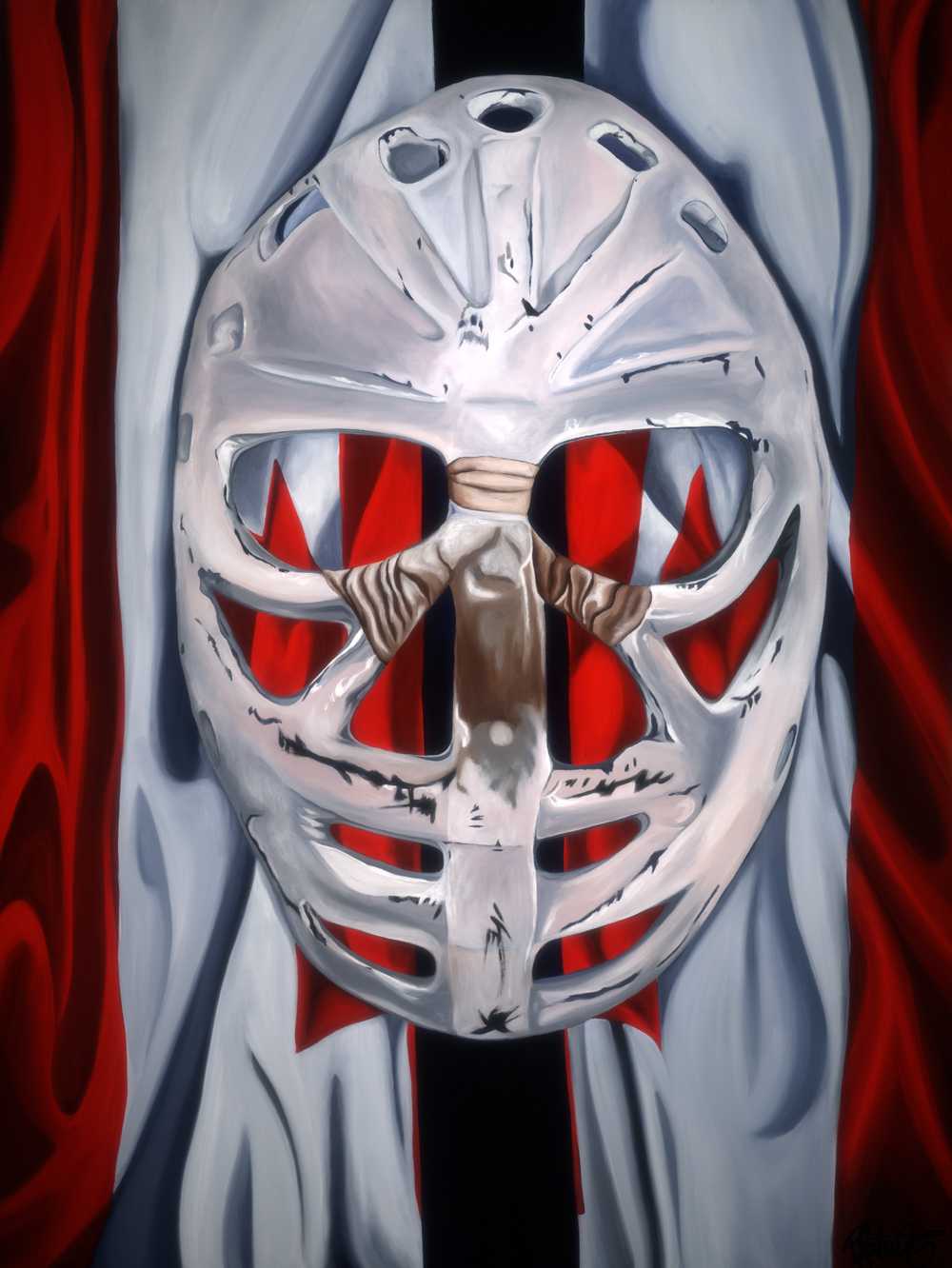
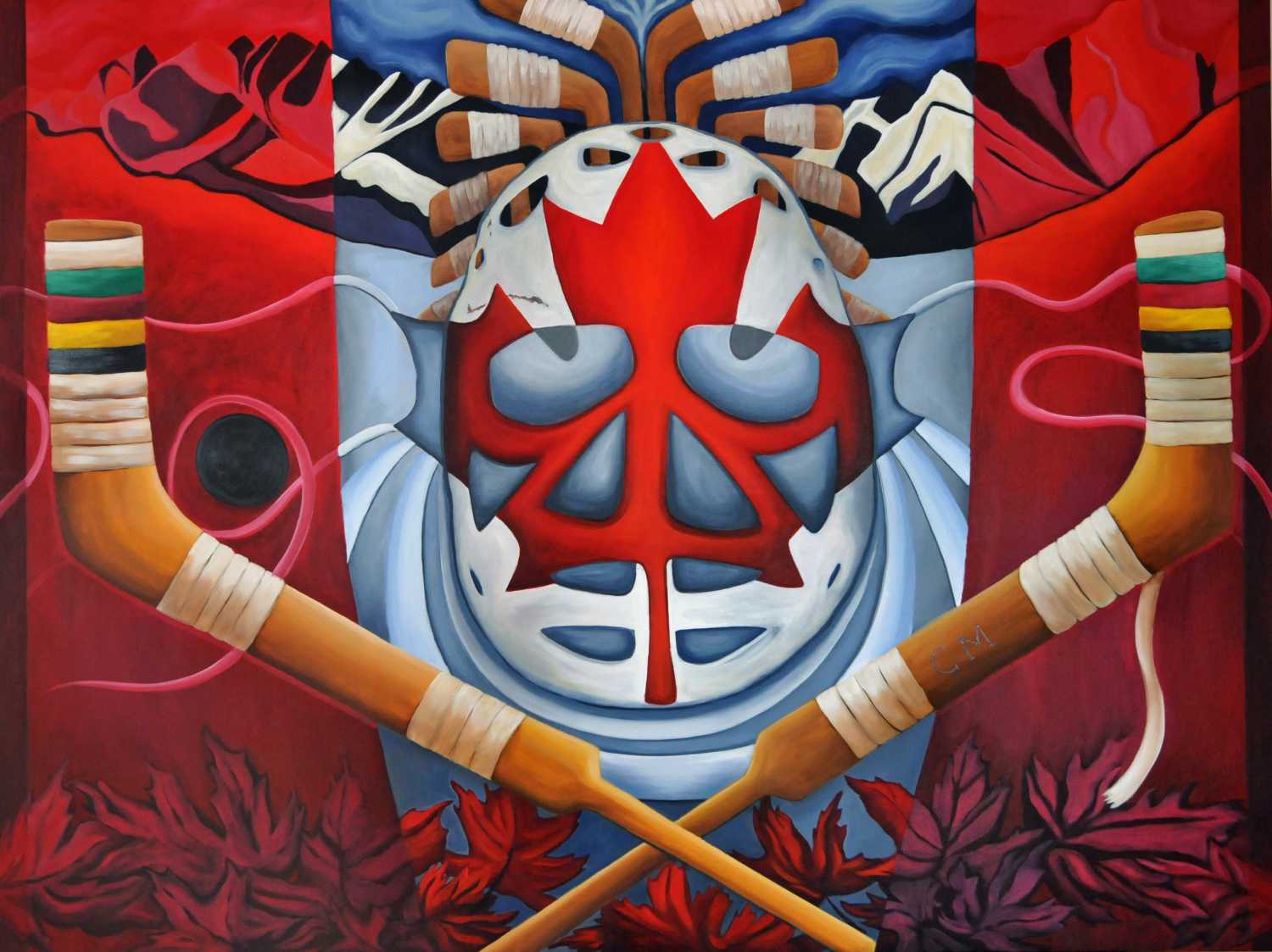
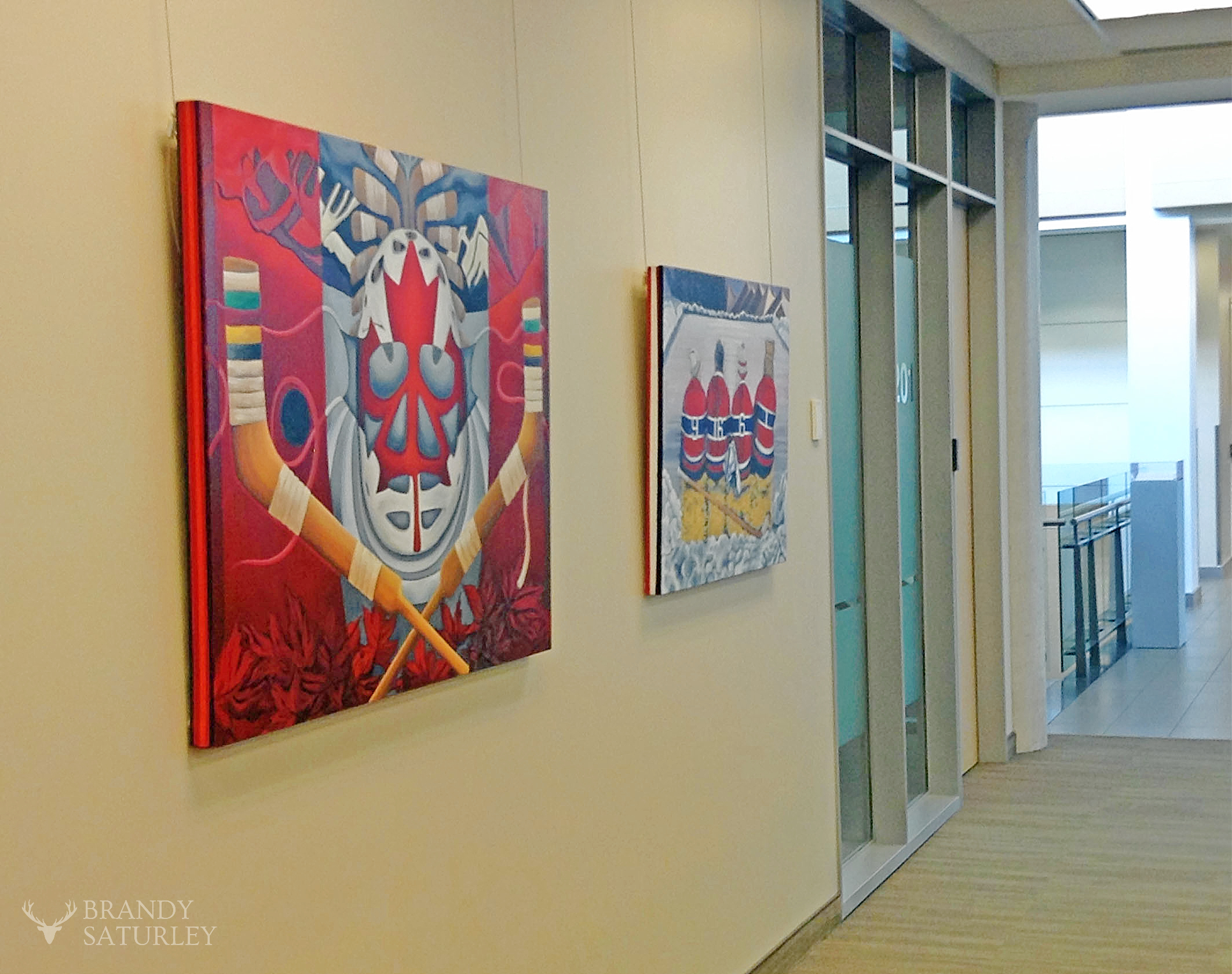
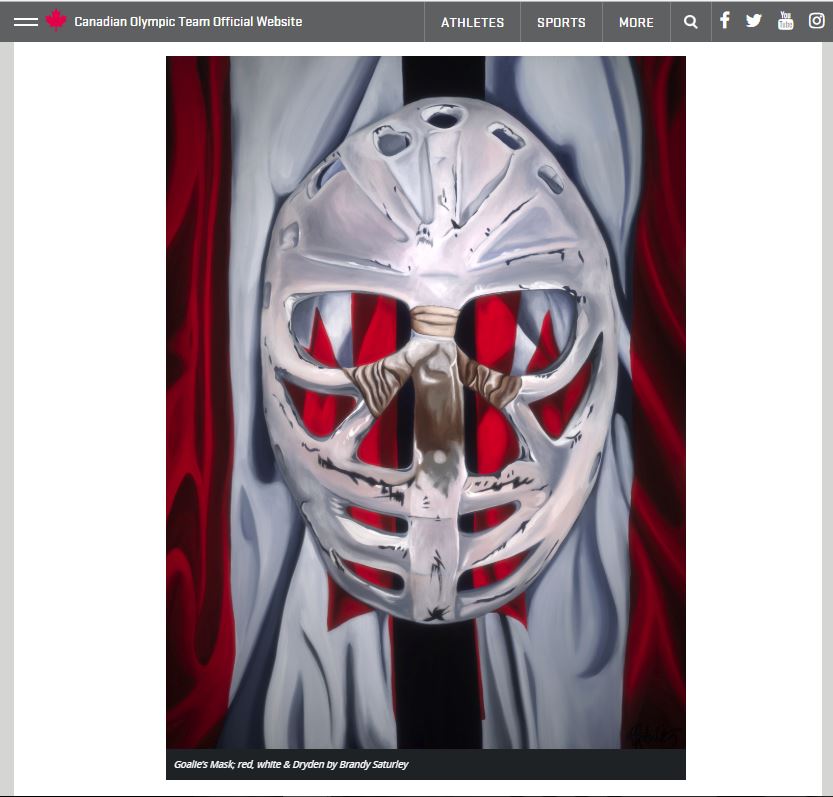
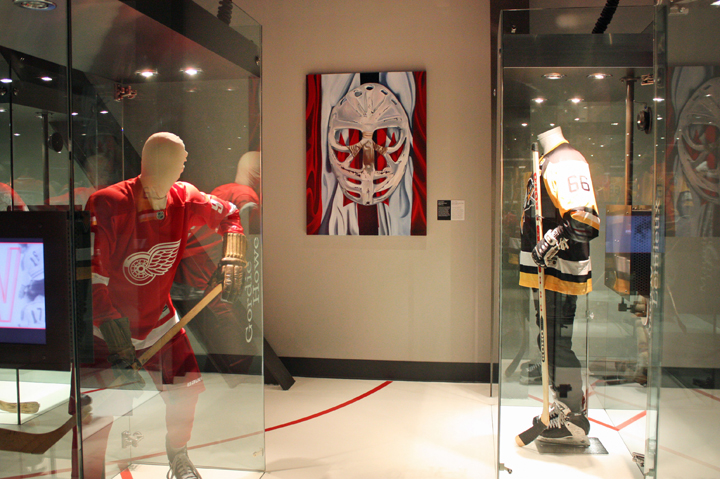
I began painting hockey masks floating above the landscape, stories of hockey on canvas, and cultural icons reimagined through paint. I placed the Stanley Cup in the serene lounge of Château Lake Louise and set a giant cup of Tim Hortons coffee and donut holes on a frozen rink surrounded by skaters. I painted a Mountie with a thumbs up like The Fonz, riding a horse with a maple leaf tattoo on its flank that read “Eh.” I painted Pamela Anderson, clad in a bikini, reclining on top of a Macintosh’s Toffee Bar at Peggy’s Cove, and a portrait of everyday Canadians posed in front of the original Forum building, hockey stick in hand, wearing the same stoic expressions as American Gothic.

What is Canada?

In 2016 I set out on a series of journeys that would take me across Canada and into the Northern Territories. Through residencies, exhibitions, and planned excursions, I began to ask a deeper question: Who are Canadians? What began as a playful exploration of symbols and stereotypes evolved into a profound investigation of identity, geography, and collective consciousness.

The question “What is Canada?” became not a single answer but a lifelong dialogue.

available paintings montreal canadiens

It became about experience and connection, about gathering impressions and stories, then filtering them through paint, memory, and emotion.

Nearly twenty years later, my visual stories of Canada now encompass people, landscapes, myth, and Mother Nature herself. My work has become a conversation between the land and the people, between history and the present moment. From coast to coast to coast, each painting tells part of the story of how this vast and complex country shapes those who live within it.

Tariffs and Canadian Art

Writers such as Margaret Atwood, Louise Penny, Mike Myers, and Will Ferguson have wrestled with similar questions in their work. In Ferguson’s Why I Hate Canadians, he writes with both affection and frustration about our national character – our politeness, our contradictions, and our quiet pride. Like these authors, I too am searching for Canada, not as a fixed image, but as an evolving reflection of its people and places.

Art with a Narrative

Through painting, I have learned that Canada is not one story but many. It is the laughter echoing from a rink in small-town Saskatchewan, the vast silence of the Arctic, the salt air of the Atlantic, and the rain-soaked forests of the Pacific. It is our symbols, our humour, and our shared moments of awe in nature’s company.

What is Canada?

To paint Canada is to keep asking the question. And in doing so, I continue to discover a country that reveals itself one brushstroke at a time. For collectors, each painting in this ongoing series offers a piece of that discovery – a visual story of Canada seen through the eyes of an artist who has spent decades exploring its symbols, spirit, and soul.

See more Canadian paintings by Brandy Saturley.

October 14, 2025
https://www.brandysaturley.com/wp-content/uploads/2024/12/Canada_1.jpg 492 1500 Brandy Saturley https://www.brandysaturley.com/wp-content/uploads/2020/10/brandysaturley_logo.png Brandy Saturley2025-10-14 10:51:132025-10-14 10:52:29What is Canada?
Page 1 of 7123›»

BLOG archive

Search Posts

Search Search
© Copyright 2024 - The Art of Brandy Saturley
  • Link to X
  • Link to Youtube
  • Link to Facebook
  • Link to Vimeo
  • Link to Instagram
Scroll to top Scroll to top Scroll to top