A Messenger From The North – A Painting About a Canada Goose

When I look back at the paintings I’ve made over the past two decades, a few things rise to the surface like landmarks on a familiar map. I return again and again to the stories of my Canadian experience as seen through the eyes of a woman travelling, observing, and painting her way across the country. I’m drawn to figurative landscapes where people anchor the land and the land shapes them in return. And woven through this long journey is one recurring companion: the Canada Goose.

The goose has appeared in many of my narratives about Canada. Sometimes it stands at the centre, a full-bodied protagonist. Other times it moves along the edges, framing the story with its quiet authority. No matter its position, it carries its own weight of meaning.

To many, the Canada Goose is more than a bird. Its steadfast flight speaks of loyalty, cooperation, communication, and endurance. Its V-formation is a testament to shared leadership. Its lifelong bonds echo the resilience of relationships built through weather and time. Across Indigenous cultures, the goose is a sacred seasonal marker, a signal of change and continuity. In folklore, it can move between worlds, a guide or a wandering soul. It is a creature stitched deeply into the cycles of nature and into our collective sense of the North.

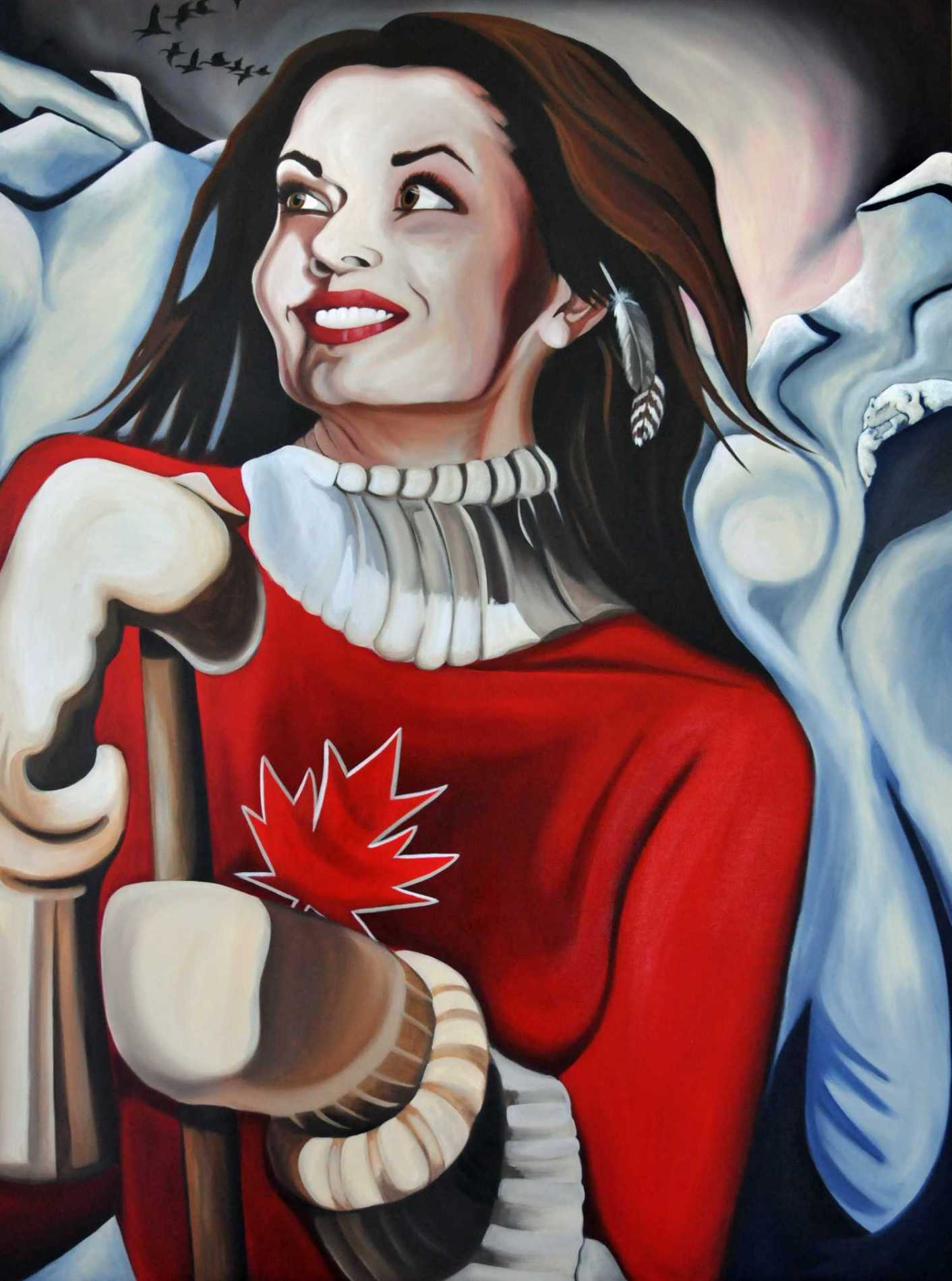
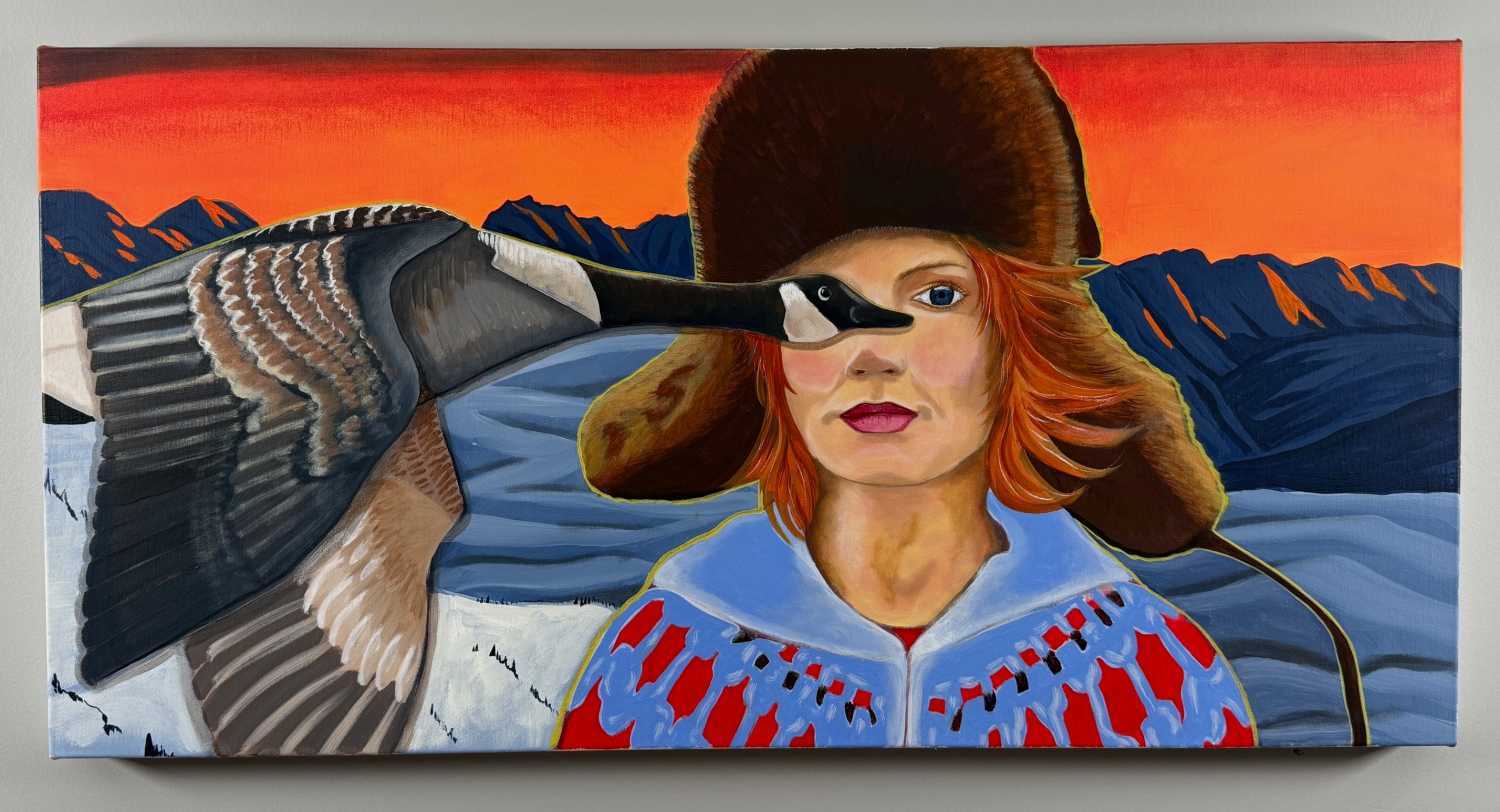
In this new painting, a woman stands in the open hush of a snow-covered landscape, her gaze steady beneath the warm shelter of a fur hat. Behind her, the sky burns in a late-day flare of orange, as if the sun has cracked the horizon and spilled its final breath of light across a ridge of deep blue mountains.

Canada Goose Painting

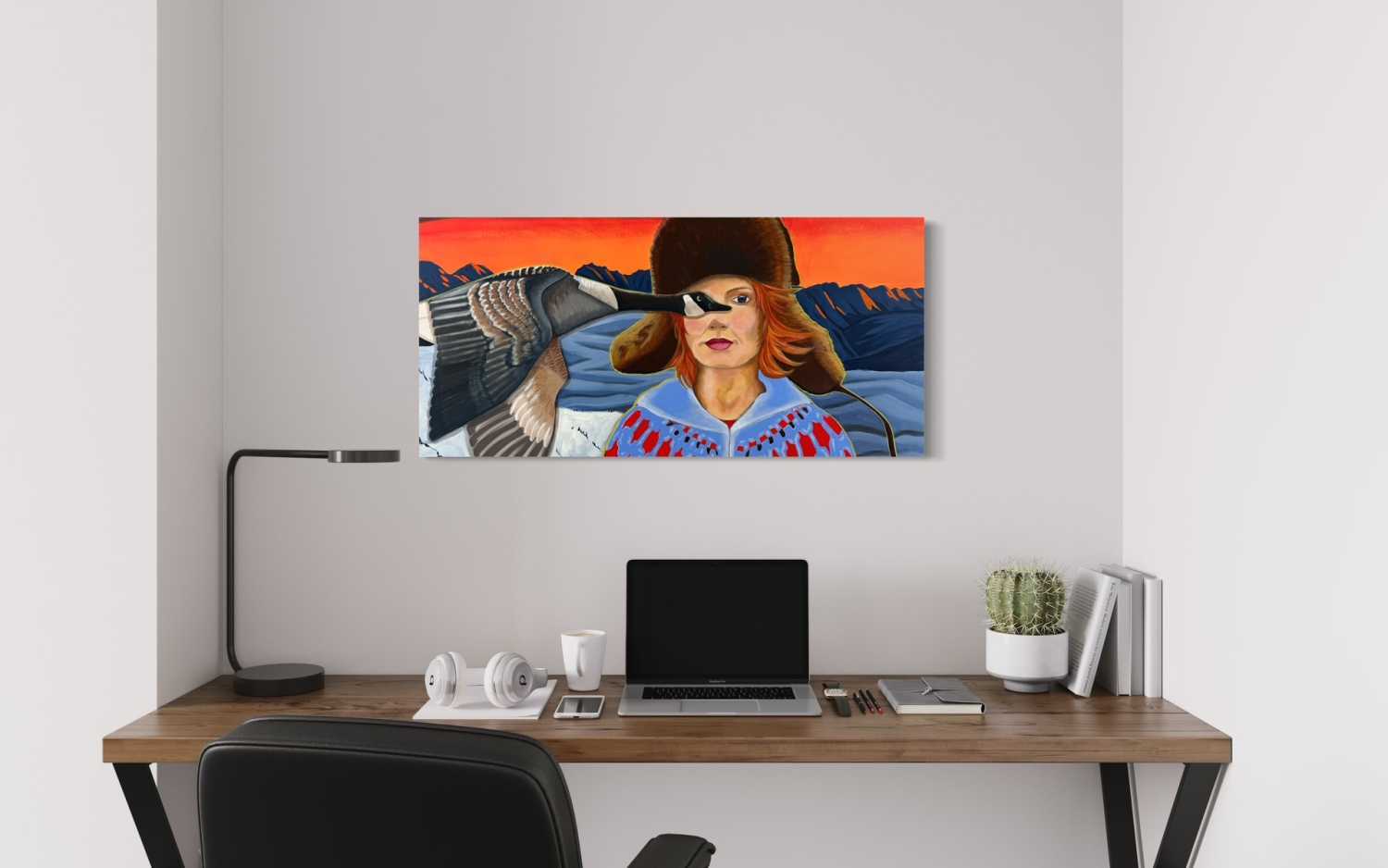
Northern Messenger – 18×36 inches, acrylic on canvas, 2025 – Brandy Saturley

A Canada Goose cuts across her face in full flight, its wing sweeping through the scene like a living brushstroke. It becomes an envoy, sliding the wild world directly into her line of sight, binding her to the land and to the long migratory stories carried on beating wings. Her embroidered coat glows with reds and blues, a pulse of northern life against the winter quiet.

Canada Goose Painting

The painting settles into something part portrait and part vision: a moment where human presence and the instinctive rhythm of nature align in brief, luminous agreement. The goose becomes the messenger, the woman the witness, and the landscape a silent accomplice to their shared moment of connection.

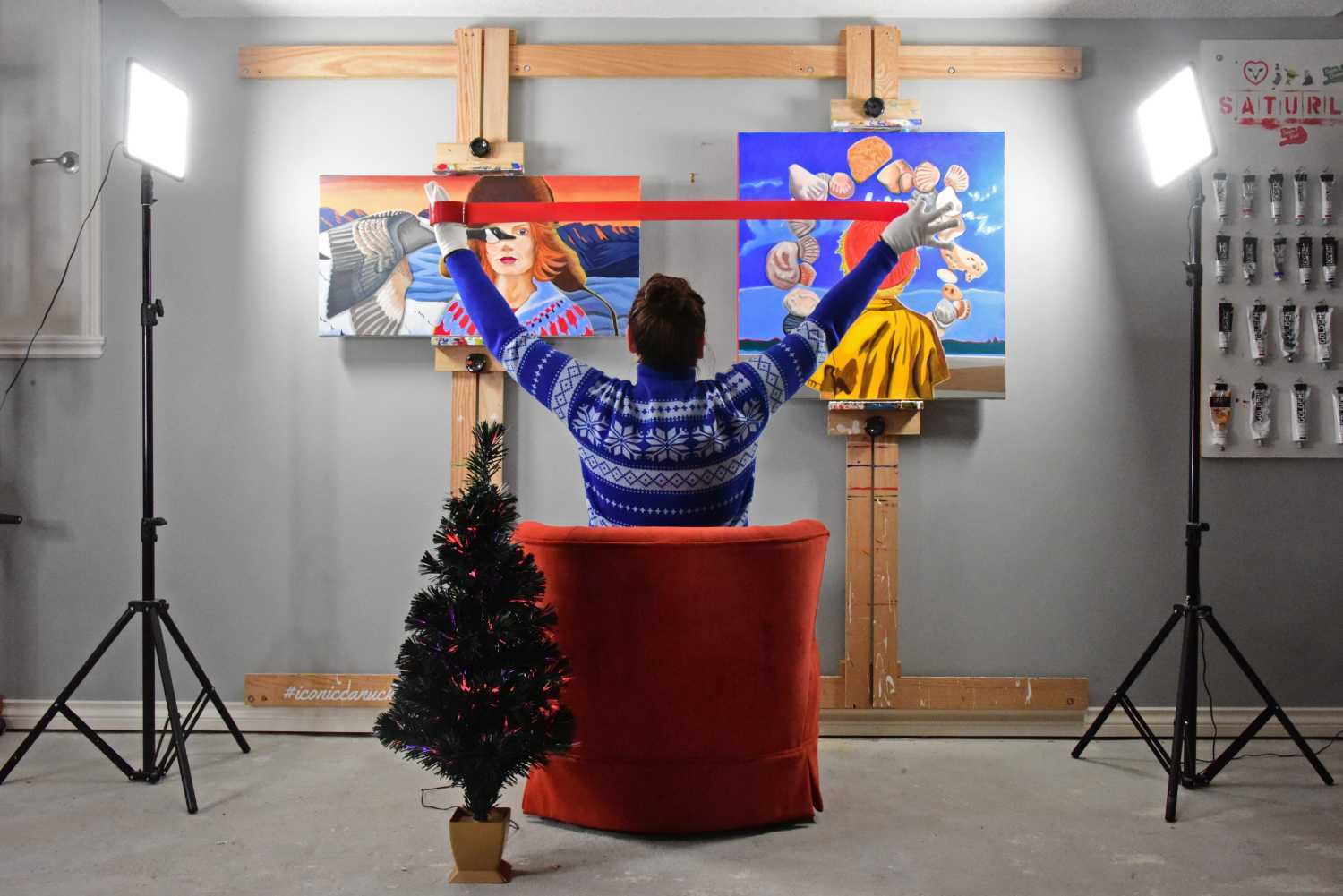
Inside Brandy Saturley Studio – Parksville, Canada

The Business of Editing Art – When It Ends Up on the Cutting Room Floor

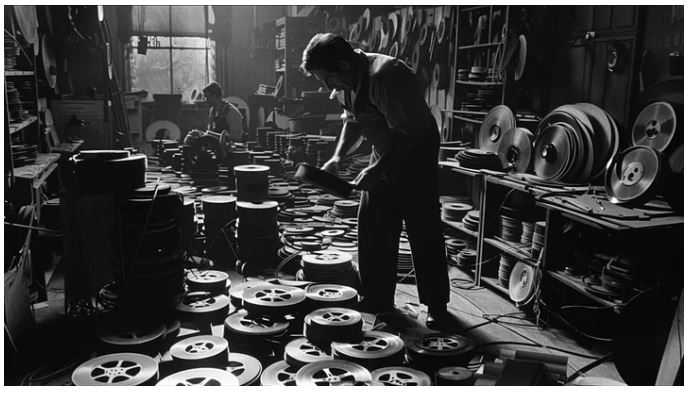
You’ve likely heard the phrase “the cutting room floor.” It comes from the early days of filmmaking, when footage was physically shot on film and editors would literally cut unwanted frames from the reel. Those discarded snippets, sometimes entire scenes, would fall to the floor beneath the editing table, later swept into a bin at the end of the day. While rooted in film history, the phrase has grown to describe anything removed from a final product, and the thoughtful, sometimes difficult, process of deciding what stays and what goes.

In painting, editing takes on its own form. After creating a series of works, or even within the development of a single commissioned piece, there comes a moment of selection. It’s the quiet but essential task of choosing the strongest pieces, the ones that create a cohesive story, a sense of flow, or a clear direction for an exhibition. With commissions, it becomes the process of exploring and refining ideas, then presenting the options that best align with a client’s vision.

The Cutting Room Floor

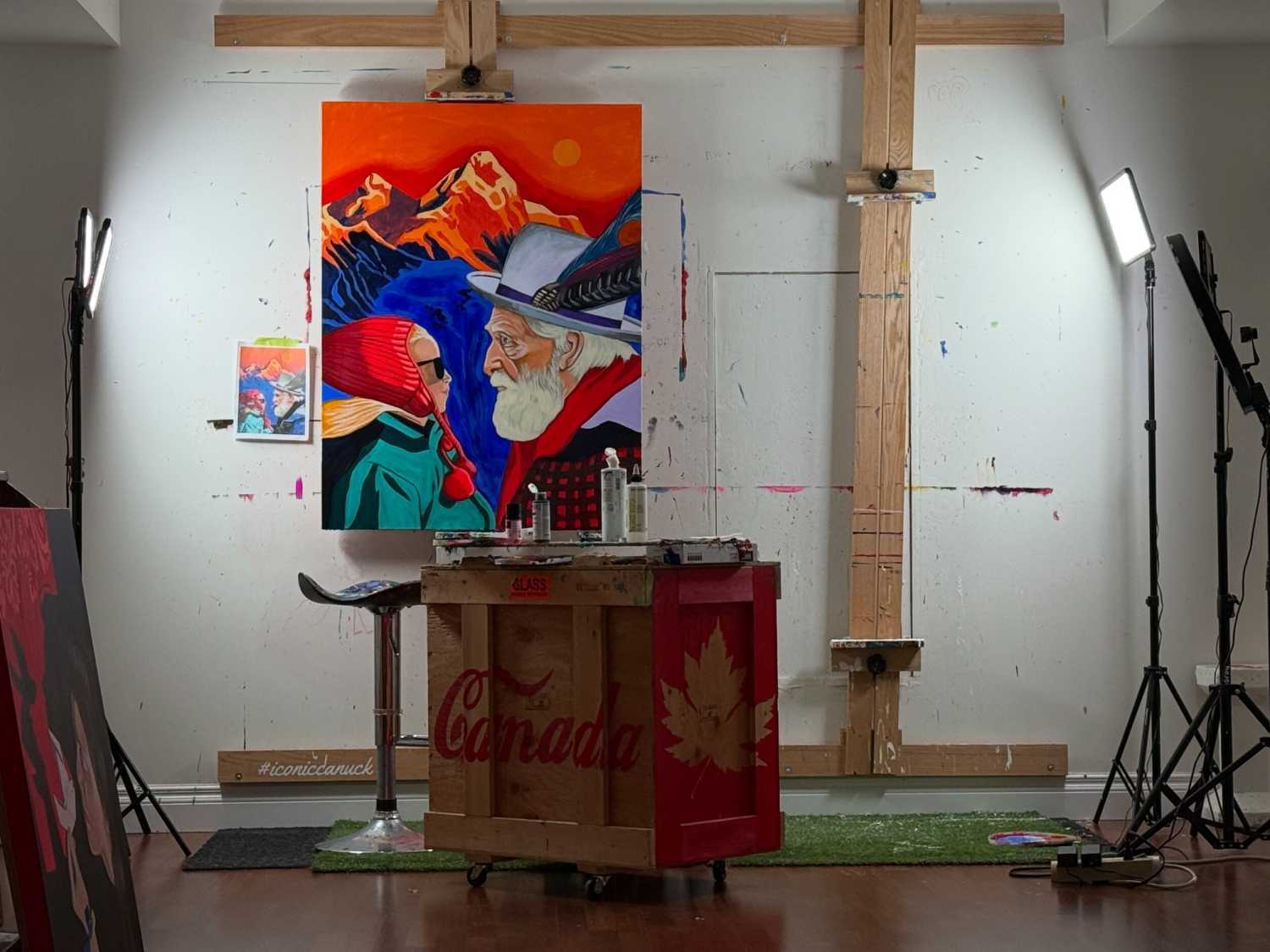
Inside Brandy Saturley studio

Recently, I was commissioned by The Tragically Hip to create a winter-themed image for their Strictly Limited poster series. The brief was to produce an original painting that would later be photographed and reproduced as prints. With a few concepts swirling in my mind, I decided to paint two different versions and let the band choose the one they felt resonated most with the project.

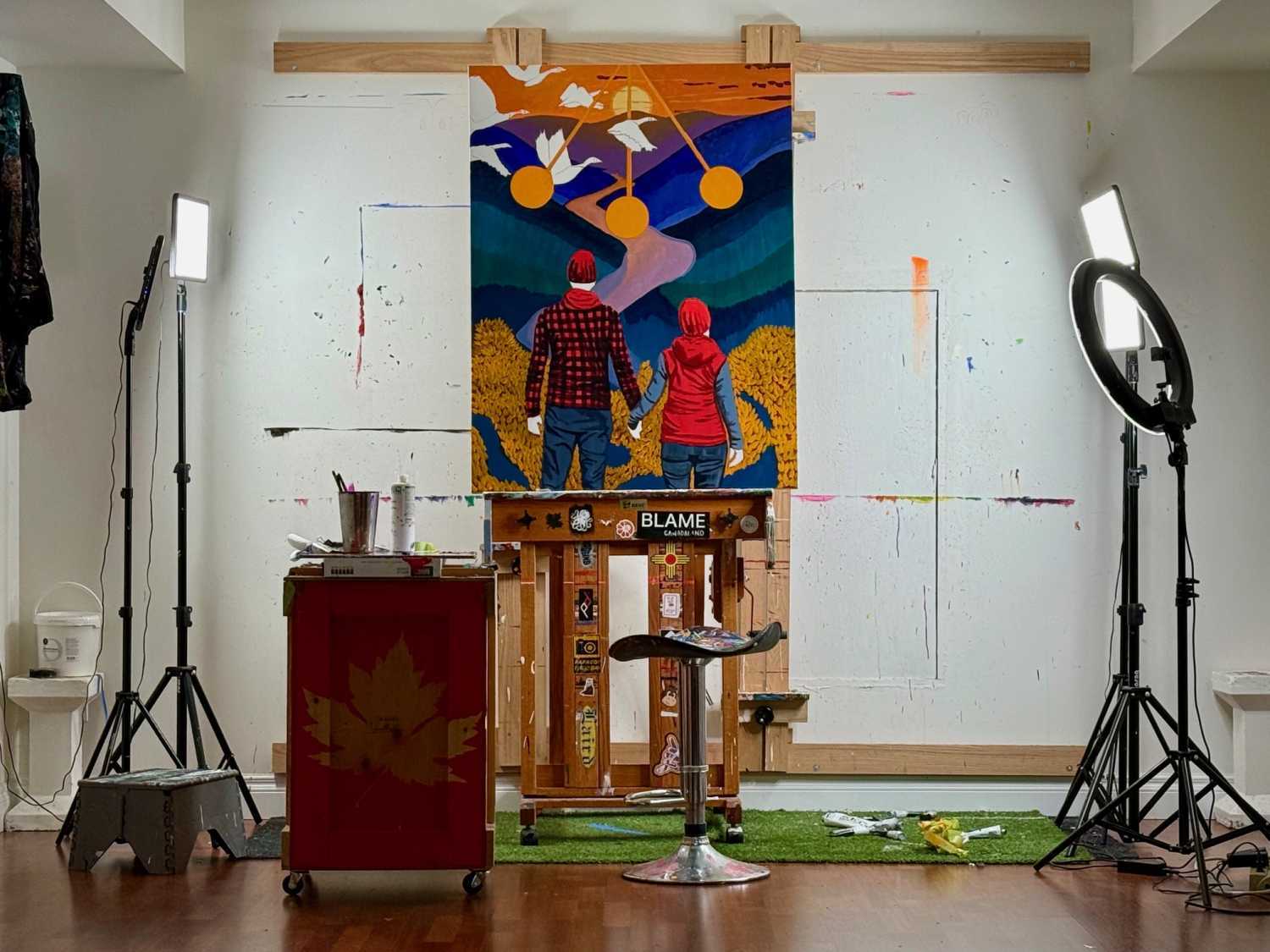
Inside Brandy Saturley studio

Now that the prints are complete and the commission wrapped, I’m left with the painting that wasn’t selected. And as often happens in the creative process, what doesn’t make the final cut still has its own story, and sometimes its own moment to shine. With its warm, festive mood, I chose to give this painting a new purpose as the image for my holiday cards this year.
So while painters don’t have a literal cutting room floor, we do have pieces that don’t end up where originally intended. The beauty is that these works – often strong, meaningful pieces in their own right – can still find their place in the world. And in this case, while the image is spreading holiday cheer through cards, the original painting itself is available for purchase.

The Cutting Room Floor

You’re Too Sweet For Me, 48×36 inches, acrylic on canvas, 2025 – Brandy Saturley

A Totem to The Stars – An Inukshuk Painting

It is no secret by now that I have been painting stories of west coast beaches this Autumn. The treasures that line the sand and the structures built from beach things by human hands. I have been making paintings about shells, beach huts, Inukshuk and being in these landscapes.

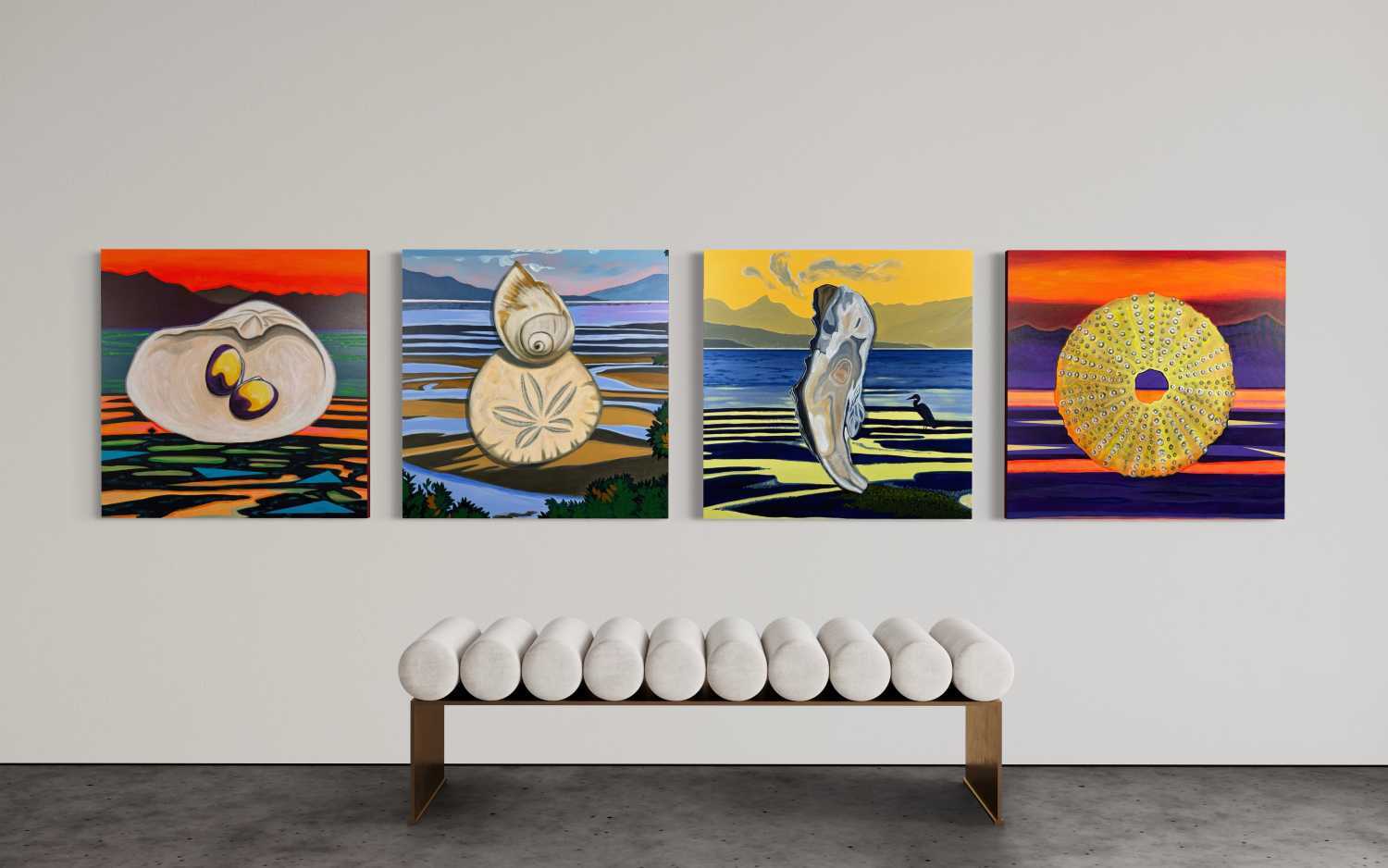
Shell Still Life Paintings – Brandy Saturley – 2025

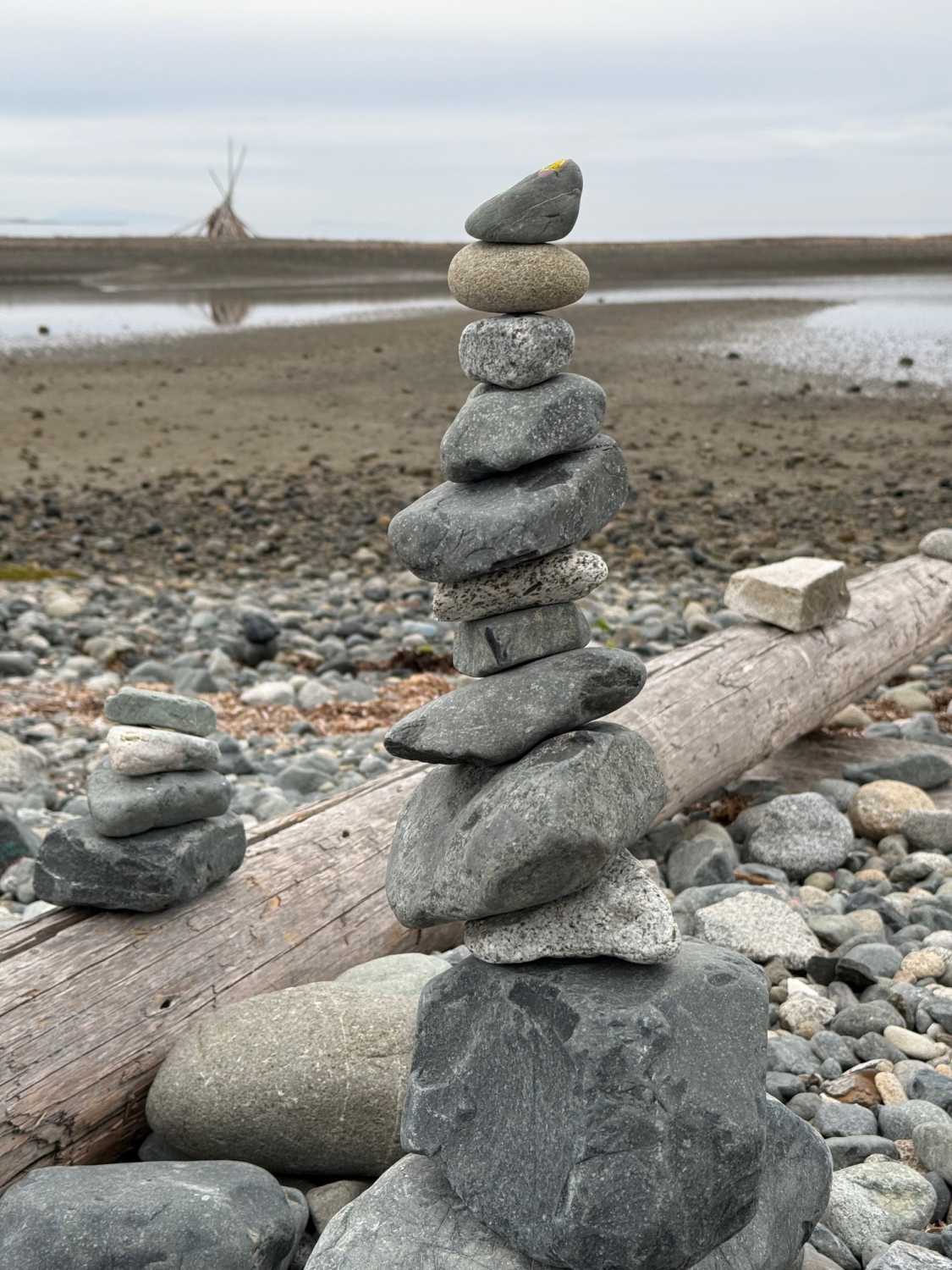
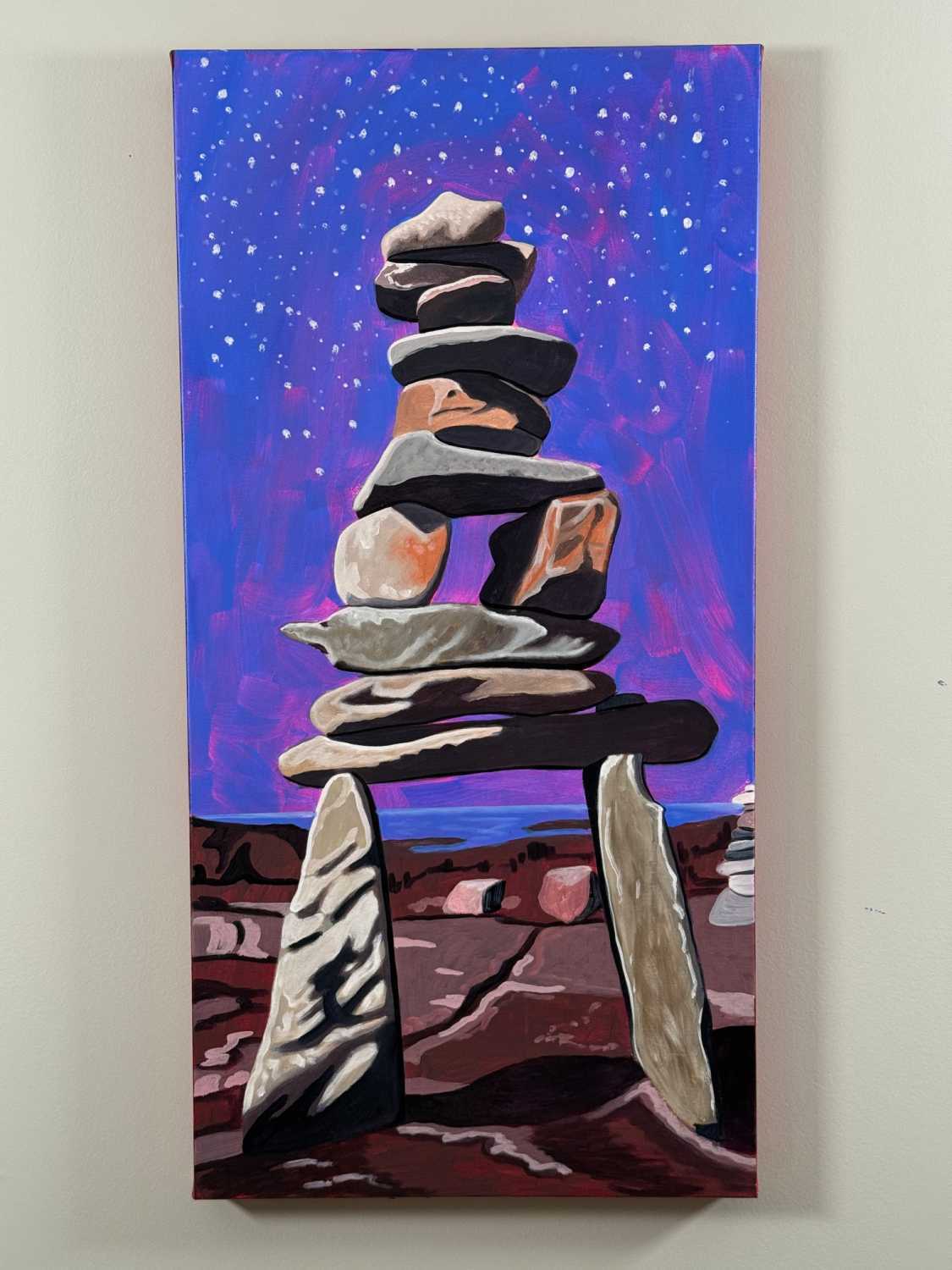
With this most recent painting I wanted to capture the aura of the rock stacks seen on the beaches. Here on Vancouver Island you will see these totems of balanced rocks at the corners of the beaches. Sometimes balanced on rock and other times balanced on logs. Know as Inukshuk, these towers come with rocks of various sizes and shapes and are skillfully built into delicately balanced towers to the sky.  Inukshuk is a figure made of piled stones or boulders constructed to communicate with humans throughout the Arctic. Traditionally constructed by the Inuit, inuksuit are integral to Inuit culture and are often intertwined with representations of Canada and the North.

Inukshuk in Parksville, BC – 2025

This vibrant acrylic painting features an inuksuk rendered in bold, sculptural layers of stone, each shape carefully balanced to form a vertical figure rising from a rugged landscape. The stones are painted in warm earth tones – soft creams, deep charcoals, russet reds, and weathered greys – giving the structure a grounded, tactile presence. Behind it, the sky glows with a rich blend of ultramarine, violet, and magenta, creating a luminous twilight atmosphere. Flecks of white stars scatter across the sky, lending a sense of vastness and quiet northern magic.

Inukshuk Painting

Totem Song, 36×18, acrylic on canvas, 2025 – Brandy Saturley

The foreground suggests rocky terrain, its textures and contours echoing the layered forms of the inuksuk itself. The contrast between the solid, ancient stones and the dreamlike celestial backdrop creates a powerful tension between earth and sky, permanence and wonder. The painting captures the symbolism of the inuksuk as both a guide and a marker of presence – a beacon of human connection within the expansive Canadian landscape.

Inukshuk Painting

Inukshuk painting on an entry wall.

A Circle of Floating Shells and Childlike Wonder – West Coast Stories

Since relocating to the west coast in September 2025, I’ve been immersed in a new series of west coast paintings, stories inspired by shoreline wandering, quiet discovery, and the simple adventure of exploring beaches. In these works, large shells float over coastal landscapes and stacks of stones take on a monumental presence, everyday objects becoming the central characters in their own visual stories.

Beach shells from Vancouver Island

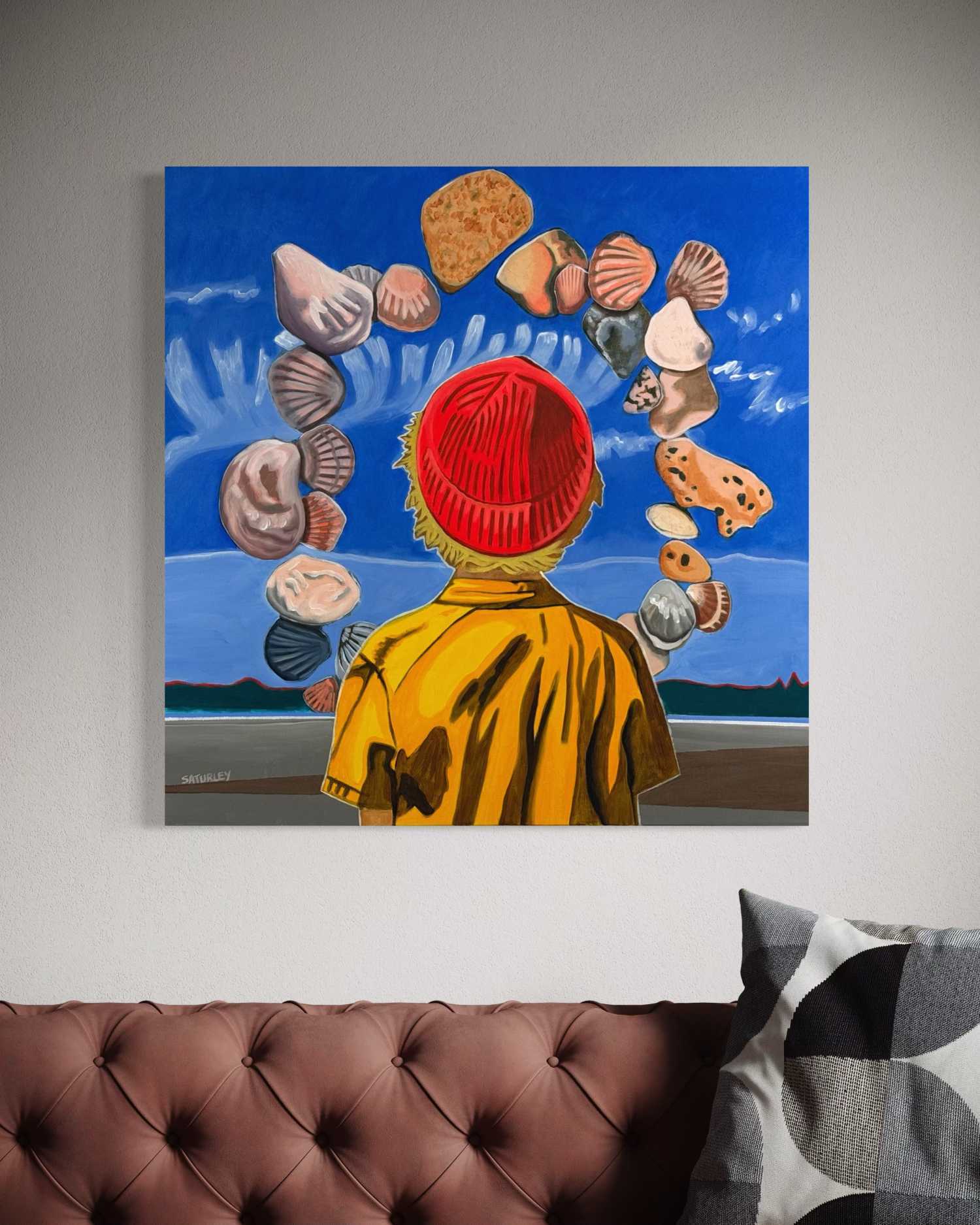
In this newest painting, a child stands with their back to the viewer, gazing up at an arc of floating shells and stones that seem to defy gravity. Dressed in a bright red knit toque and a golden yellow jacket, the figure offers a warm, grounding focal point against the cool blues of the sky and distant water. Above them, shells rendered in soft pinks, sandy neutrals, and deep earthy tones rise and swirl like a circular constellation of gathered treasures, echoing the wonder of childhood beachcombing. Wisps of white cloud stretch across the horizon, enhancing the dreamlike quality that threads through the scene.

West Coast Stories

West Coast beach and shell paintings by Brandy Saturley – November 2025

The composition feels musical, a moment suspended in time. There is an exuberance here, a spark of childlike imagination that lifts the piece beyond realism. It’s almost as if the circle of shells hovering above the child has been lifted directly from their thoughts, made visible for us to witness.

West Coast Stories

Game of Shells, Acrylic On Canvas, 30 x 30 x 1.5 in, 2025 – Brandy Saturley

With this eighth painting in the series, the west coast becomes newly rooted within an oeuvre that spans Canada coast to coast to coast. These works continue my ongoing exploration of place, memory, and the magic hidden in the everyday stories gathered like shells along the shoreline.

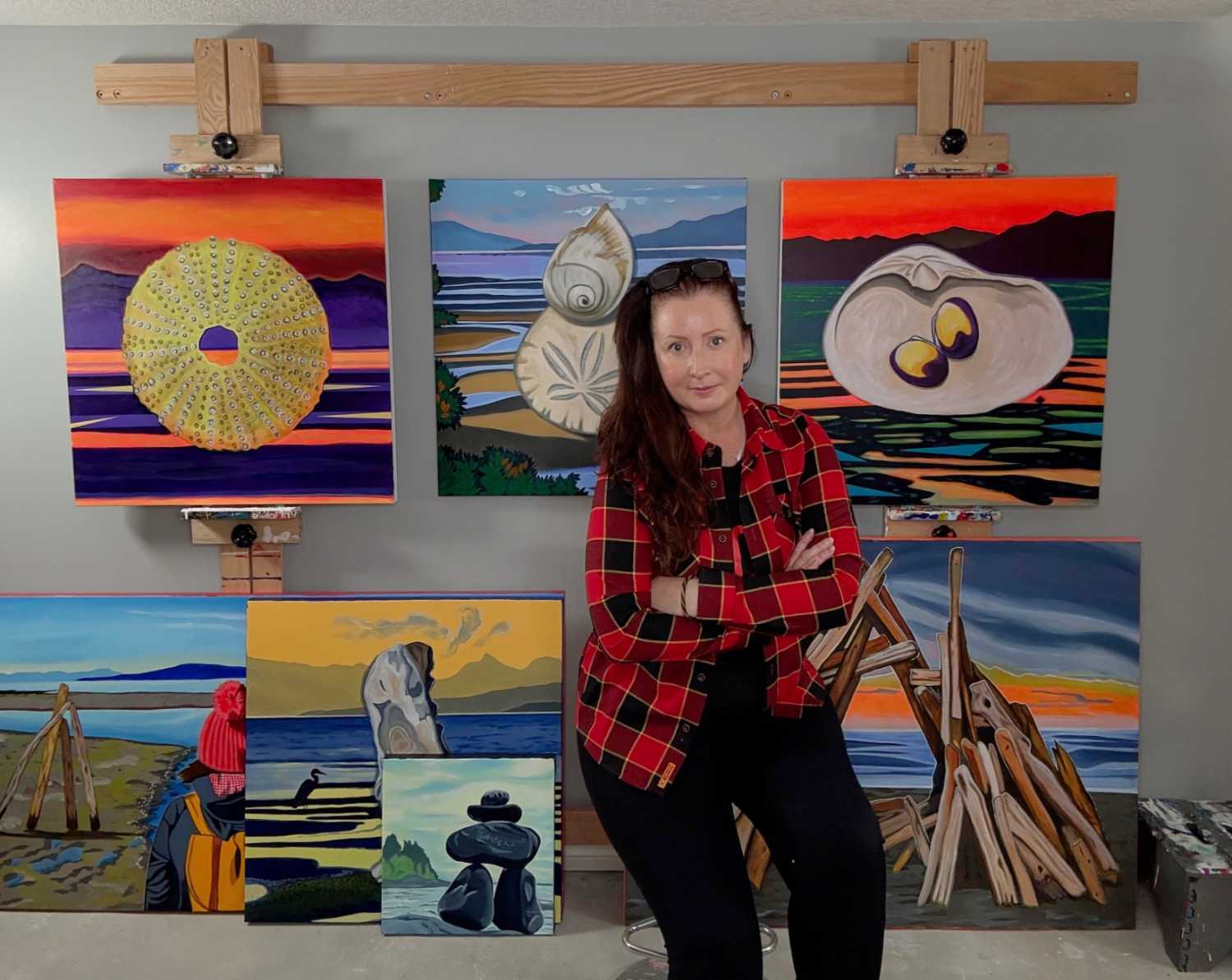
Brandy Saturley with her West Coast beach paintings series, November 2025

Paintings Inspired by a West Coast Beach

In early September, I moved my studio from Victoria to Parksville on Vancouver Island. With this shift came new scenery, a quieter pace, and a deepened closeness to the sea. Since settling in, I’ve created half a dozen paintings inspired directly by the nearby beaches – work shaped by daily walks, shifting tides, and the familiar rhythm of the West Coast.

Beach Paintings

Beach House, 2025 Acrylic On Canvas 36 x 48 x 1.5 in – Brandy Saturley

Nearly every day, my routine includes a long walk by the ocean. When the tide recedes, the sandy beach stretches into what feels like miles of new coastline, revealing areas rarely visible at high tide. Exploring these changing landscapes has become part of my practice. I grew up beachcombing with my mom on the west coast shores of Sooke, Jordan River, and Port Renfrew. We spent countless hours wandering slowly, eyes glued to the sand and the rocky seams where the waves meet land – searching for beauty, texture, and surprise.

Beach Paintings

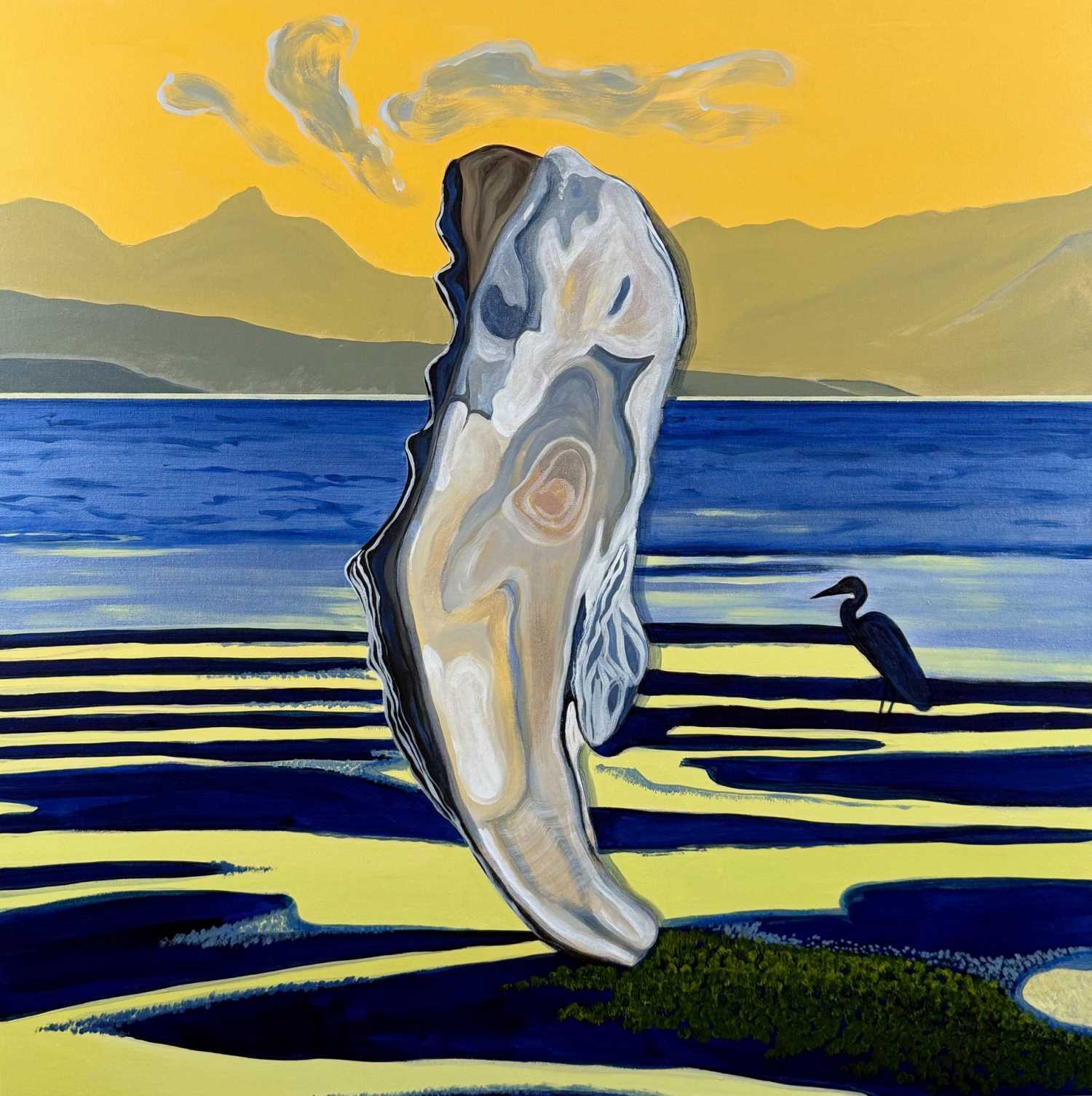
The World is Your Oyster, 2025 Acrylic On Canvas 30 x 30 x 1.5 in – Brandy Saturley

West Coast beaches offer an abundance of natural treasures: sun-bleached logs of fir and cedar, rugged rocks, and gritty sand that shifts from Payne’s grey to raw sienna as it dries. Kelp and seaweed wash in with the surf, and seabirds animate the shoreline – great blue herons stalking in the shallows, gulls hovering overhead, Canada geese honking by, and sandpipers skittering across the water’s edge. The beach is never still; it’s alive with movement and detail, always asking your eyes to follow.

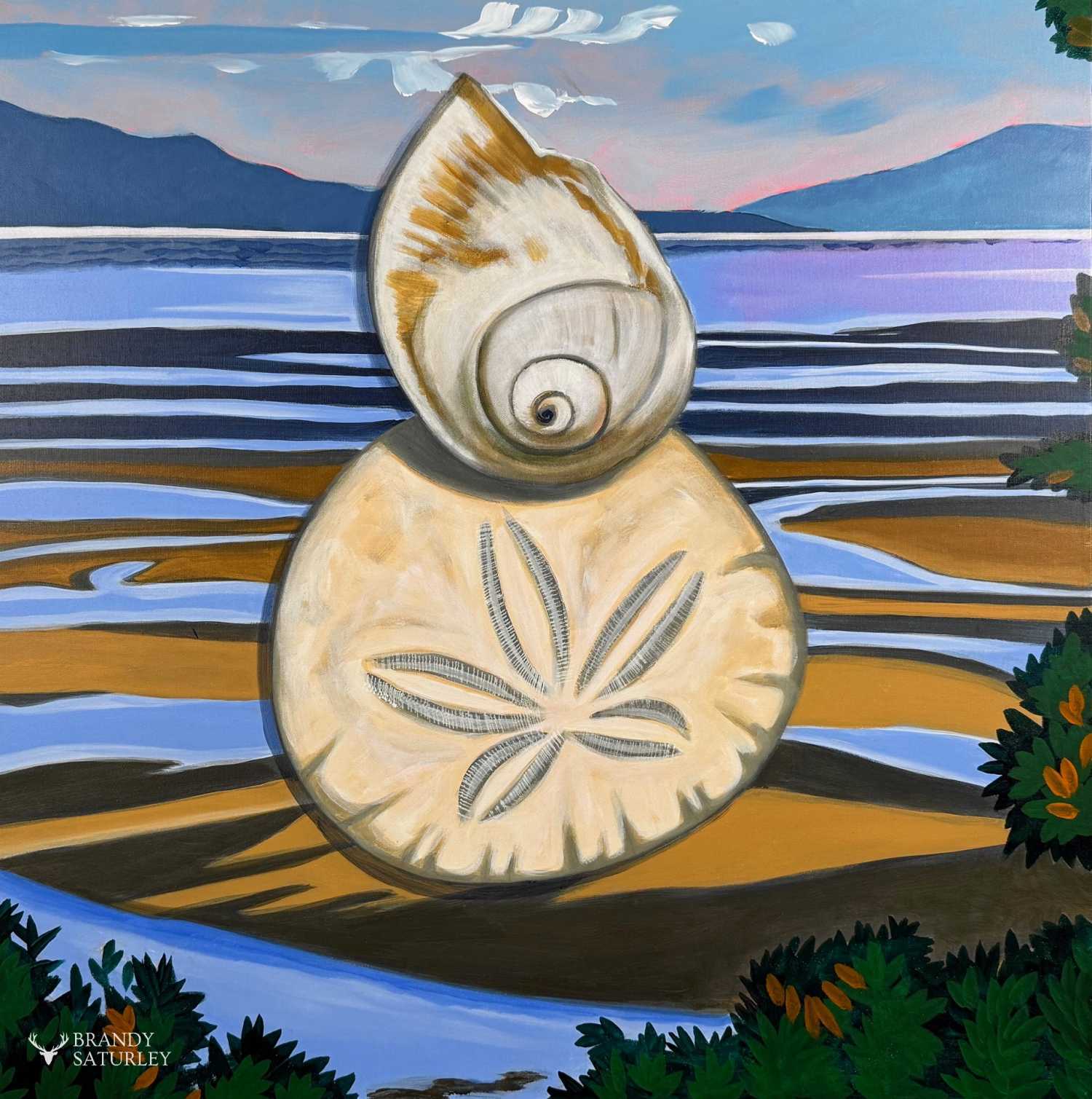
Piece of Mind, 2025 Acrylic On Canvas 30 x 30 x 1.5 in – Brandy Saturley

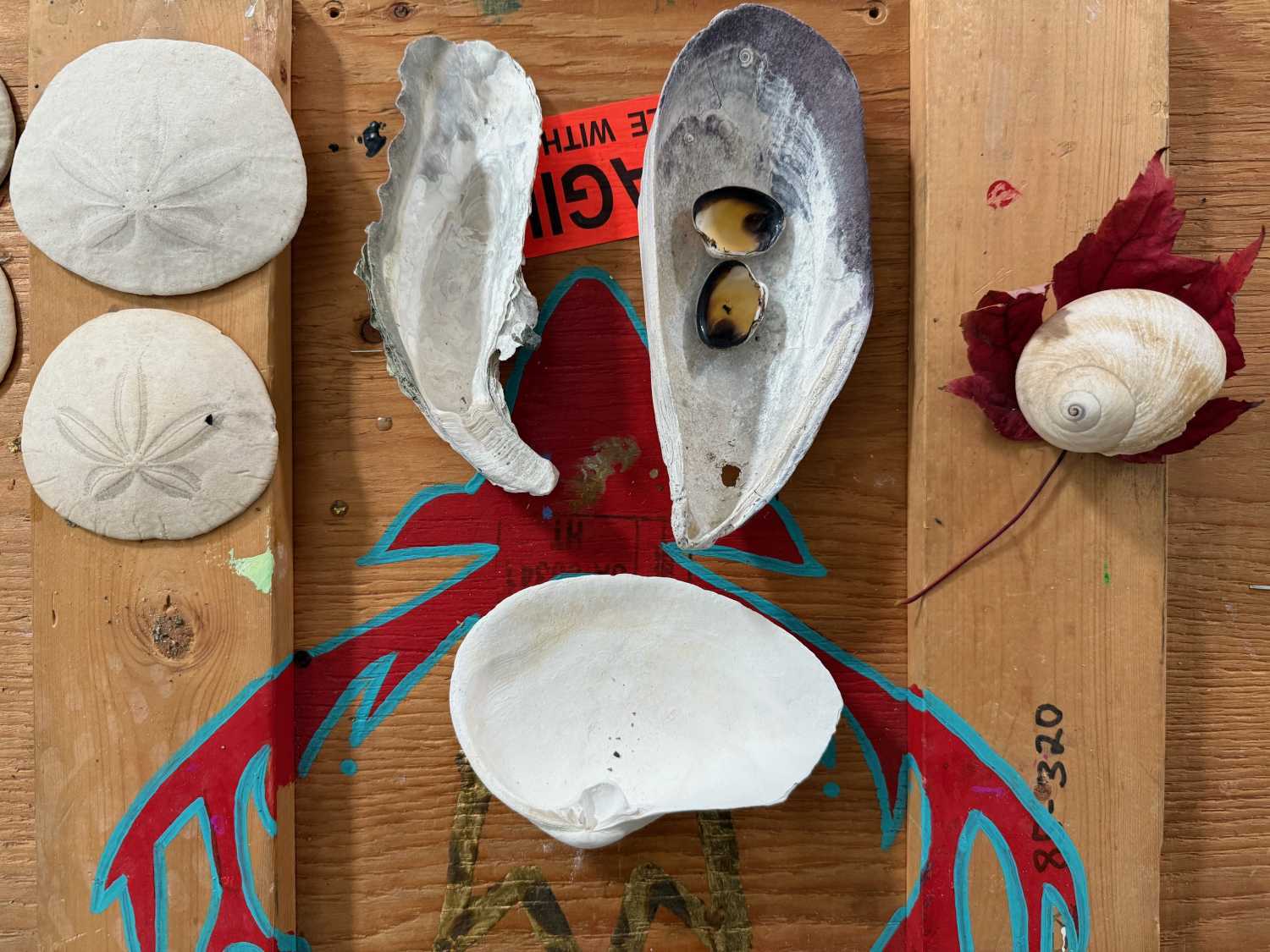
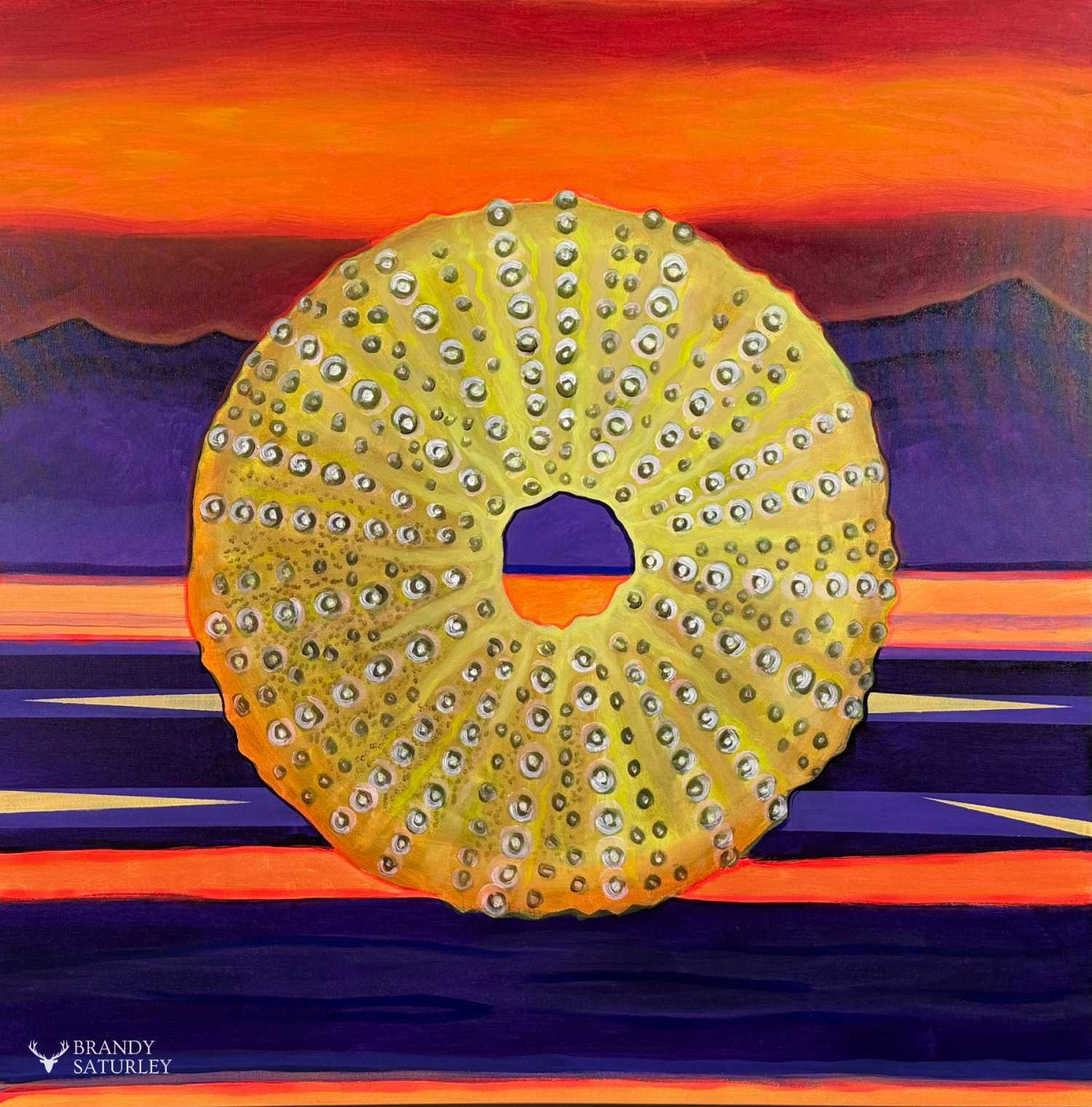
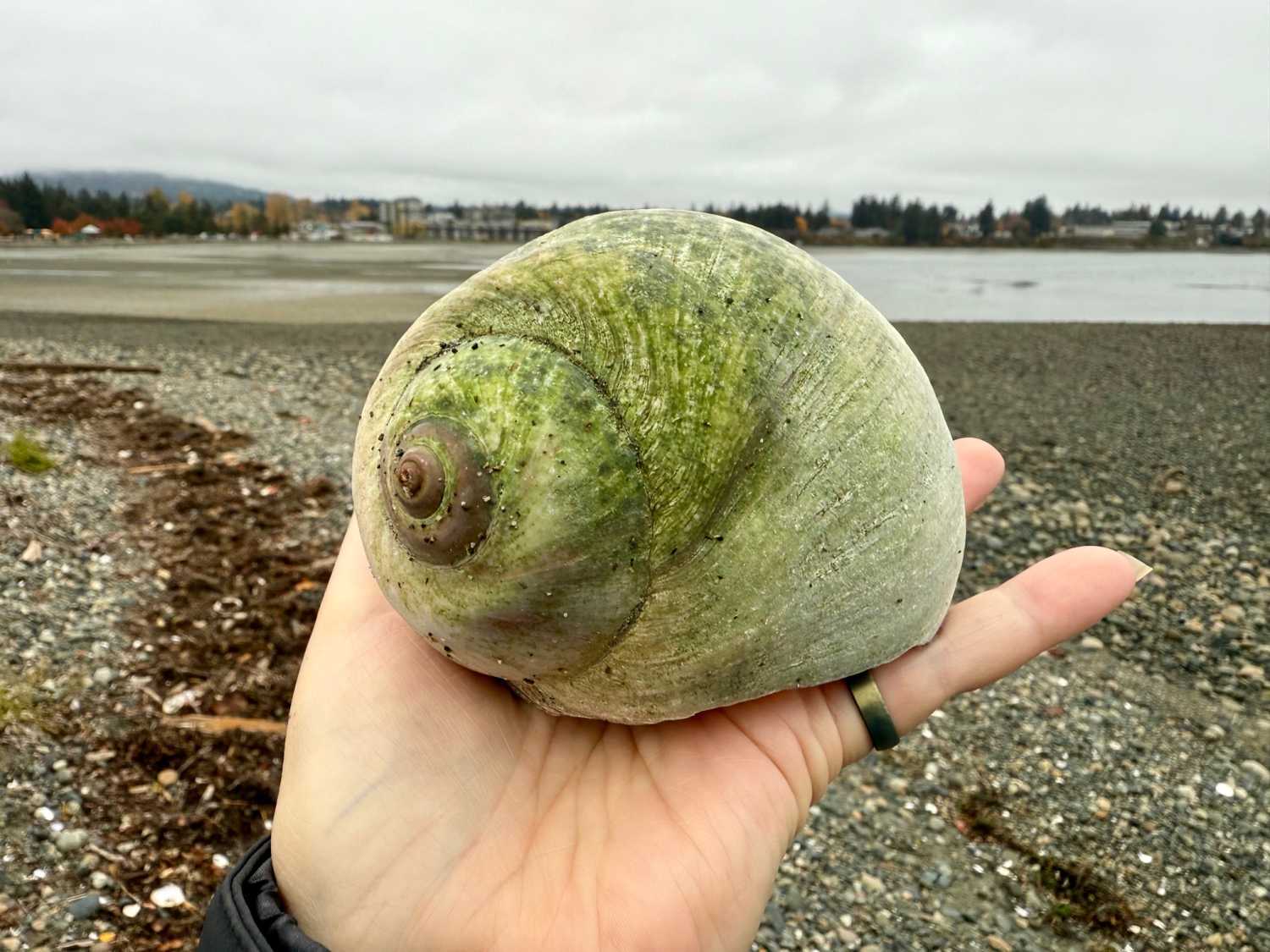
The shells alone could fill an entire painter’s palette. Clams, mussels, urchins, and sand dollars scatter the beach in sculptural arrangements. If you’re patient, you may even find a moon snail shell with its perfect spiral centre. Ancient-looking oysters, limpet “hats,” sea snails, weathered sea glass in ocean greens and blues, and the occasional dried starfish all contribute to this shoreline treasure trove. It’s a natural gift shop, continuously restocked by the tides.

Beach Paintings

Pilgrimage, 2025 Acrylic On Canvas 30 x 30 x 1.5 in – Brandy Saturley

With all this richness, it’s no wonder my recent paintings have become stories of the beach – reflections of this place, its rhythms, and the familiar West Coast magic that has shaped me since childhood. Parksville has already found its way into my work, and I imagine the shoreline will continue to shape my canvas for a long time to come.

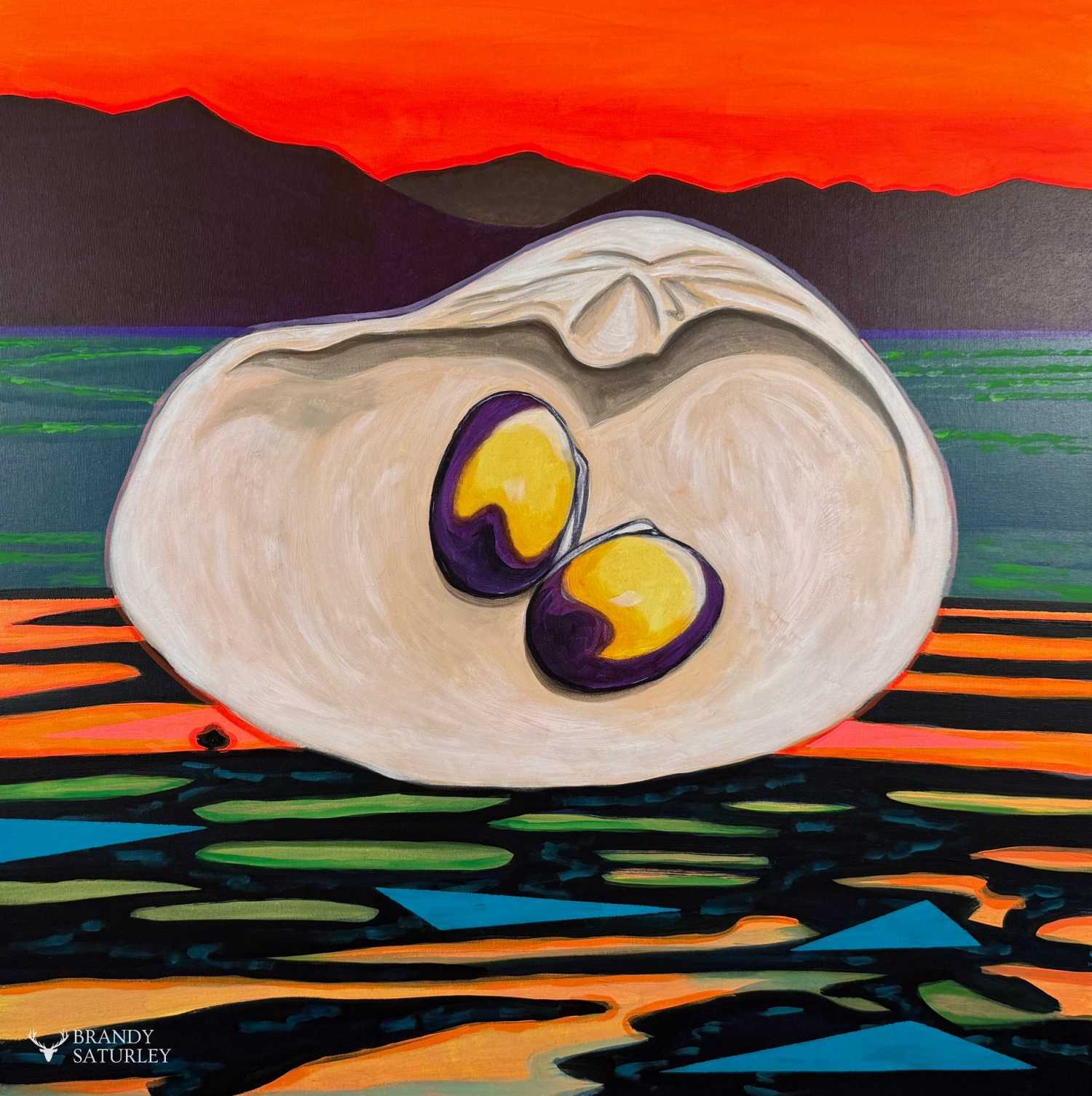
Resilience, 2025 Acrylic On Canvas 30 x 30 x 1.5 in – Brandy Saturley

Explore the other areas of Canada through the paintings of Brandy Saturley here.

Visited a West Coast Beach? You’ve Seen a Beach House

When I was young, I spent countless hours roaming the beaches of Canada’s West Coast on Vancouver Island, searching for treasures. We would beachcomb in wind, rain, and even sweltering summer heat, nothing could stop us from the thrill of discovery. Shells, driftwood, smooth stones, and strands of kelp filled our buckets and pockets. We built makeshift structures in the sand and decorated our little dwellings with every shiny or unusual object we found.

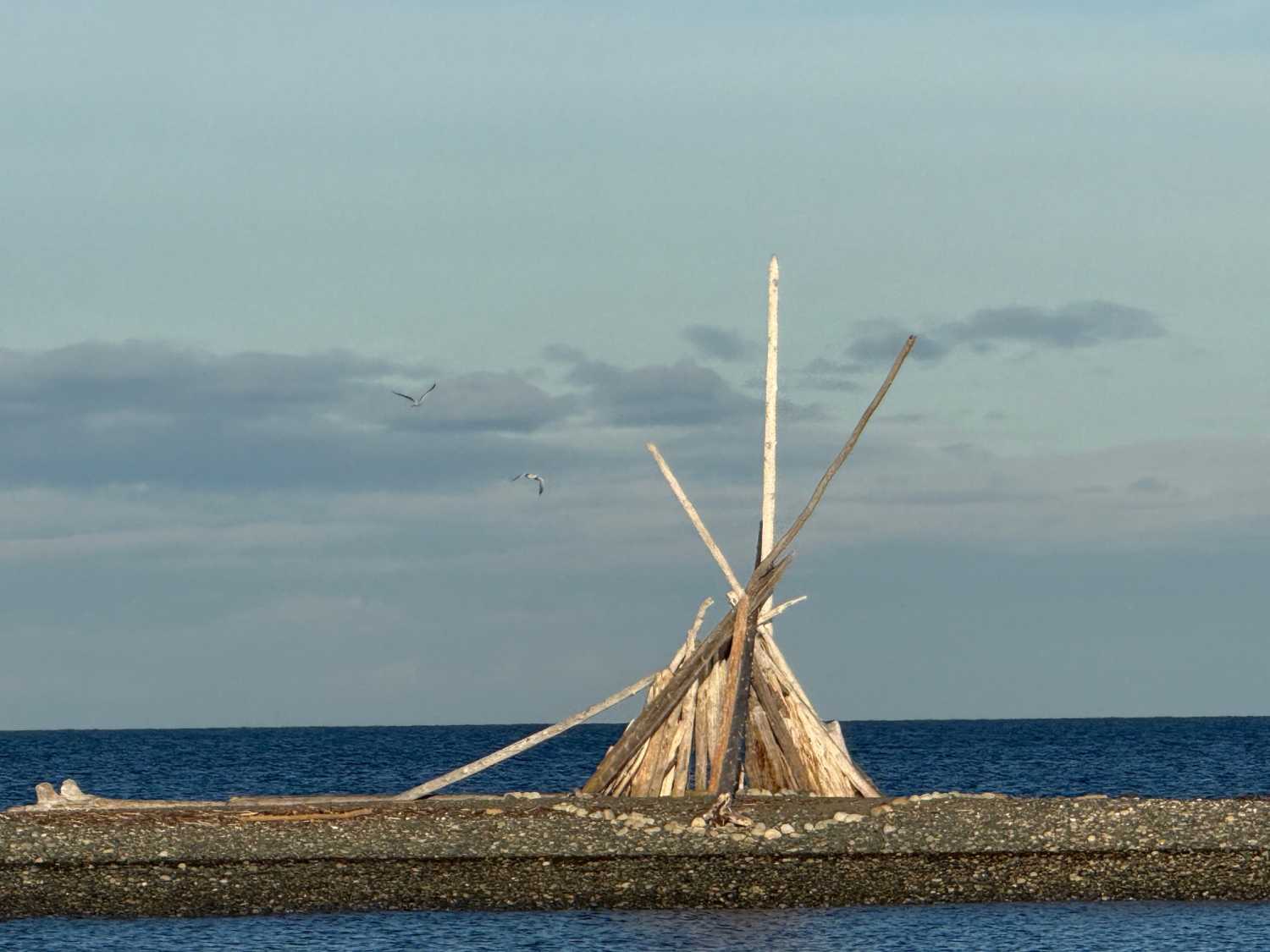
A log structure on the beach in Parksville, BC Canada

If you’ve ever visited the West Coast – whether the beaches of Vancouver Island or the rugged shorelines of Washington, Oregon, or California – you’ve likely encountered the iconic “beach house.”

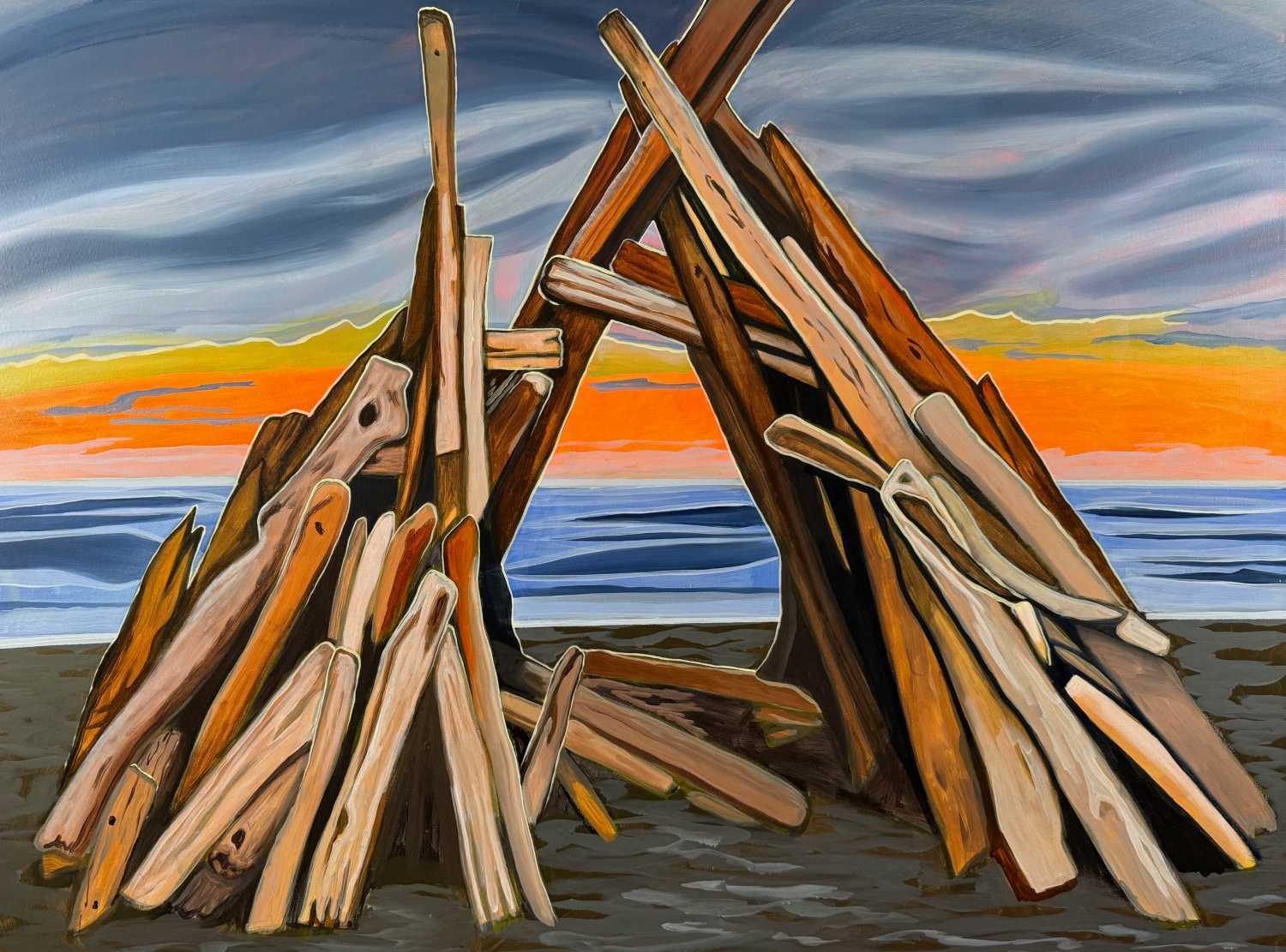
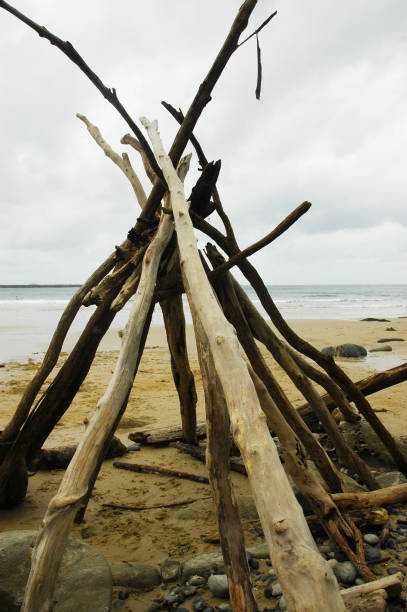
These driftwood structures dot the coastline in all shapes and sizes. Built by leaning and stacking logs into teepee-like forms, they are part sculpture, part shelter, part childhood dream. Some are small and humble; others are substantial enough to withstand years of storms and tides. Many of the logs glow with the warm tones of yellow cedar, slowly weathering to soft silvers and greys as salt air and sun sculpt their surfaces.

These beach houses offer sun-seekers a place to rest in the shade, and give children the perfect canvas to build their own dream home from nature’s materials. Since my recent move to Parksville, a true beach town on mid-Vancouver Island, I’ve felt a renewed connection to these familiar coastal forms. Here, the beach houses feel almost like local landmarks, each one telling a different story of tide, time, and community creativity.

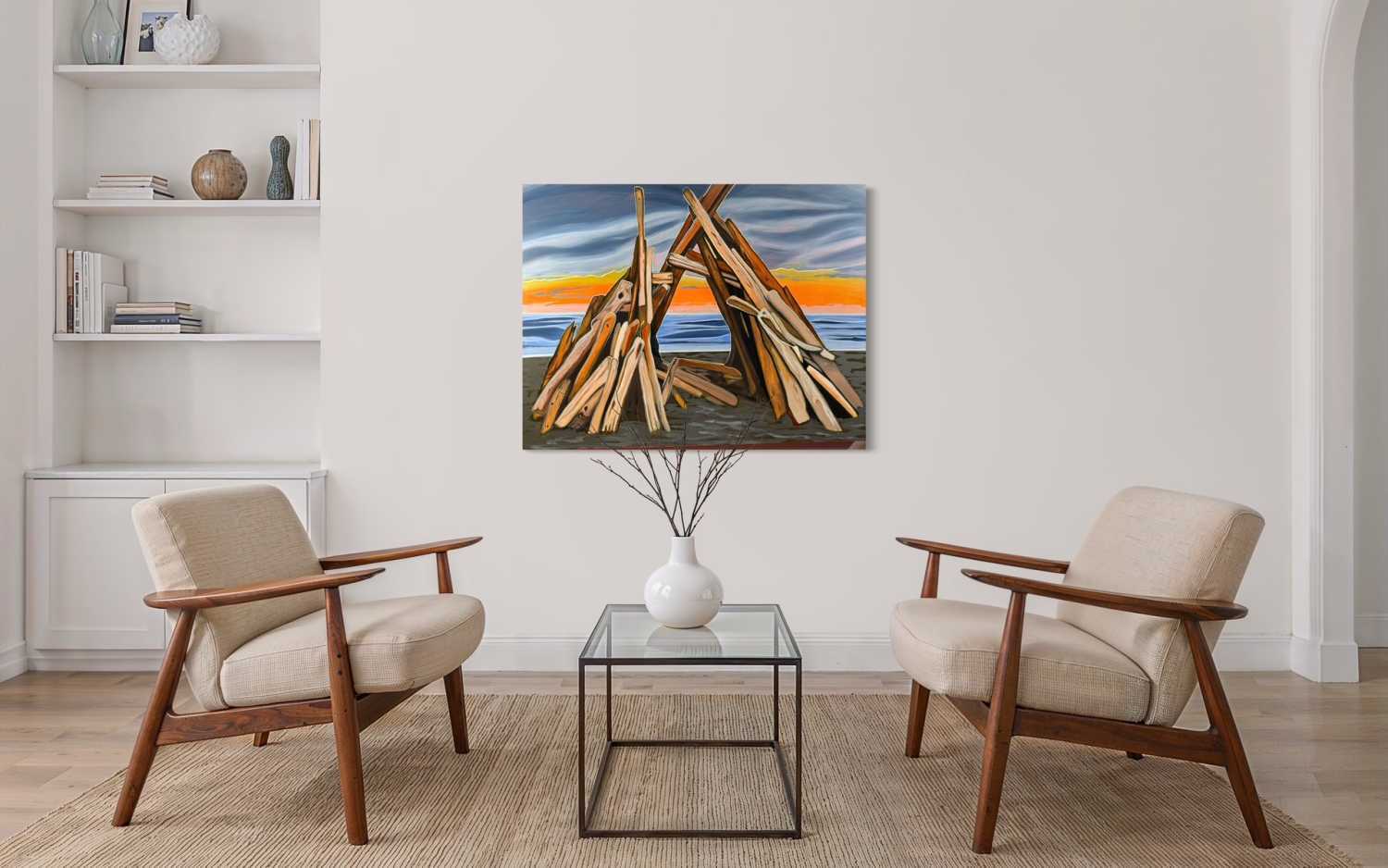
Beach House, 36×48 inches, acrylic on canvas, 2025 – Brandy Saturley

My new painting celebrates these driftwood beach houses and the enduring presence they hold on West Coast shores. They are temporary, handmade, and shaped by both nature and imagination – just like so many of the stories that define life by the sea.

Shells As Still Life – Paintings of the West Coast

I grew up on a West Coast beach. As a child, my days were spent either drawing in my bedroom or beachcombing and hiking. Just a mile from my house was a quiet stretch of sand with a view of the snow-capped Olympic Mountains, near a place called East Sooke. It was there that my fascination with collecting shells began – arranging them into still life compositions and collages right on the shore.

Moon Snail Shell found in Parksville, BC Canada

Sometimes the shells came home with me, transforming into elaborate displays on my bedroom shelves, often accompanied by rocks and driftwood. Later in life, I began photographing these arrangements, some created on the beach and left behind for others to discover. I became captivated by their smooth, sculptural forms, their layered textures, and their soft, natural palette.

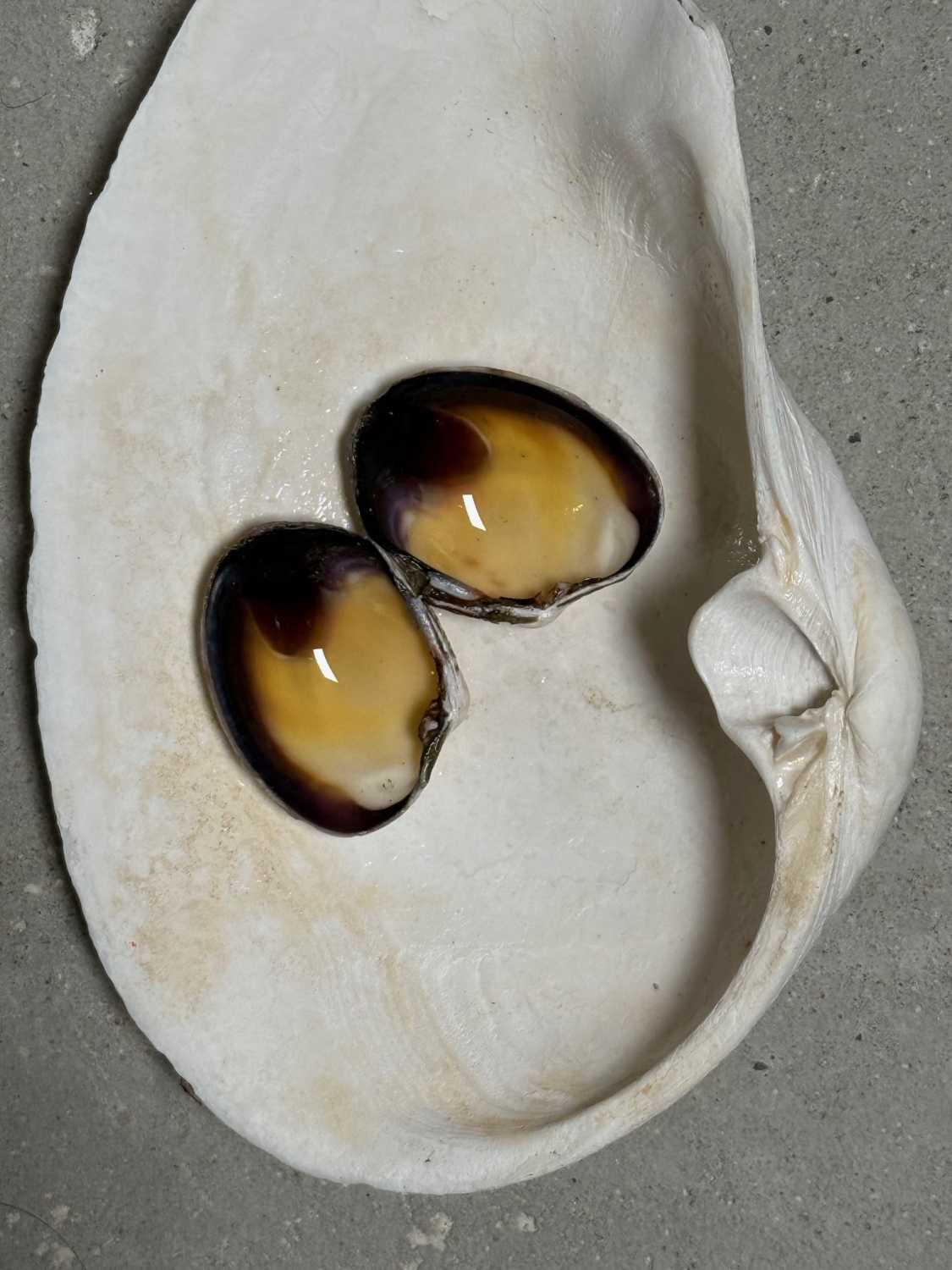
Various clam shells – Vancouver Island, BC Canada

When I think of shells in art, Georgia O’Keeffe immediately comes to mind. I remember visiting her home in Abiquiú, New Mexico, where she kept collections of shells and rocks displayed in her courtyard – often alongside her iconic skulls. In many ways, we are kindred spirits, both drawn to natural specimens that eventually find their way into our work through paint and brushstroke.

Shells found on beaches on Vancouver Island, BC Canada.

Since moving my studio to Parksville, BC – near the expansive sandy beaches on the east coast of Vancouver Island, I’ve found myself revisiting this lifelong fascination. I walk the shoreline almost daily, continually distracted by the remnants of shells scattered along the tide line. For the first time, I’ve felt compelled to paint them, translating these natural arrangements into still life compositions on canvas.

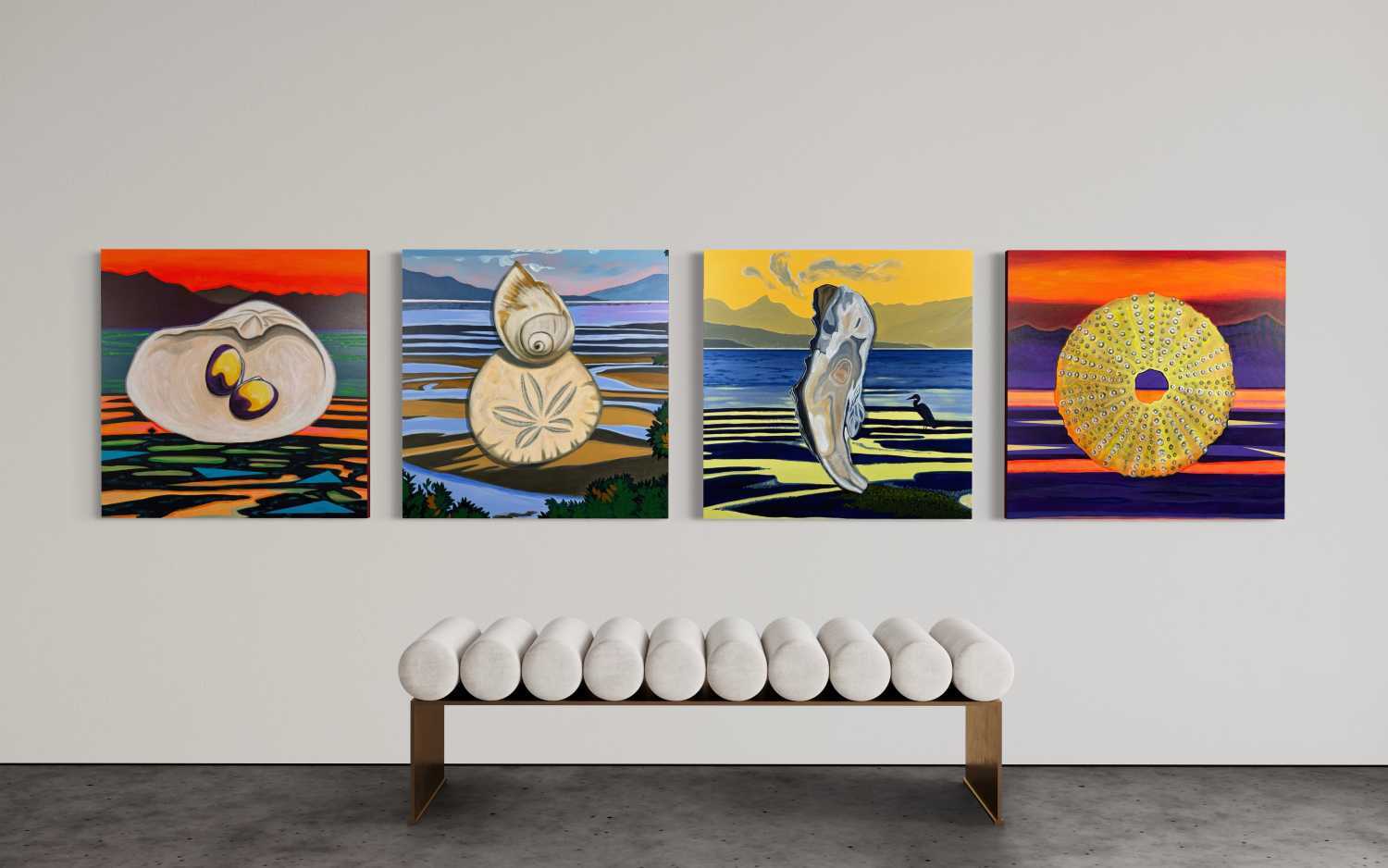
Still Life Shells Paintings

Sea Shells Still Life Paintings – Brandy Saturley 2025

Four New Still Life Shell Paintings

These four new paintings feature shells suspended within coastal landscapes, captured at different times of day and in shifting light. While they are still life paintings, I also refer to them as portraits, as I am painting a portrait of the landscapes, where the shells act as the sitter. They express my enduring love and curiosity for these homes of the sea – a West Coast meditation on beauty, fragility, and form.

Still Life Shells Paintings

The World is Your Oyster, 30×30 inches, acrylic on canvas, 2025 – Brandy Saturley


Still Life Shells Paintings

Piece of Mind, 30×30 inches, acrylic on canvas, 2025 – Brandy Saturley


Resilience, 30×30 inches, acrylic on canvas, 2025 – Brandy Saturley


Still Life Shells Paintings

Pilgrimage, 30×30, acrylic on canvas, 2026 – Brandy Saturley

Tales of the Wild West Coast – A Spirit Bear Painting

In late 2019, I began painting stories of a polar bear searching for a new home – a journey that took this wandering bear from coast to coast, discovering the beauty and vastness of Canada. Along the way, the bear has been joined by a cast of familiar Canadian characters, from Canada Geese to moose, each adding to this evolving visual narrative.

A Spirit Bear Painting

Float Away With Me, 12×9 inches, acrylic on canvas, 2025 – Brandy Saturley

Most recently, I found myself drawn to another iconic creature, the spirit bear, adding a new chapter to this ongoing story of travels across Canada.

The elusive Kermode – Spirit Bear

The spirit bear, also known as the Kermode bear, is a subspecies of the American black bear found along the Central and North Coast regions of British Columbia. With its distinctive white coat, the spirit bear is the official provincial mammal of British Columbia. These white bears are not albinos, they have pigmented skin and eyes, and while not exceedingly rare, their populations are carefully protected because of their deep ecological and cultural importance.

View of Mount Arrowsmith from Parksville, BC beach.

Over the past month, I’ve been painting the landscapes and still life of Parksville, British Columbia, my new home and studio by the sea. For this latest work, I wanted to capture the spirit of the West Coast in autumn: the soft tones of the beach, the distant rise of Mount Arrowsmith, and the abundant bird life that fills the scene with energy. It felt like the perfect landscape for a spirit bear to roam, quietly powerful, reflective, and free.

A Spirit Bear Painting

A Spirited Walk, 30×30 inches, acrylic on canvas, 2025 – Brandy Saturley

Here is A Spirited Walk, my newest painting and the latest tale in this series of Canadian wanderers, a story of connection to place, myth, and the wild heart of the West Coast.

Painting on the Left Coast – West Coast Still Life

We recently moved our home and my studio to the seaside city of Parksville, British Columbia – leaving my hometown of Victoria behind for a serene and immersive locale. After just one month, the studio is finally feeling like my own, and the paintings are flowing again. Five new works are already complete. It feels somewhat like being on an artist residency, and I’ve been treating these first few weeks as such.

The beach at low tide in Parksville BC – Canada

Though I’ve lived on Vancouver Island my entire life and traveled across Canada to make and show my art, I’ve rarely turned my focus to painting the West Coast itself. Since moving here, I’ve learned that many locals affectionately refer to it as the “Left Coast.” The phrase plays on geography, our coast lies on the left of the map, but also carries a certain spirit of independence and creative energy that defines this region.

The desire that once drove me to travel and connect with the rest of Canada came largely from feeling isolated from the national identity and the stereotypes of “Canadiana.” British Columbia has always stood apart. When British poet Rupert Brooke arrived in Vancouver after a cross-Canada journey in 1913, he wrote home: “It’s a queer place, rather different from the rest of Canada.” While others may have viewed BC as a rain-sodden outpost, those who live here understand that “Super, Natural British Columbia” is far closer to the truth. As humorist Eric Nicol once quipped, “British Columbians like to think of their province as a large body of land entirely surrounded by envy.”

The Beach in Parksville, BC – Canada

I’ve often said that we live in our own biosphere here on the coast. BC is undeniably part of Canada, yet it feels like its own realm, a place of unique rhythms and light. If, as historian Jean Barman suggested, “British Columbia is not so much a place as a state of mind,” then I find myself now immersed in exploring what that state of mind truly means.

Here in Parksville, I’ve been walking the endless sandy beaches, observing wildlife, flora, and the play of tide and wind. I find myself looking more closely than ever before, perhaps it’s that residency mindset taking hold. Beyond the beaches, I’ve explored the wetlands and railway tracks, visited the local MacMillan Arts Centre, and joined the Oceanside Arts Council, connecting with the vibrant creative community of Oceanside, Qualicum Beach, Nanoose Bay, and Nanaimo.

West Coast Still Life

New Paintings – West Coast Still Life

This exploration has already inspired two new paintings, visual stories of life by the ocean. The palette of these works draws directly from the coast: green-golds, blues, Payne’s grey, and raw sienna. They are part still life, part landscape, inviting the viewer to look closely at the natural details that define this place. Rocks and shells float serenely within these compositions, much as I feel when walking along the shore, listening to the rhythm of the waves.

West Coast Still Life

Unusual Oyster shell in Parksville, BC

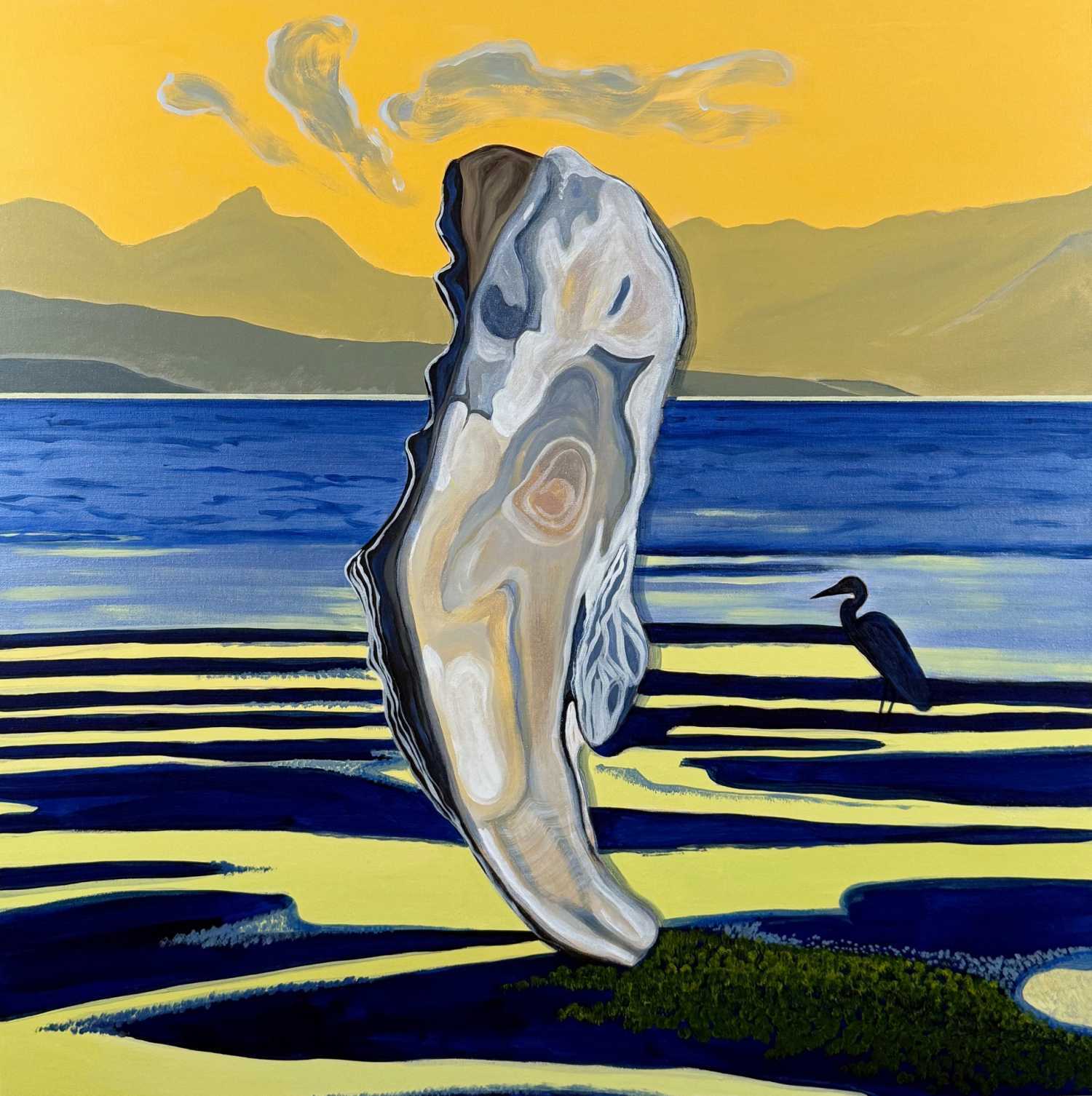
The World Is Your Oyster reveals a uniquely shaped oyster shell shimmering above a beach landscape at low tide, while a Great Blue Heron stands silhouetted in the distance. The sundown sky glows with yellows and greys, a quiet tribute to the poetic solitude of the coast.

West Coast Still Life

The World is Your Oyster, 30×30 inches, acrylic on canvas, 2025, Brandy Saturley

Sumo tells another West Coast story. A stack of stones, balanced like an inukshuk, takes on the presence of a Sumo wrestler, strong, grounded, and immovable, set against a moody sky of blues and greys with a lush outcropping of green trees in the distance.

West Coast Still Life

Sumo, 16×16 inches, acrylic on canvas, 2025 – Brandy Saturley

These paintings are undeniably Left Coast – rooted in place and mood. As I continue this residency-like chapter of my practice, I look forward to seeing how this new home will shape the stories I tell through paint.

See more paintings of Canada here.

She Was Knocking On The Sky – A New Painting with a Bowler Hat

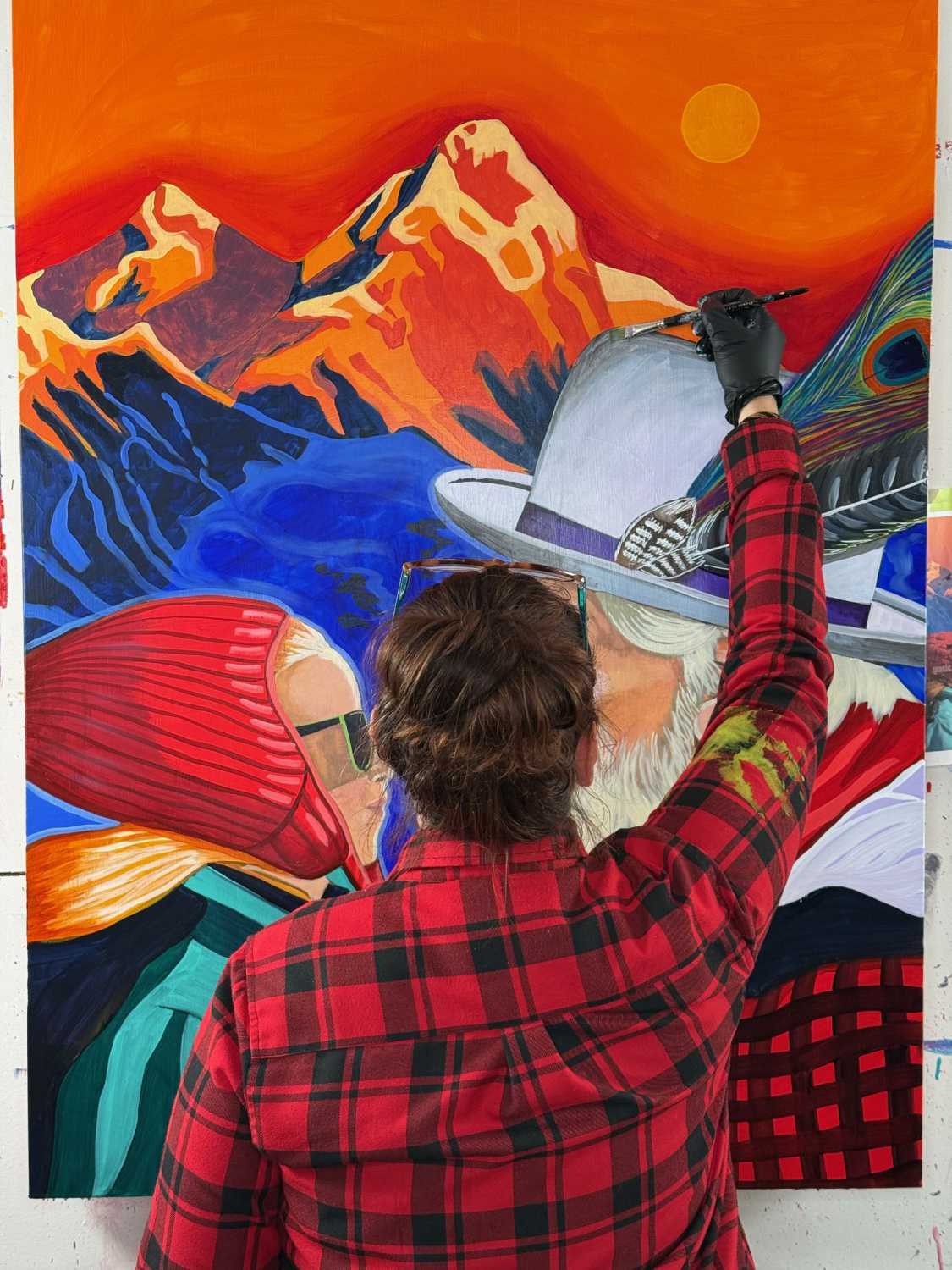
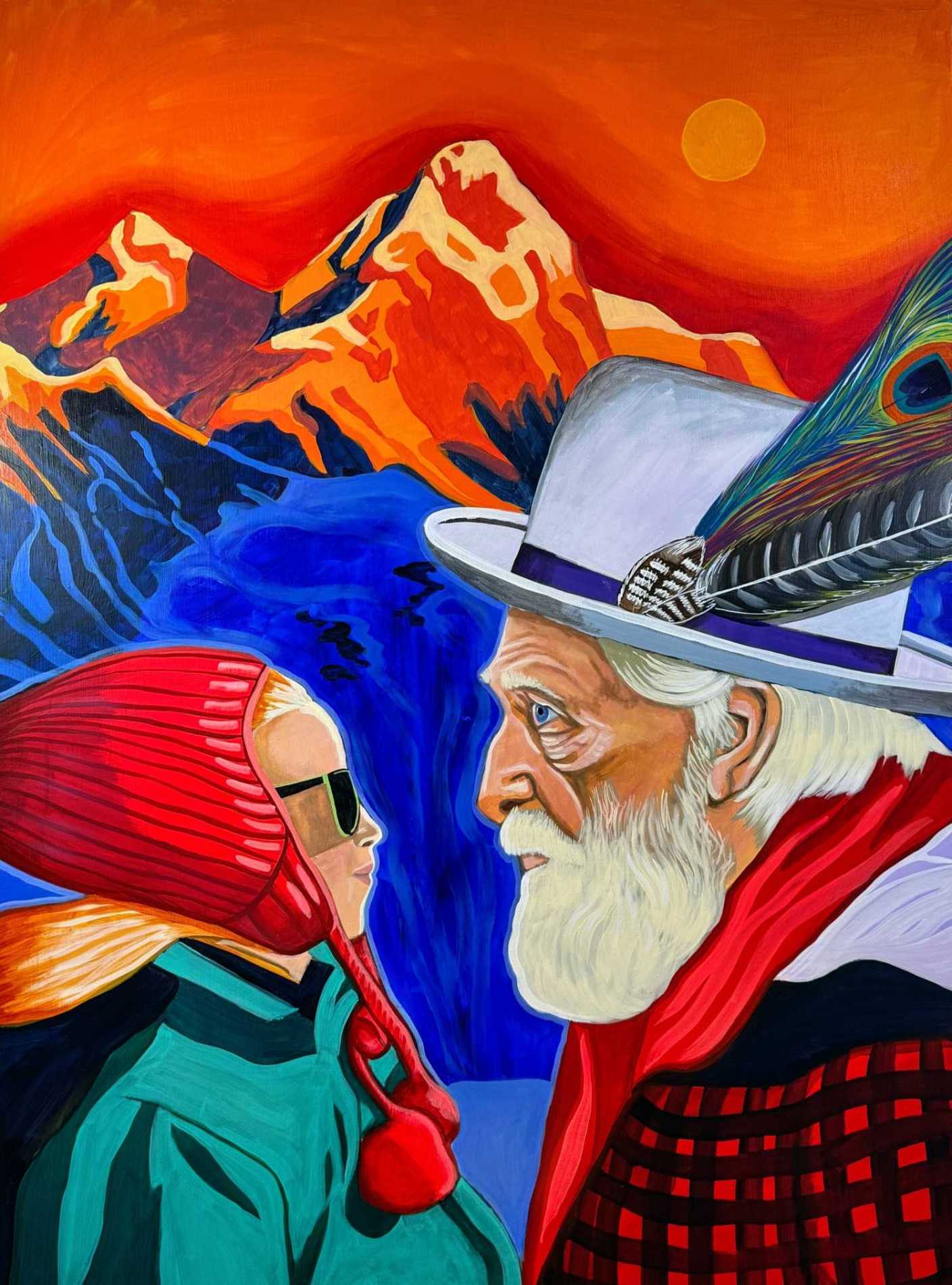
My painting process has always been rooted in storytelling. It begins with collecting, taking numerous photo references from my travels across Canada and collaging them together into a single narrative or scene. These photos might come from moments in nature or from the controlled light of my studio. Often, they sit in my archive for years before revealing their purpose. This is the story of a painting with a bowler hat.

bowler hat painting

Canadian Artist Brandy Saturley wearing Lilliput Hats Bowler Hat

The latest painting began with two familiar objects: a bowler hat custom-made for me by Karen Ruiz of Lilliput Hats, and a flannel shirt from Dixxon Flannels Canada – a combination that has become part of my #ICONICCANUCK persona. Over the past two decades, this persona has found its way into several of my self-portraits – a recurring figure set against landscapes that echo the abstracted forms of Lawren Harris. These works merge the real and the surreal, blending lived experience with imagined topographies.

12 years Painting Canada

Let Your Backbone Rise, 36×36 acrylic on canvas, 2016 – Brandy Saturley

In this new painting, I return to those themes – idealized forms, undulating skies, filtered light, and softly rounded island shapes. The figure wears a purple bowler hat and a plaid shirt, her long brown hair moving with the wind. She is a wanderer, never home long, drawn to the road and to the horizon beyond.

bowler hat painting

Inside Brandy Saturley Studio

The title and spirit of the piece come from a Buddhist proverb: “Knock on the sky and listen to the sound.” It speaks to the act of seeking- of listening deeply to nature, to intuition, to the world’s quiet messages. In this painting, “knocking on the sky” becomes both a poetic and spiritual gesture, a moment of connection between self and landscape.

bowler hat painting

Knocking On The Sky, 30×30 acrylic on canvas, 2025 – Brandy Saturley

The girl with the bowler hat is, in many ways, me, and all who search for meaning in the beauty of the unknown.

bowler hat painting

The Bowler Hat in Art History

The bowler hat has a rich and layered symbolism in art history, a small object that has come to represent much larger ideas about identity, class, conformity, and individuality.

Originating in 19th-century England as practical headwear for working-class men, the bowler quickly crossed class boundaries. By the mid-20th century, it became synonymous with the British middle class, the uniform of bankers and city workers, a symbol of respectability and social order.

In art, however, the bowler hat took on more surreal and philosophical meanings. Most notably, René Magritte used the bowler repeatedly in his paintings as a stand-in for the “everyman” – a faceless, anonymous figure navigating dreamlike realities (The Son of Man, Golconda, The Man in the Bowler Hat). Magritte’s use of the hat stripped it of social hierarchy and turned it into a symbol of mystery, anonymity, and the tension between appearance and reality.

Later artists and filmmakers have drawn on the bowler’s visual and cultural weight to explore ideas of duality, between individuality and conformity, reality and illusion, the seen and unseen self.

In your own work, the purple bowler hat subverts this history. It becomes personal rather than anonymous – a symbol of self-definition instead of conformity. By placing it within a natural, Canadian landscape rather than an urban or surrealist setting, you transform the hat from a marker of class or mystery into a poetic emblem of identity, curiosity, and connection to place. Having the woman wearing a plaid shirt, the uniform of the working class everyman, further echoes the sentiments of Magritte.