
Do We Really Need D-Rings?

Do Paintings Really Need D-Rings? Rethinking the Standard for Hanging Art
If you have exhibited your paintings in Canadian galleries, you have probably encountered the rule: D-rings and wire required.
For many galleries and art organizations, this has become a standard condition of exhibiting. Artwork must arrive wired a certain distance from the top, using D-rings of an appropriate size and picture-hanging wire. Some galleries will even charge artists to replace hardware that does not meet their requirements.
But here is a question worth asking: Does every painting actually need D-rings?
I have been thinking about this because the majority of my paintings are unframed gallery-wrapped canvases. When I sell a painting to a collector, it is usually going directly from my studio into someone’s home, office or private collection. In most of those spaces, there is no museum-style hanging system waiting for the painting. There is simply a wall, a suitable wall anchor and a desire to get the painting safely onto the wall.
For this situation, I believe there is a strong case for properly installed screw eyes and picture wire.
D-Rings Became a Gallery Standard
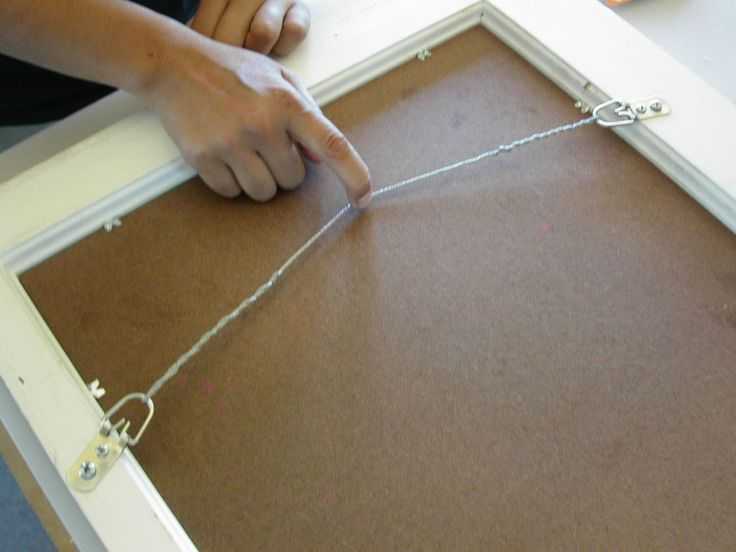
D-rings are not a bad invention. In fact, they have several advantages. They sit relatively flat against the back of a frame, they are available in different sizes and weight ratings, and they provide a standardized attachment point. They are particularly useful in environments where artworks are repeatedly moved, stored, transported and installed. That last point is important.
A public gallery may handle hundreds of artworks in a year. Paintings may be unloaded from trucks, carried through doorways, stacked temporarily, placed into storage, installed on walls, removed, transported again and installed somewhere else. In that environment, standardized hardware makes the work of installers and art handlers more predictable.
Canadian galleries and arts organizations have increasingly adopted D-rings as part of these standardized procedures. The Federation of Canadian Artists, for example, currently requires D-rings and plastic-coated wire for submitted works, while some galleries explicitly state that D-rings are required because they fit their particular hanging systems.
But there is an important distinction:
A gallery’s preferred hanging system is not necessarily the same thing as the only professionally appropriate way to hang a painting.
The Canadian Conservation Institute, part of the Government of Canada, recognizes both D-rings and screw eyes as hanging hardware. The appropriate hardware depends on the size, weight and construction of the artwork.
In other words, the conversation should be about appropriate hanging hardware, not simply about whether the hardware is shaped like a D.
Screw Eyes Are Not the Same as Cheap Eyelets
There is also some confusion around terminology. When artists hear that “eye hooks” or “eyelets” are not acceptable, they may assume that all screw eyes are inferior hardware. They are not. A properly selected, properly installed screw eye is a substantial piece of hardware with a threaded shank that anchors into the wood of the stretcher or frame. It can be used with appropriately rated picture wire to create a secure two-point hanging system. This is very different from using a lightweight decorative eyelet, a tiny hardware-store hook or an improvised piece of wire.
The Canadian Conservation Institute has long recognized screw eyes as a legitimate hanging solution. Interestingly, an earlier CCI publication stated that screw eyes were a safer way to attach a framed painting to a wall, while noting that D-rings protruded less from the back of the frame and were therefore less likely to interfere with other works in storage. That historical detail is worth remembering.
D-rings did not suddenly make screw eyes unsafe.
Rather, D-rings offered practical advantages in professional handling environments.
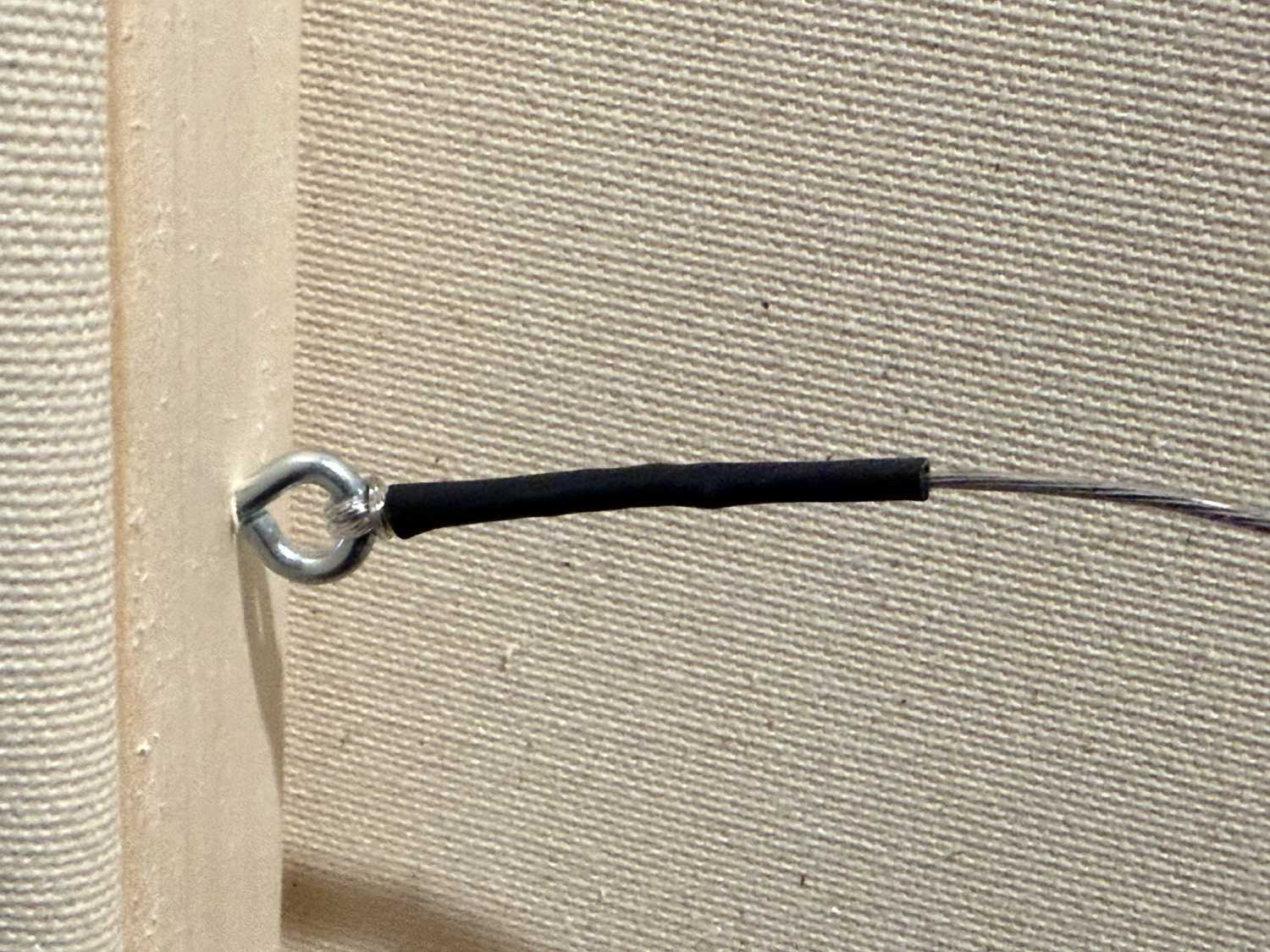
Screw eye and rubber shrink wrap on coated hanging wire – The Art of Brandy Saturley
Why D-Rings Make Sense in a Gallery
If I were preparing a painting for a large public exhibition where the gallery specifically requires D-rings, I would use D-rings.
Why?
Because the gallery has established a system.
A standardized hanging point means the installation team knows what to expect. They also work well with gallery hanging systems and are easy for installers to identify and handle.
But it is a gallery-handling reason, not necessarily a reason that every painting sold to every collector needs D-rings.
Do We Really Need D-Rings? What Happens When the Painting Leaves the Gallery?
This is where I think the conversation gets interesting. Most collectors do not live in galleries. Most homes do not have professional art hanging systems. Most offices do not have museum track systems. A collector purchasing a painting may simply have a stud, a suitable wall anchor, a picture hook or another appropriately rated hanging point.
Once a painting leaves the gallery, its hanging hardware needs to make sense for its actual environment. For a properly constructed, unframed gallery-wrapped canvas, two appropriately sized screw eyes installed securely into the stretcher bars, combined with properly rated picture wire, can provide a straightforward hanging solution.
And there is another advantage: simplicity.
The hardware can be unobtrusive, inexpensive, easily replaced and familiar to framers, artists and homeowners. There is no requirement that the collector own or install a specialized gallery hanging system simply because the painting happened to be exhibited in one.
The Real Question Is Not D-Rings vs. Screw Eyes
The better question is:
Is the artwork properly engineered for its weight, construction and intended environment?
That means considering:
- the weight of the painting
- the strength and depth of the stretcher or frame
- the quality and gauge of the hanging wire
- the size and load rating of the hardware
- where the hardware is installed
- how securely it is fastened
- the type of wall and wall anchor being used
- whether the artwork will be repeatedly handled or transported
- whether it is being installed in a gallery, institution, commercial space or private home
The Canadian Conservation Institute emphasizes exactly this principle: hanging hardware needs to be appropriate for the weight of the painting and frame, and different hanging solutions have different advantages and limitations.
In fact, for heavier works, neither a generic screw eye nor a small D-ring should automatically be considered sufficient. Larger or specialized hardware, cleats or other systems may be appropriate.
Hardware should be selected according to the artwork, not according to a universal shape preference.
What About Unframed Paintings?
This is particularly relevant to contemporary painting. A gallery-wrapped canvas is fundamentally different from a traditional framed painting. With a traditional frame, D-rings have a long history of being used as part of the framing and hanging system. With a contemporary gallery-wrapped canvas, however, the artwork itself may have a deep wooden stretcher, no frame and a relatively clean reverse.
There is no decorative frame to protect from contact with a protruding piece of hardware. For a painting that will ultimately hang in a private home, the goal is simply to create two secure attachment points and a reliable hanging system that allows the painting to sit correctly against the wall. That can be accomplished with screw eyes and appropriately rated picture wire.
The Collector’s Experience Matters Too
There is another part of this discussion that artists and galleries sometimes overlook.
The artwork has a life after the exhibition.
An artist may spend weeks or months creating a painting. A gallery may spend several days installing an exhibition. But the collector may live with that painting for decades. The hardware on the back should make sense for the collector’s reality. A painting should arrive ready to hang, with secure hardware appropriate to its size and weight. The collector should not have to become an art installer simply because a gallery has a particular exhibition standard.
With screw eyes a painting hangs flat to the wall, unlike with D-rings. If you prefer a flush mount look, screw eyes are the best solution.
This does not mean galleries should abandon D-rings. Quite the opposite.
Gallery systems exist for good reasons. Standardization makes exhibitions safer and more efficient. Some hanging systems genuinely require D-rings, and artists exhibiting in those spaces should follow the gallery’s requirements.
But there is a difference between saying:
“Our gallery requires D-rings because our hanging system is designed for them.”
and saying:
“D-rings are the only professional way to wire a painting.”
Those are two very different statements.

Perhaps It Is Time for a More Flexible Standard
The Canadian art world has developed many excellent standards around the care, handling and presentation of artwork. Standardization is valuable, particularly when many artists, installers, galleries and institutions are working together. But standards should also evolve with contemporary art practices. Today’s paintings are not all traditionally framed oil paintings. Artists work on gallery-wrapped canvas, wood panels, aluminum, mixed-media supports and unconventional substrates. Works vary enormously in size, weight and construction.
Perhaps the better standard is not:
D-rings required.
Perhaps it should be:
Artwork must be professionally wired or equipped with hanging hardware appropriate to its construction, weight and intended method of display.
That leaves room for D-rings where D-rings make sense. It also leaves room for properly installed screw eyes where screw eyes make sense. And ultimately, that is what professional art handling should be about: not following a rule simply because it has become a rule, but choosing the safest and most appropriate solution for the artwork in front of you.
A D-ring is not a badge of professionalism. Good craftsmanship is. Good judgment is.
And making sure the painting stays securely on the wall is probably the most important part of all.
